
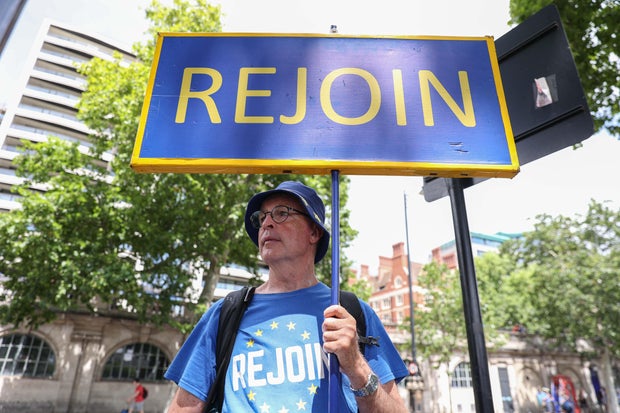
By June 23, 2026, ten years after the United Kingdom’s referendum that led to its departure from the European Union, a significant portion of Britons view Brexit as a mistake, based on a survey by YouGov. A pro-EU campaigner expressed concerns about the economic and social consequences, stating that Brexit was detrimental not only economically but also in terms of loss of freedom of movement and family separations.
Brexit has created a deep division in Britain with ongoing repercussions. Demonstrators participated in the National Rejoin March in London to mark the 10th anniversary of the Brexit referendum, emphasizing the call for the UK to rejoin the EU.
Since the vote, the UK has experienced political instability, having had seven prime ministers over the decade. The economic impact has been significant, exacerbated by the COVID-19 pandemic and conflicts in Ukraine and the Middle East. According to the Office for Budgetary Responsibility, Brexit has led to decreased productivity, imports, and exports, resulting in a 6% economic downturn.
“The consequences 10 years on are worse than we feared,” said London Mayor Sadiq Khan, a pro-EU advocate before the referendum.
Public Opinion and “Bregret”
While some former Brexit supporters express regret, commonly termed “Bregret,” two-thirds of those who voted for Brexit continue to support their decision. According to YouGov, 30% of respondents believe leaving the EU was the right decision. Many argue that the execution of Brexit by subsequent governments is to blame rather than the decision itself.
Nigel Farage, a leading proponent of Brexit and head of the Reform UK party, maintains that leaving the EU was “absolutely the right thing to do.” He criticized the establishment’s handling of the process and accused them of failing to implement the public’s wishes post-referendum.
Future Prospects and the Idea of Another Referendum
A significant campaign promise during the “Vote Leave” campaign was to regain control of British borders and limit EU migration. However, post-Brexit labor shortages prompted then-Prime Minister Boris Johnson to relax restrictions, leading to increased non-EU immigration.
Simon Boyd, a Brexit campaign advocate and steel manufacturer, expressed disappointment with the outcomes but called for embracing the opportunities Brexit presents. He dismissed the idea of rejoining the EU, suggesting it would be like “getting back on the Titanic without a life vest.”
The thought of another referendum is daunting for many in the UK, but public opinion has noticeably shifted. In 2016, the “Leave” campaign won with 51.9% of the vote. Since then, six million Britons, many of whom supported Brexit, have passed away, according to pollster Peter Kellner. The younger generation, generally more pro-EU, is now of voting age, altering the demographic landscape.
Research by the More in Common think tank reveals that three-fifths of Gen Z voters favor a new EU membership referendum. Over half of the general population surveyed by YouGov express interest in rejoining the EU in some form.
Despite the growing public sentiment, political appetite for another referendum is limited. Nigel Farage’s anti-EU Reform UK party gained traction in recent local elections, indicating the issue’s divisive nature. Andy Burnham, the presumptive next Prime Minister, hopes to see the UK rejoin the EU but believes revisiting these debates now would be unwise.