
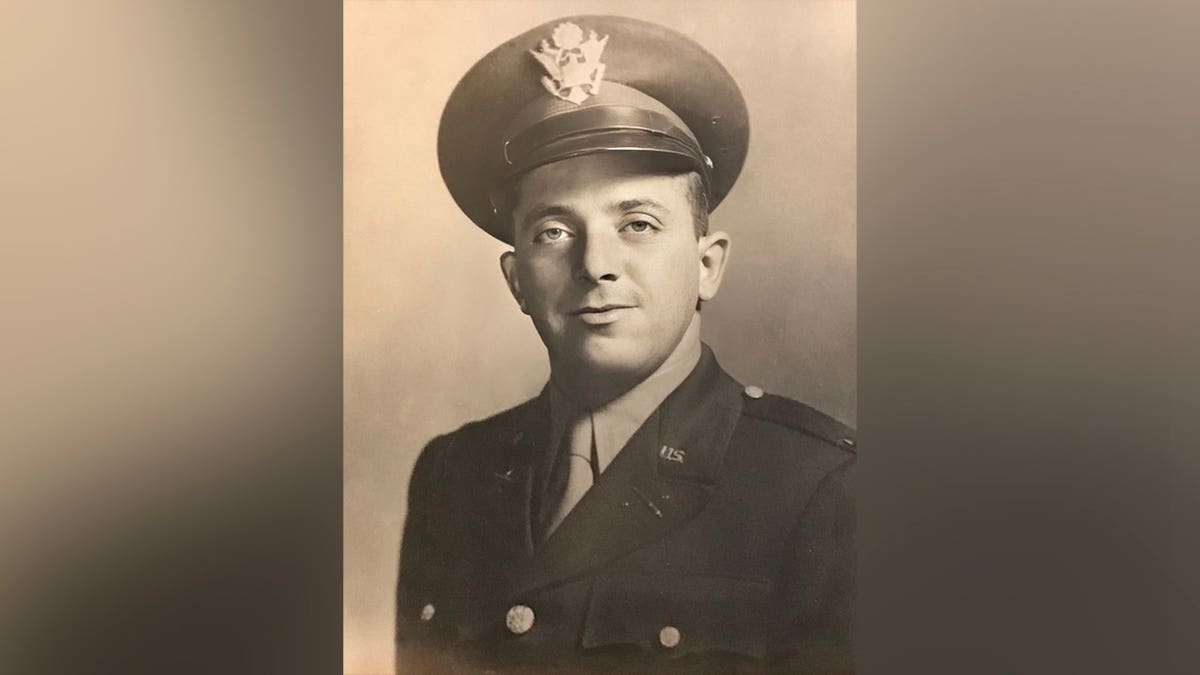
Eighty years after 1st Lieutenant Nathan Baskind’s sacrifice in the Battle of Cherbourg, he has finally been laid to rest with his fellow soldiers at the Normandy American Cemetery in France. Baskind, a Jewish American officer from Pittsburgh, Pennsylvania, remained missing for many years after the war, leaving his family without answers.
On D-Day, Baskind came ashore on Utah Beach as part of the 899th Tank Destroyer Battalion. During the Battle of Cherbourg on June 23, 1944, he was lost in action. German records later disclosed he was ambushed, shot, and taken prisoner by German forces, ultimately succumbing to his injuries at a Luftwaffe field hospital. He was buried in a mass grave along with 23 Nazi soldiers.
After WWII, the mass grave was moved to the Marigny German War Graves Cemetery, but Baskind’s family remained unaware of his fate.
Despite the American Grave Registration Service’s 1957 efforts to identify him, Baskind’s remains were elusive. His unit patch, lieutenant’s bars, and dog tag were found, but positive identification was lacking.
Operation Benjamin, an organization dedicated to correcting headstones of Jewish American soldiers mistakenly marked with a cross instead of a Star of David, played a pivotal role. Co-founder Shalom Lamm shared insights into Baskind’s story, explaining how genealogical research led to the discovery of Baskind’s name in German military cemetery records.
After extensive investigation and advances in DNA technology, Operation Benjamin revealed Baskind’s identity and contacted his great-niece, Samantha Baskind. She expressed disbelief upon learning the truth about her uncle’s fate.
Operation Benjamin faced challenges, requiring permission from the U.S., Germany, and France to move Baskind’s remains. Brigadier General Secretary General Dirk Backen at the German War Graves Commission initially denied the request, citing past failures in identification. However, advancements in DNA analysis and personal appeals from Baskind’s family changed the outcome.
In December, a team of 17 people worked to exhume the grave. Baskind’s height provided a clue that led to matching remains. A successful DNA comparison confirmed Baskind’s identity.
Samantha Baskind recalled the emotional moment she learned of the match and planned her great-uncle’s burial, a duty she never anticipated. On June 23, 2024, Baskind received a burial with full military honors and in line with Jewish customs.
Samantha expressed a sense of closure gained from seeing Baskind’s headstone marked with a Star of David. She emphasizes his story as a testament to Jewish Americans’ contribution to the nation’s defense.
For Dirk Backen, moving Baskind’s remains to an American cemetery symbolized more than correcting an error. He reflected on the personal impact of war, noting the involvement of his own great-uncle in nearby battles.
Lamm underscored the sacrifices made by servicemembers and their impact on the present, while Backen spoke on war’s profound effects.
Samantha Baskind highlighted the role of Jewish Americans in defending freedoms, countering stereotypes and acknowledging their contributions.