
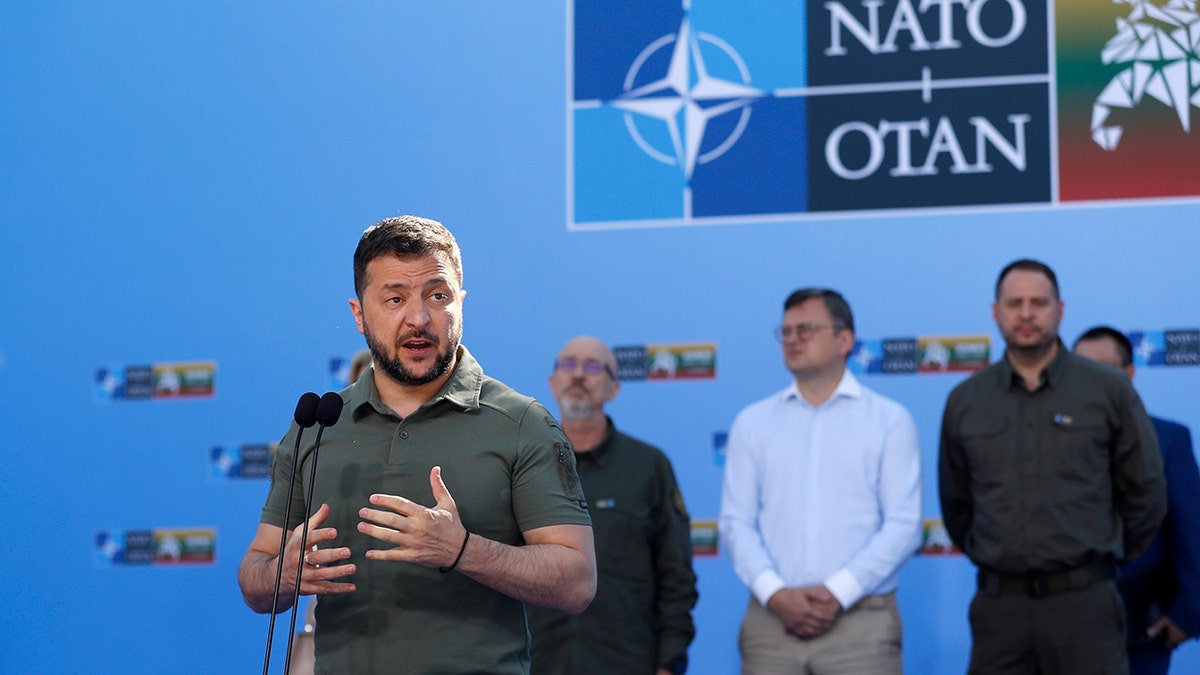
In Ukraine, now four years into Russia’s invasion, officials in NATO’s eastern regions believe their future is being reshaped by the war. They point to Ukraine’s evolving military capabilities, including drone warfare, cyber defense, and mobilization of forces. These developments are prompting NATO to rethink strategies for future conflicts.
This week, NATO Secretary General Mark Rutte invited Ukrainian President Volodymyr Zelenskyy to the annual summit in Ankara, highlighting Ukraine’s pivotal role in NATO’s strategy, even without formal membership.
Ukraine’s Military Evolution
The Mayor of Lviv, Andriy Sadovyi, expressed a strong belief in Ukraine’s capabilities. He stated, “I think today the Ukrainian army is the number one army in Europe,” emphasizing NATO’s need for Ukraine’s military expertise.
This comes as NATO foreign ministers convened in Sweden, anticipating a significant summit in July. U.S. Secretary of State Marco Rubio stressed the need for increased munitions production, noting the Pentagon’s interest in Ukraine’s rapid adaptation of its defense industry.
US and NATO Commitments
Rubio also mentioned former President Trump’s reassurance regarding American troop deployments in Poland, which Polish Foreign Minister Radosław Sikorski praised. This continued presence aims to unsettle Russia, reinforcing NATO’s commitment.
Russia’s invasion paradoxically accelerated NATO’s expansion. While Putin opposed NATO’s eastern growth, Finland and Sweden have joined the alliance, significantly increasing NATO’s borders with Russia.
NATO’s Strategic Transformation
NATO’s focus is shifting, as noted by Polish Deputy Defense Minister Paweł Zalewski. He pointed out the modern reliance on drones in warfare, highlighting Ukraine’s prowess in this area.
Retired Gen. Philip Breedlove emphasized the global shift in military understanding due to the conflict in Ukraine. He praised Ukraine for building a formidable military, despite initially lacking nuclear capabilities.
Wartime Innovation in Ukraine
Ukraine’s IT sector, once a large civilian cluster, has rapidly adapted to support defense needs. This innovation, particularly in drones and communications, is now a model studied by NATO and European militaries.
Breedlove noted the limits of traditional air power revealed in Ukraine, showing how drone warfare has become essential where modern air support is lacking.
The Concept of NATO 3.0
The Pentagon is now encouraging a shift to greater European responsibility for defense, as per the “NATO 3.0” model. This aligns with Poland’s increased military spending, making it a leading power on NATO’s eastern front.
Polish officials argue the war highlights the prescience of Eastern Europe, which recognized Russia’s threats ahead of many Western nations. Deputy Foreign Minister Marcin Bosacki stated, “The eastern flank is much more powerful than even five years ago.”
Despite Ukraine not being a NATO member, the alliance may rely on it in shaping its future strategy, underscoring the significance of Ukraine’s wartime resilience and innovation.