
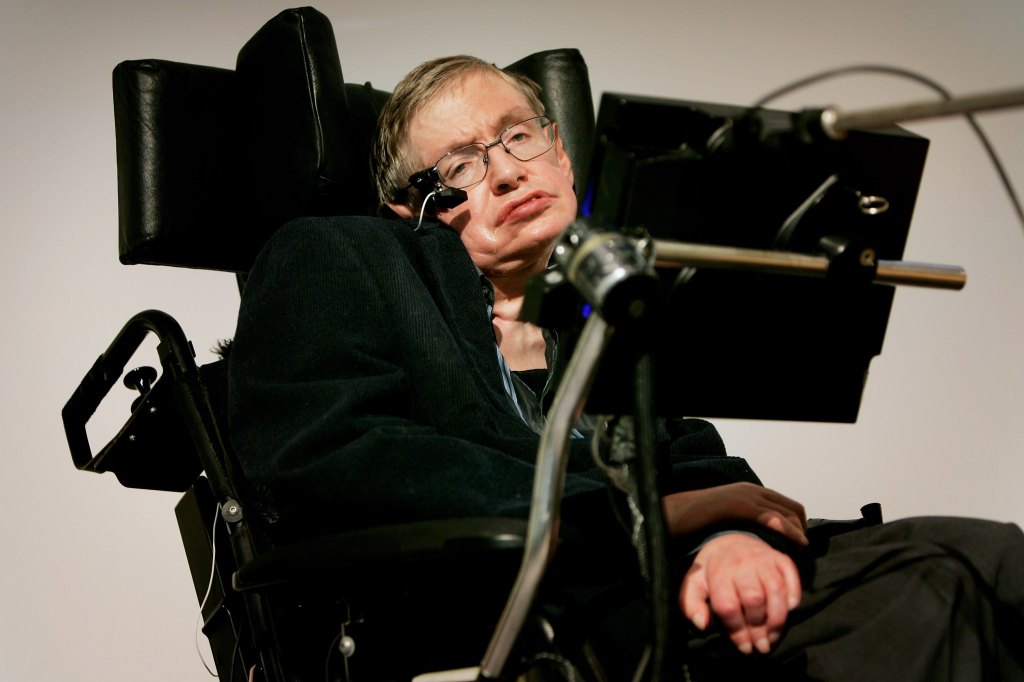
On a chilly Christmas morning in 1989, renowned physicist Stephen Hawking exchanged gifts with his wife and children. The day took an unexpected turn as he left to meet another woman, profoundly impacting his daughter Lucy. She described the incident as an unnecessarily painful experience.
This event is highlighted in Graham Farmelo’s biography, Hawking: His Life and Work, which unveils unsettling aspects of Hawking’s personal life. Alongside groundbreaking contributions to the understanding of black holes, Hawking’s life was marked by controversy.
His father’s notes revealed early signs of Hawking’s complex personality. Frank Hawking observed his son’s tendency to bully his younger sister and act selfishly.
Diagnosed with ALS at 21, Hawking defied odds by living with the condition for decades. Despite his physical challenges, he pursued various pleasures, often attending strip clubs and indulging in the company of entertainers. On his 60th birthday, a Marilyn Monroe impersonator serenaded him, marrying humor with scientific curiosity.
“I won’t compare it to sex, but it lasts longer.” – Stephen Hawking on scientific discovery.
In 2012, rumors surfaced about Hawking’s visit to a California swingers club, although these claims were largely dismissed by Cambridge University.
Hawking’s interactions with Jeffrey Epstein added another layer of intrigue. During a 2006 conference in the US Virgin Islands, Hawking, along with other scientists, was hosted by Epstein, raising questions due to Epstein’s later-disclosed criminal activities.
Portraits from Hawking’s personal life are equally revealing. He married Jane Wilde in his early twenties after being diagnosed with ALS. Their marriage faced challenges, particularly as Jane became a primary caregiver. The dynamics shifted with the presence of Jonathan Hellyer Jones, leading to further tension.
After Hawking’s affair with nurse Elaine Mason, their troubled relationship continued post-marriage, drawing media attention and spurring police investigations. Allegations of domestic abuse surfaced, but no charges were filed. Hawking publicly refuted these accusations.
Hawking’s family described strained relationships. His sister Mary criticized his lack of communication, while his mother, Isobel, attributed his dismissive behavior to his celebrity status.
Professionally, Hawking’s demeanor was equally intense. Disputes, such as the one with student Andrew Farley over black hole theories, highlighted his authoritarian approach, yet he later admitted the flaws in his earlier stance.
Hawking’s relentless nature extended to his life choices. Against medical advice, he pursued travel to China, showcasing his determination to experience life fully despite his condition.
Hawking passed away in March 2018 at 76, outliving predictions by decades. His friend Kip Thorne summed up Hawking’s spirit, noting his remarkable control over his life and decisions despite his physical limitations.