
In Ningbo, China, a factory surrounded by green hills and wind turbines is producing vehicles that Geely Auto Group believes are the cars of the future. Here, one of China’s largest electric vehicle producers, manufactures its luxury brand Zeekr. The name combines ‘Zee’ for Generation Z and ‘Kr’ for Krypton, the element associated with Superman’s weakness.
The plant commenced operations in 2023 and is a testament to automation, with 99% of the work performed by AI-guided mechanical arms. Human workers are present only to monitor production. Zhao Chunlin, Vice President of manufacturing at Zeekr, previously with General Motors, acknowledges U.S. automakers’ long-standing legacies but emphasizes China’s focus on the future. Zhao asserts that the demand for excellence in China has propelled it to the forefront of the EV industry. ‘Our market is the largest globally, and with high customer expectations, we strive for superior products,’ said Zhao.
Confidently, Zhao claims Chinese EVs are superior to those made in the U.S., including the Tesla models manufactured in China. Zeekr is soon to enter the North American market after Canadian Prime Minister Mark Carney signed a trade deal with Chinese President Xi Jinping. The deal allows for the sale of 49,000 Chinese EVs in Canada in the first year and lowers tariffs from 100% to 6% on imports.
This influx will represent a substantial portion of Canada’s EV market, competing against U.S. brands like Tesla, GM, and Ford. The key advantage lies in pricing, with Chinese EVs significantly more affordable. Australian market trends show Chinese vehicles gaining from zero market share to over 30% in ten years. Similar growth is observed in Europe, where Chinese EVs increased their market share from 9% to approximately 14% this year.
Could Canada witness a similar trend? While geographic advantages favor U.S. automakers, the Chinese presence in Canada could signal future developments that might concern the U.S. auto industry, especially near the Detroit River.
The U.S. government currently prohibits Chinese vehicles from entering the market, citing national security and domestic industry protection. Zhao, at the Zeekr factory, assures that China’s automakers are not a threat, emphasizing collaboration and joint ventures potential. ‘No need to fear, the market is vast,’ he states, adding humorously, ‘Trump, don’t worry!’
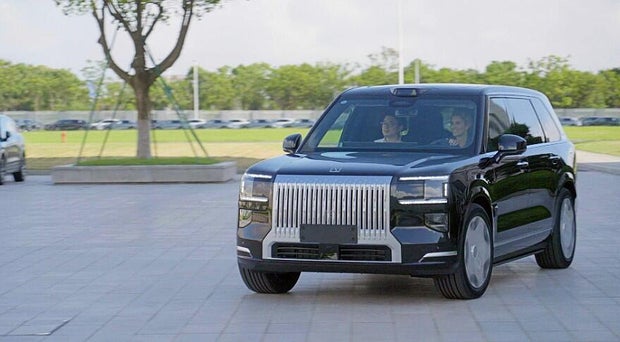
Chinese EVs aim to offer an unmatched driving experience, demonstrated as CBS News test drives Zeekr’s luxurious 9X plug-in hybrid model. With luxury inspired by the Range Rover SUV and enhanced by technology from Volvo, the vehicle epitomizes high-end design. Features include leather interiors, plush seats, and a Naim Audio sound system, integrated with autonomous driving capabilities.
The hybrid engine is quiet, offering smooth driving experience, accelerates from 0 to 100 km/h in four seconds, and boasts a combined range of 745 miles. Notably, the 9X’s self-parking capability could revolutionize parallel and reverse parking for drivers. Retailing at $70,000, it costs roughly half of a Cadillac Escalade.
A decade ago, Chinese cars faced skepticism in Western markets. Today, they are often considered on par or superior to many American and European brands, especially with competitive pricing. Zeekr has expanded to over 50 countries and will begin exporting the 9X to Europe and the Middle East this month.