
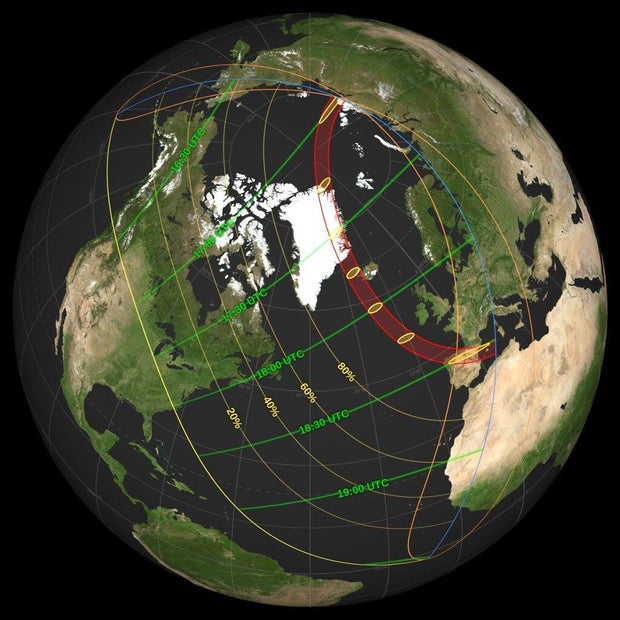
The 2026 total solar eclipse is set to captivate observers as it casts its shadow across a section of the Northern Hemisphere. On August 12, darkness will briefly fall in its path.
Understanding a Solar Eclipse
A solar eclipse occurs when the moon passes directly between the Earth and the sun. While a solar eclipse takes place somewhere on Earth approximately every 18 months, specific locations may experience one only every few hundred years.
Visibility of the Solar Eclipse
The path of totality for this eclipse includes areas that are largely uninhabited, such as northern Greenland. Nonetheless, ideal viewing spots like western Iceland and northern Spain are on the path for a peak experience. Notably, Spain has not seen a total solar eclipse since 1905.
230 million people are expected to experience 90% totality across a broad region.
In Europe, major cities will witness at least 90% totality, including Madrid, London, and Paris. Some areas in North America, like Fairbanks, Alaska, will see partial visibility, reaching 37% totality.
Timing of the Eclipse
The total eclipse begins in northern Russia at 17:00 UTC (1 p.m. ET). By 1:30 p.m. ET, it will reach northeast Greenland, followed by western Iceland at 1:45 p.m. ET. Reykjavik will experience totality precisely at 5:48 p.m. local time.
The eclipse will then cross the northern Atlantic. It peaks over the U.K., with London hitting 91% totality at 2:13 p.m. ET (7:13 p.m. local). By 2:30 p.m. ET, northern Spain will see totality, specifically at 8:32 p.m. local in Valencia. The event concludes by 2:45 p.m. ET.
For those in North America, partial views are possible with New York City’s peak at 1:54 p.m. local time.
Viewing the Eclipse Safely
During totality, the eclipse lasts about two minutes. Solar eclipse glasses are essential to protect your eyes from the sun. Take off the glasses only during totality for a direct view. Outside totality, glasses should remain on to prevent eye damage.
Future U.S. Total Solar Eclipses
The next total solar eclipse in the U.S. arrives in 2044, visible in Montana, North Dakota, and South Dakota. A more widespread view follows in 2045 across many states. This path begins in Northern California and travels eastward, ending in Florida.
In 2052, a southeastern eclipse will cross Florida, Georgia, and South Carolina. A northeastern U.S. total eclipse won’t occur until May 1, 2079.
Watching the 2026 Eclipse Coverage
Live coverage of the 2026 total solar eclipse will start at 2 p.m. ET on CBS News. Rob Marciano will be reporting from Mallorca, Spain, where totality takes place around 2:30 p.m. ET. Access live streaming via CBS News on various devices.