
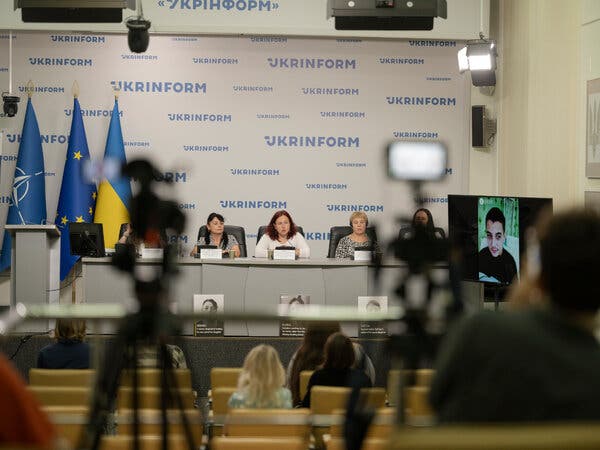
Four years after the Russian invasion of Ukraine, many individuals from institutional settings remain missing. Recent efforts in Kyiv aim to highlight their plight and demand accountability.
Hanna Zamyshliaieva expressed distress over her disabled son’s disappearance. He vanished in southern Ukraine soon after the invasion. In a news conference held in the Ukrainian capital, she vowed to fight for his return. ‘I am here to fight for the return of my child,’ she stated. ‘I don’t know where my son is, what’s going on with him, what condition he is in, and if he’s still alive.’ Her resolve was echoed by another mother and a grandmother, all seeking answers for their missing loved ones.
The women disclosed that their family members, all in their 20s, were residents of a specialized care home in Oleshky, Kherson, at the invasion’s outset in 2022. Without families’ communication, the residents were transferred amid the chaos.
The issue of forced deportations remains contentious. Ukrainian officials reported 19,500 Ukrainian children forcibly moved from institutions following the invasion. This mass deportation, including to Russia, led to a war crimes arrest warrant against Russian President Vladimir Putin and an aide.
Ukraine continues to grapple with the consequences of these forced transfers, emphasizing the need for urgent solutions and support for affected families.