
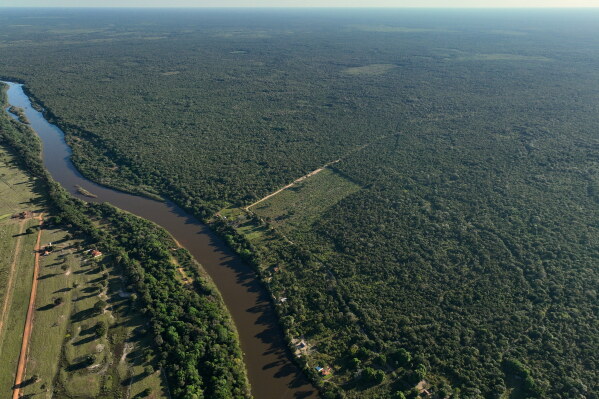
In Formoso do Araguaia, Brazil, a significant debate is occurring on Bananal Island regarding cattle and conservation. Federal authorities have ordered the removal of cattle from protected Indigenous land on the island, stating it is reserved for Indigenous peoples and conservation. They claim that herds managed by external ranchers have caused habitat degradation.
Over 100,000 cattle were herded off the island by wranglers when river levels permitted. However, this action has induced new challenges for Indigenous residents, who previously relied on income from renting land to ranchers. This situation highlights the complex challenge of balancing conservation, Indigenous rights, and the influence of Brazil’s powerful agribusiness sector. As the world’s leading beef producer, Brazil contributes about 20% of global beef production and 6% of its GDP.
Protecting Indigenous territories is considered one of the best methods to reduce deforestation in the Amazon, a crucial part of the world’s climate system. Although Brazil has seen success in slowing deforestation, cattle ranching continues to drive it. Ranchers clear forests extensively for grazing purposes.
Tocantins, the state where Bananal Island is located, recorded high deforestation rates in 2025 according to MapBiomas, an organization tracking land use. Biodiversity suffers from this as trees that absorb pollutants are replaced by methane-emitting cattle, a contributor to global warming.
Cattle’s Benefits and Conflicts on the Island
Brazilian law restricts commercial activities on Indigenous lands, allowing cattle raising only for subsistence. Nonetheless, parts of Bananal Island have been leased for decades. Under informal agreements, ranchers paid village leaders approximately 15 reais ($3) per head, much less than the 60 reais ($12) outside the island. With over 100,000 cattle, monthly earnings from leasing reached about 1.5 million reais ($290,000). Payments went to Indigenous chiefs, who passed a portion to community associations.
Chief Cleiton Javae of Txuiri village noted that cattle income covered community expenses such as schools, medicine, and transport. However, some argue the payouts disproportionately benefited leaders and did not assist all 5,000 inhabitants across 40 villages. According to Leandro Milhomem, head of IBAMA in Tocantins, the law mandates consultation and shared benefits, yet some chiefs had ample resources while children suffered malnutrition.
Indigenous residents reported fencing by wranglers restricted access to communal farming areas. Leaders backing agreements with ranchers see these incidents as anomalies, noting that ranching is wrongfully blamed for broader policy issues. They admit the situation worsened when undeclared cattle overflowed. Javae commented on the unsustainability, stating that removal was the only option.
Claims about Indigenous ownership of remaining cattle led to a seizure of 550 head in March by environmental authorities, who issued citations based on document reviews. Accusations were made against a wrangler claiming instructions to falsely declare cattle as Indigenous-owned to evade penalties.
Environmental Impact of Cattle Ranching
Bananal Island, located between the Javae and Araguaia rivers, sits at the convergence of Brazil’s leading soy and cattle states. European colonizers found the island endowed with banana groves, inspiring its name “Ilha do Bananal.” The area was made a protected region in the 1950s while also paving the way for leasing agreements with local Indigenous groups to facilitate non-Indigenous cattle ranching.
Ranching began as an income opportunity for village communities but brought in environmental and social inequalities. The environmental agency of Brazil found that grazing-induced wildfires and soil acidification occurred. Fires, often started near grazing sites, were a traditional method for pasture renewal by ranchers.
Three Indigenous groups inhabit the island: the Javae, Karaja, and Ava-Canoeiro. Over time, close associations with non-Indigenous ranchers developed through marriage and settlement, leading to economic initiatives in these protected areas. The juxtaposition of traditional and adopted traditions becomes evident. Brick houses juxtapose thatched structures, children practice traditional skills near modern religious buildings, and meals blend Indigenous practices with new technologies.
Reimagining Economic Models by Brazilian Indigenous Communities
Efforts to align economic activity with rights and environmental preservation are underway. The Javae collaborate with The Nature Conservancy to devise island land management plans addressing social, ecological, and economic goals. In May, Javae chiefs and other Indigenous representatives visited the Macuxi in the northern Amazon to learn sustainable income generation methods via agriculture.
The Macuxi, who started raising cattle in the 1980s to reclaim areas under threat from farmers and miners, exemplify successful Indigenous land rights preservation through economic ventures. By 2005, their land received official demarcation, recognizing Indigenous ownership. Presently, the Macuxi own around 45,000 cattle, as reported by Ivo Aureliano Macuxi of the Indigenous Council of Roraima.
This ongoing Indigenous discourse highlights the need for diverse legal frameworks aligning with the varied realities of Brazil’s 391 Indigenous groups. As Aureliano emphasized, each territory must have plans tailored to its unique circumstances.
Note: The Associated Press receives funding from private foundations for their climate and environmental reporting but retains full responsibility for their content. More details can be found at AP.org.