
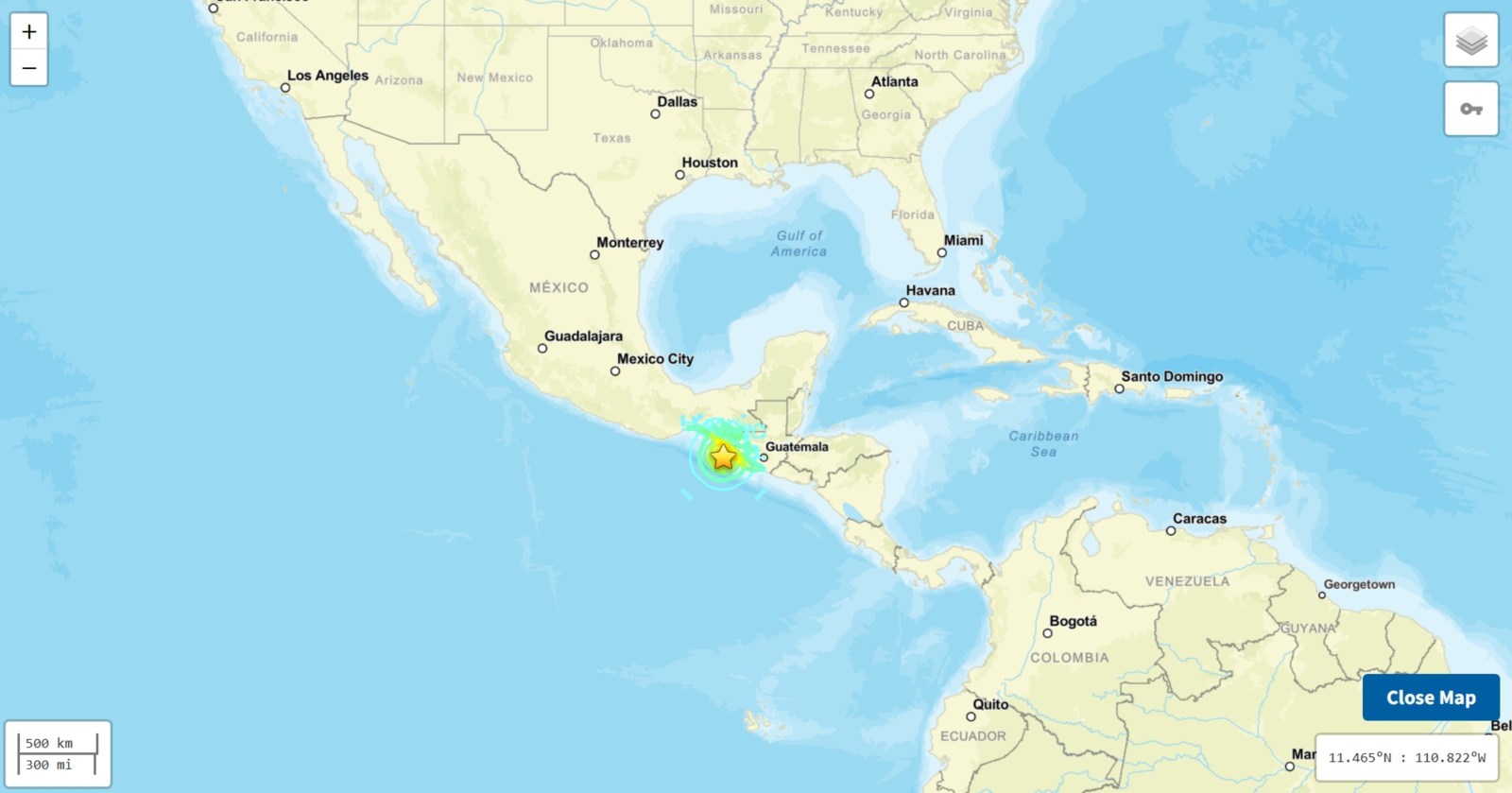
An earthquake with a magnitude of 7.3 struck off the southern coast of Mexico early Friday morning, prompting emergency officials to conduct infrastructure reviews. The U.S. Geological Survey (USGS) reported the quake near Chiapas state’s Pacific coast. The shallow depth of approximately 9 miles increased the intensity of the tremor and expanded its reach.
This significant seismic event was part of broader seismic activity in the region. Other earthquakes occurred before and after the main tremor, including a magnitude 4.7 near Aquiles Serdán, plus magnitudes 5.1, 5.3, and 6.0 near Puerto Madero.
The epicenter was about 30 miles southwest of Aquiles Serdán, close to Puerto Madero near the Guatemala border. This major quake struck at 8:48 a.m. local time.
Earthquakes with magnitudes of 7.0 or higher are capable of causing severe to catastrophic damage near the epicenter, particularly in areas with older or vulnerable structures. Recent assessments by the USGS indicate such earthquakes can lead to significant structural damage, potential fatalities, landslides, liquefaction, and disruptions to infrastructure.
Impact of the Earthquake
Immediately following the earthquake, there were no reports of severe damage or casualties, yet authorities planned to assess infrastructure and coastal areas for potential tsunami risks. People shared videos on social media that displayed the strong shaking at the time of the quake.
While a tsunami was not expected in the U.S., a tsunami alert was in effect within 200 miles of the epicenter due to the quake type. MyRadar Weather senior meteorologist Matthew Cappucci explained that the activity involved the Cocos plate’s subduction beneath the North American and possibly Caribbean plates, causing a vertical thrust movement.
Significant aftershocks are predicted to continue, potentially causing ground liquefaction, where soils might temporarily behave like liquids, affecting surface stability.
Mexico’s Deadliest Earthquake
The earthquake on September 19, 1985, was one of Mexico’s most devastating, hitting Mexico City with a magnitude of 8.0–8.1. This event caused severe human losses and structural damages. The city, built on an ancient lake-bed, experienced amplified shaking. Official death toll estimates ranged widely from 5,000 to 10,000, with thousands more injured and numerous buildings damaged or destroyed.
What Happens Next?
After a major earthquake like this, officials urge residents in affected areas to follow local emergency management guidance. They should remain cautious for aftershocks, which can persist for weeks. Although they generally decrease in frequency and magnitude, the largest are likely in the first hours or days after the initial quake. Significant aftershocks may still occur later.