
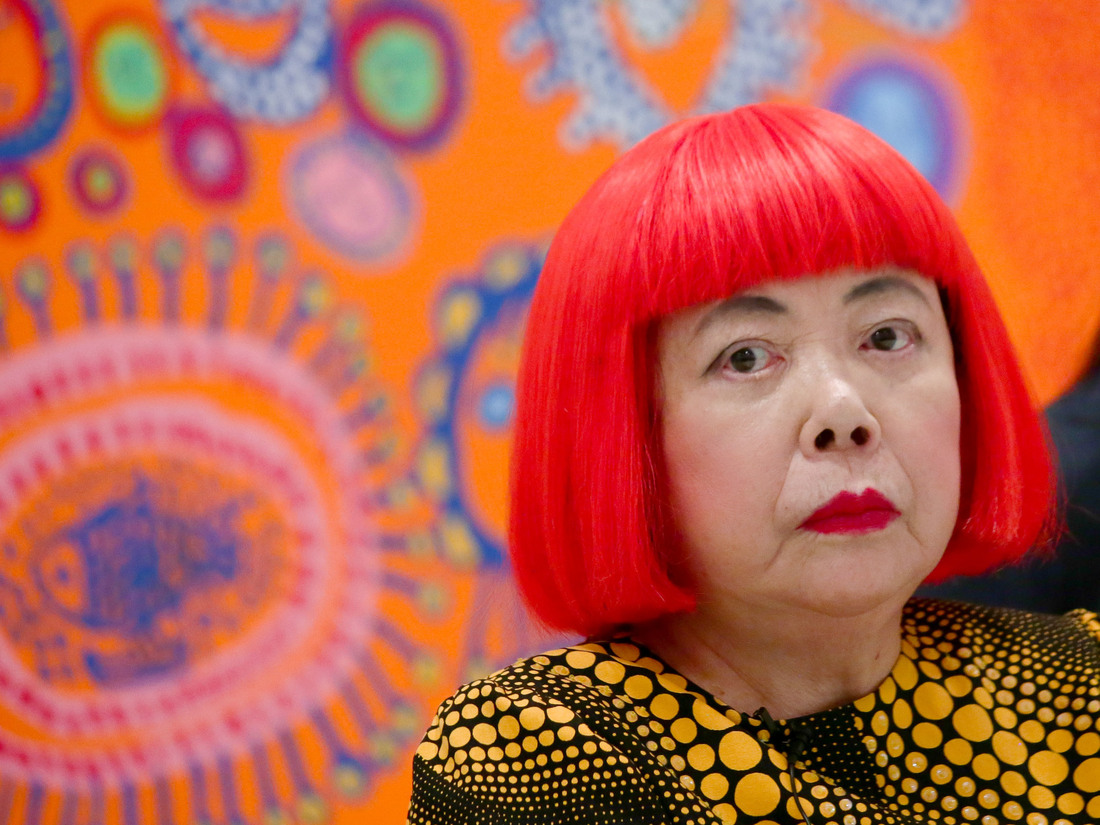
Yayoi Kusama, the Japanese artist renowned for her vibrant polka dot sculptures and mesmerizing “Infinity Rooms,” passed away at 97. She died from multiple organ failure in a Tokyo hospital on August 14, as confirmed by her representative David Zwirner.
Kusama’s innovative art explored personal obsessions through her signature use of repetitive brushstrokes and dotted canvases, known as infinity net paintings. Her work included monumental orange and black polka-dotted pumpkins, mirrored rooms creating endless reflections, and vivid fluorescent paintings and sculptures. Kusama described her art as a vital survival tool, offering viewers an exploration of their place in the universe. “Our earth is only one polka dot among a million stars in the cosmos,” she stated.
Kusama was born in Matsumoto, Japan, where her family ran a seed nursery. During World War II, she worked in a parachute factory alongside other children. Throughout her life, she experienced hallucinations, documenting them in sketchbooks as a coping mechanism. Her artistic pursuits were initially discouraged by her mother, who confiscated her art supplies.
Inspired by paintings in a secondhand bookstore, Kusama communicated with renowned artist Georgia O’Keeffe, seeking guidance. O’Keeffe advised her on the challenges of an artistic career in the U.S. but encouraged Kusama to pursue her passion. Kusama emigrated to New York in the late 1950s, becoming an avant-garde scene fixture.
During the Vietnam War, Kusama staged provocative public happenings, painting polka dots on nude protestors and proposing peace initiatives to President Nixon. Her dealer, Richard Castellane, recalled her Infinity Rooms: phallic sculptures and blinking lights synchronized with Beatles music, creating an experience of infinite space.
Kusama faced challenges as a female artist in a male-dominated art world, and her presence was often exoticized. Despite her success, she struggled financially and continued to battle mental health issues. In the early 1970s, she returned to Japan, residing in a psychiatric institution for the remainder of her life.
International exhibitions, including those at the Smithsonian’s Hirshhorn and London’s Tate, showcased Kusama’s work and elevated her global reputation. The Yayoi Kusama Museum launched in Tokyo in 2017. Kusama produced art into the 2000s, working from a studio near her hospital. Her designs have graced consumer products like cellphone cases, Lancôme lipsticks, and Louis Vuitton items.
Kusama believed art to be a fundamental necessity, expressing her hope that future generations would recognize her contributions. “If, a hundred years from now,” she wrote, “someone were to see my art and think ‘Kusama did some good work,’ I would be satisfied. Art, for me, is a creed.”