
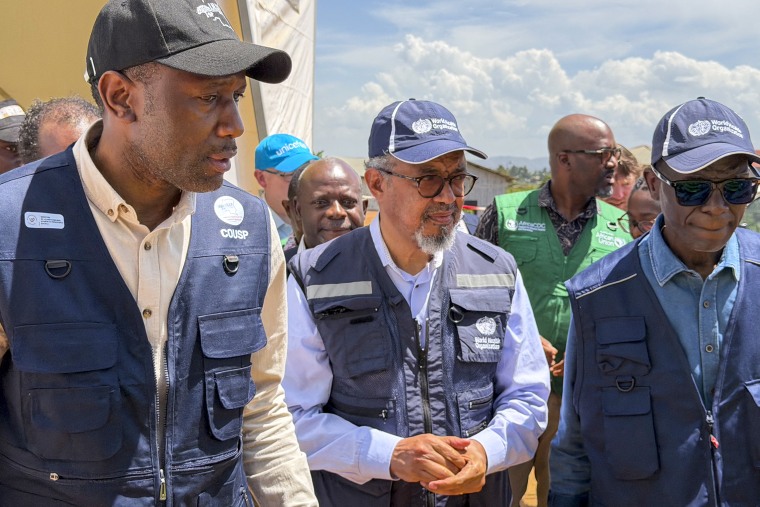
The Director-General of the World Health Organization, Tedros Adhanom Ghebreyesus, visited Bunia in the eastern Democratic Republic of Congo on Saturday. Bunia is currently facing a severe outbreak of a rare type of Ebola where the virus spreads rapidly despite improvements in health facilities and new aid deliveries.
During his visit, Tedros plans to inspect a treatment center and engage with local authorities, healthcare providers, and families impacted by the virus. Addressing the situation, he emphasized the importance of focusing resources at the epicenter of the outbreak and ensuring continued support.
The best way to address this is to provide all the necessary support to fight the disease at its epicenter and to continue offering every assistance needed,” Tedros stated.
As of Friday, health authorities documented 906 suspected cases and 223 possible deaths in the region. In neighboring Uganda, nine cases and one death have been confirmed, according to the Ugandan Ministry of Health.
The current outbreak involves the Bundibugyo strain of Ebola, for which there is no approved treatment or vaccine.
Medical aid from the European Union reached Ituri, a central area of the outbreak, and further shipments are planned over the coming week. The United States has announced an additional $80 million in aid, raising its total support to more than $112 million.
In Bunia’s Rwampara and General hospitals, response efforts show better organization with more staff, protective equipment, and medical supplies. However, new patients continue to arrive continuously.
The outbreak’s rapid spread has concerned Doctors Without Borders (MSF), which described it as one of the fastest-spreading on record. They are urging for expanded testing, quicker deployment of aid, and consistent medical supply access.
Never before has an Ebola outbreak recorded so many cases so soon after its declaration,” remarked Dr. Alan Gonzalez of MSF.
The response is further complicated by local hostility towards medical protocols for handling Ebola victims, clashing with traditional burial customs. This has led to multiple attacks on health facilities. Additional challenges stem from armed conflict in the region, notably by the Allied Democratic Force and various militias.
Ebola cases have spread to the North Kivu and South Kivu provinces, areas influenced by the M23 rebel group. Two cases have been reported by the rebels.
Amid these challenges, Uganda and Rwanda have closed their borders, and the U.S. has restricted entry for individuals recently in Congo, Uganda, or South Sudan. Tedros criticized these measures, arguing they do not effectively contain the outbreak.
Closing borders, as some countries have done, only discourages transparency. The Democratic Republic of Congo is reporting the situation openly and transparently,” Tedros stated, urging a reevaluation of travel restrictions.