
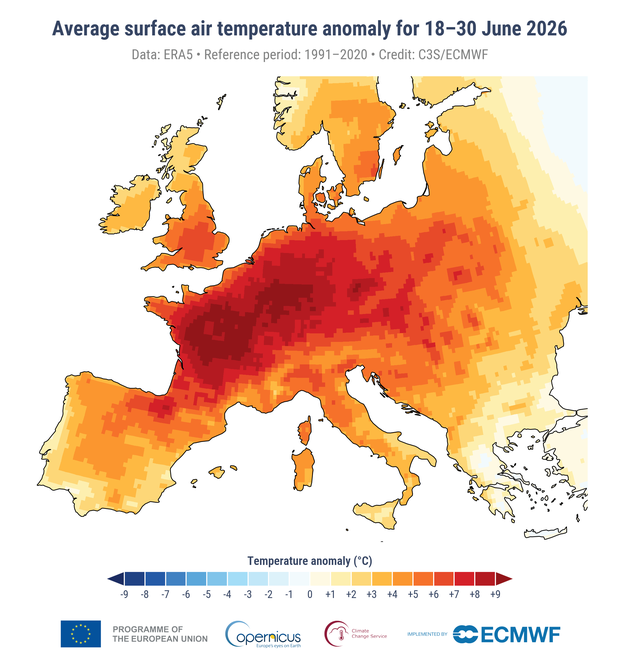
In June 2026, Western Europe recorded its hottest June ever, according to a report by the Copernicus Climate Change Service (C3S). The report highlights a global trend of rising temperatures, with June being the second-hottest globally on record.
Western Europe faced a massive heat wave in the latter half of the month, breaking monthly and all-time temperature records in numerous countries. This heat wave followed earlier extreme heat in May and preceded another in July.
“The succession of heatwaves illustrates the growing challenge posed by increasingly frequent and intense heat extremes across Europe and the globe,” the report noted.
Samantha Burgess, from the European Center for Medium-Range Weather Forecasts, pointed out that these conditions indicate profound climate changes. She mentioned that land temperatures coincided with marine heat waves across the Mediterranean and Atlantic.
Burgess stated, “Together, these records reflect a climate system continuing to accumulate heat. The result is increasingly intense heatwaves, a persistently warm ocean, and growing risks for people, ecosystems, and infrastructure across Europe and beyond.”
The June heat fueled massive wildfires in southern France, burning over 11,000 acres and forcing around 10,000 evacuations, as reported by French Interior Minister Laurent Nuñez. Meanwhile, French Prime Minister Sébastien Lecornu reported drowning cases related to heat relief attempts.
By the end of the month, Europe tallied over 1,300 heat-related deaths since June 21, many in France, attributable to heat exposure, particularly among the elderly. France and the UK both broke temperature records throughout the month.
The C3S report noted that June temperatures in Western Europe were nearly 5.5 degrees Fahrenheit above average. In contrast, the continent recorded its second-highest June overall, with temperatures about 3.2 degrees above the 1991-2020 average.
Sea surface temperatures in the tropical Pacific Ocean, where El Niño originates, remained exceptionally high. El Niño, known for warming waters, could lead to intense global weather and higher temperatures in the coming months, according to the World Meteorological Organization.
Forecasts from the European Union’s Joint Research Centre predict warmer-than-normal autumn temperatures in Europe, potentially extending into spring 2027.
Historically, Europe has seen frequent severe heat in recent years, a pattern attributed to human-induced climate change. The World Health Organization (WHO) noted that extreme temperature events are increasing in frequency, duration, and magnitude. Between 2000 and 2016, 125 million more people were exposed to heat waves, with far-reaching impacts on health, infrastructure, and stability.