
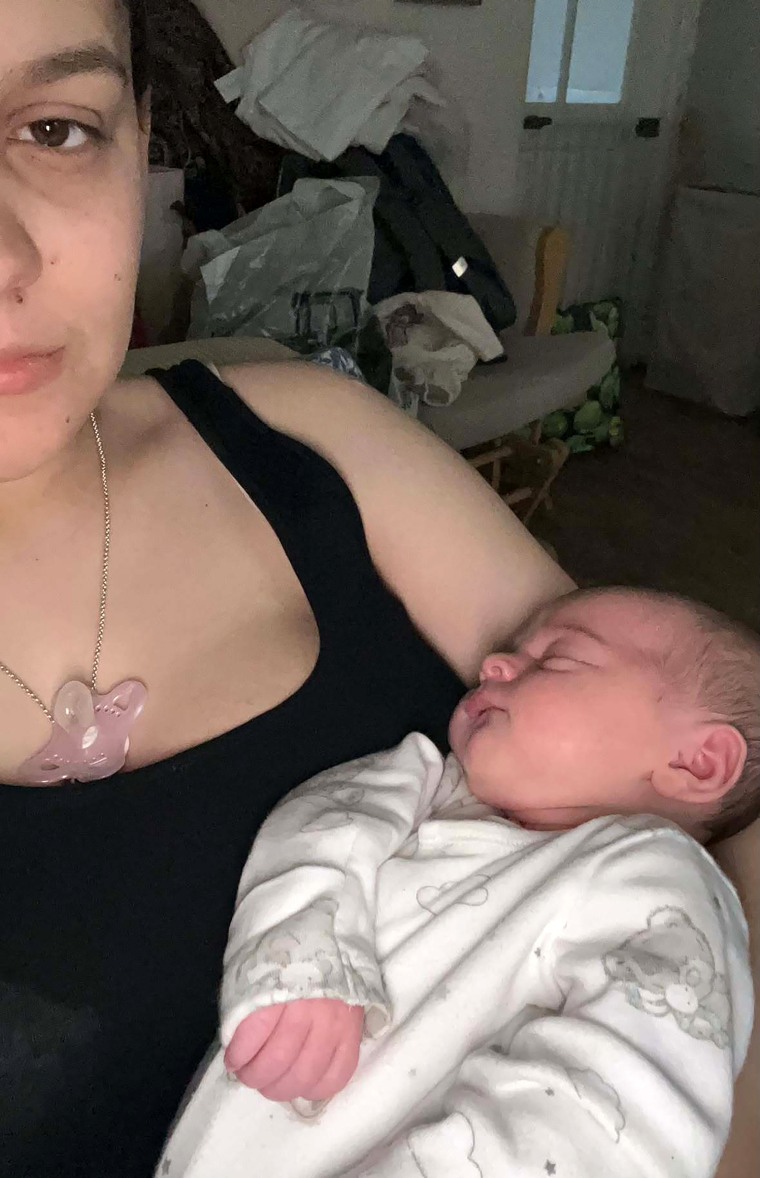
LONDON: Sofii Lewis sensed a serious problem soon after giving birth to her first child, Evie, in January 2023. She felt no bond with her daughter and dreaded being around her. Terrifying thoughts plagued her, fearing someone might harm Evie or even ‘buy’ her. The situation escalated to thoughts of suicide and harming her own child.
‘I know I certainly was hours, days away,’ shared Lewis, who resides in Aberdare, Wales.
A photograph of Sofii Lewis with baby Evie reveals her struggle: ‘I have no life in my eyes.’ Courtesy of Sofii Lewis.
Receiving treatment through the U.K.’s maternal mental healthcare system after being diagnosed with ‘tendencies of postpartum psychosis,’ Lewis believes both she and Evie survived because of this intervention. She and other mothers watched the trial of Lindsay Clancy closely, who faced charges for killing her three children in Massachusetts, citing postpartum psychosis as a defense.
‘A lot of other mums I’m in contact with who had postpartum psychosis also find it very, very triggering,’ Lewis said about the Clancy case. ‘Because that could have been any one of us who did that.’
The care she received at a Mother and Baby Unit for several months saved their lives, according to Lewis. These specialized inpatient units treat pregnant women and those who have recently given birth, allowing mothers to stay with their babies rather than being separated. Experts and mothers advocate for similar services worldwide.
‘Cradle’ of Modern Maternal Healthcare
Psychiatrist Veerle Bergink supports the idea that Clancy’s case might have concluded differently with treatment at a U.K. National Health Service MBU.
‘Lindsay Clancy had a severe postpartum mental illness,’ said Bergink, Director of Mount Sinai’s Women’s Mental Health Center in New York. ‘And she did not get the right treatment.’
The U.K. is seen as ‘the cradle’ of modern maternal mental healthcare, while the U.S. lags in perinatal psychiatry knowledge and treatment options. Britain’s MBU model is considered optimal for treating postpartum psychosis.
NHS statistics reveal up to 26% of new and expectant mothers experience perinatal mental health illnesses. In 2025 alone, over 66,000 women sought community-based support for these issues. Symptoms of postpartum psychosis, like delusions, hallucinations, and confusion, often begin within two weeks post-birth. The severity and type vary.
Suicide related to postpartum psychosis is rare, and infanticide even rarer, notes Action on Postpartum Psychosis, a British charity. Among approximately 1,200 cases annually, only 1 to 5 involve suicides. Infanticide cases are less than 0.05% in a decade up to 2021.
Photo: Lewis bathing Evie during their MBU stay in the U.K. Courtesy of Sofii Lewis.
Clancy’s defense highlighted her efforts seeking help, including consulting psychiatrists, calling hotlines, and hospitalization, but tragically ended up killing her children. Prosecutors claim she acted with intent and knowledge of wrongdoing. Her case has sparked discussion in the U.S. regarding postpartum psychosis and improving mental healthcare access.
Lewis reached out to a counselor previously for support, who quickly contacted NHS’s crisis team, leading to Lewis and Evie’s MBU admission within days. Care during their five-month stay likely saved lives.
‘Incredible Progress’
Some countries offer similar inpatient care for maternal mental health, yet Britain’s MBU program’s scale is ‘unique’ to the U.K., says Dr. Sally Wilson, National Training Coordinator for APP. The NHS’s ‘incredible progress’ over the past decade addresses postpartum psychosis effectively.
‘The development of the MBU program stemmed from prominent perinatal psychiatrists, as well as survivors, advocating for more awareness and specified treatment for the condition,’ Wilson said.
MBUs offer treatment plans, including medication, and mothers may spend weeks to months at the facilities.
Post-discharge, Lewis continued receiving perinatal community team care, recovering gradually. Later, she volunteered as a peer supporter with APP, finding two therapies particularly helpful during treatment. Video Interaction Guidance (VIG) therapy captures moments of positive connection with the infant. Eye Movement Desensitization and Reprocessing (EMDR) therapy relieves trauma-related distress.
Awareness and resources for maternal mental healthcare need expansion globally. Discoveries underline the necessity of recognizing postpartum psychosis symptoms and ensuring mothers receive essential support.
‘It doesn’t make you a bad person,’ Lewis assures survivors of postpartum psychosis. ‘It doesn’t make you a bad mum, a bad wife, a bad partner. It’s just part of the illness that you have at that time.’
If you are pregnant or a new mother in crisis, the National Maternal Mental Health Hotline provides free, confidential support 24/7 in English and Spanish. Call or text the hotline at 1-833-852-6262.
If you or someone you know is struggling or in emotional distress, call or text 988, or chat at 988lifeline.org 24/7 to reach the 988 Suicide & Crisis Lifeline. For additional resources, visit SpeakingOfSuicide.com/resources.