
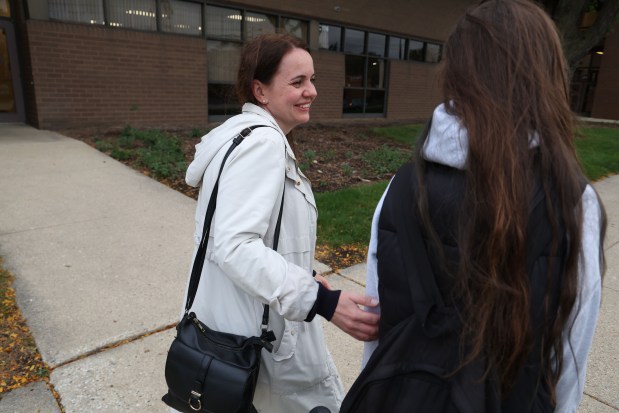
Yaryna Levchuk’s identity has been shaped by her dedication to work. A native of Ukraine, she responded to the outbreak of war in her country four and a half years ago by volunteering her skills as a pharmacist outside her regular shifts. Eventually fleeing to the United States, she immediately sought out employment in the Chicago area. Protecting her right to work became a priority, not only because it was essential for her family’s financial support but also because it was a source of personal pride.
Changes in policies and processing delays have recently threatened her ability to work. Levchuk’s husband might face similar challenges, casting the family into uncertainty regarding their future in the U.S. “We do not demand. We’re just friendly asking, if it’s possible, please help us,” Levchuk shared with the Tribune. “Just give us permission to work and we will work.”
Temporary Protected Status Concerns
Over 100,000 Ukrainians have sought refuge in the U.S. following Russia’s invasion. Their Temporary Protected Status (TPS) was scheduled to expire, causing anxiety over potential cutoffs in job and educational opportunities, and the threat of deportation. Though unofficial announcements suggest the Trump administration may maintain TPS for Ukrainians for the time being, Ukrainians remain uncertain of their future due to the silence from federal officials.
Impact of Recent Policies
Levchuk’s work authorization, tied to her humanitarian parole under the Uniting for Ukraine (U4U) initiative by President Biden, expired without renewal. Consequently, she lost her job as a pharmacy technician. U4U allowed temporary stays and work rights for Ukrainians with U.S. sponsors, but renewal processing now faces significant delays, adding to the complications for Ukrainian families.
“Work for me, it’s not just about money,” Levchuk explained. “It’s what I do to be happy and to make other people happy.”
Bureaucratic Challenges
Levchuk and her husband applied for temporary protected status, which should align with U4U, providing a pathway to continued legal presence and work authorization. However, delays in TPS processing have left them in limbo, putting their ability to sustain their livelihood at risk.
The TPS process remains complex, often failing to grant timely work authorizations. When renewing TPS, individuals must wait for final decisions before obtaining work eligibility, further exacerbated by the suspension of categorical parole programs announced by the Trump administration.
Salvadoran Example and Political Concerns
The uncertainty resonates with previous cases like El Salvador, whose recently expired TPS also lacked clear governmental communication. Political dynamics add another layer of complexity, as worsening U.S.-Ukraine relations spark fears of reduced support for Ukrainian TPS holders.
A federal statute theoretically ensures an automatic TPS extension if no action is taken by the secretary of homeland security, but real-world implementation remains murky. Advocates like Julia Sverdloff express frustrations about extensive administrative delays and uncertainties impacting employment.
Despite advocacy efforts from U.S. senators urging for an extension of TPS for Ukrainians, no immediate legislative solutions were available, leaving many families in a precarious state, including approximately 1,500 families supported by RefugeeOne, a Chicago resettlement nonprofit.
Levchuk’s Current Situation
Levchuk continues to endure work authorization setbacks. Her attempts to expedite TPS application processing have yet to yield results. While her son wishes to remain in the U.S. to complete his education, the family’s unstable immigration status casts doubt on attaining financial aid or affording schooling.
“It’s heartbreaking. I have such … pain about my country because they did not deserve it,” Levchuk said, expressing gratitude for the opportunities provided thus far.