
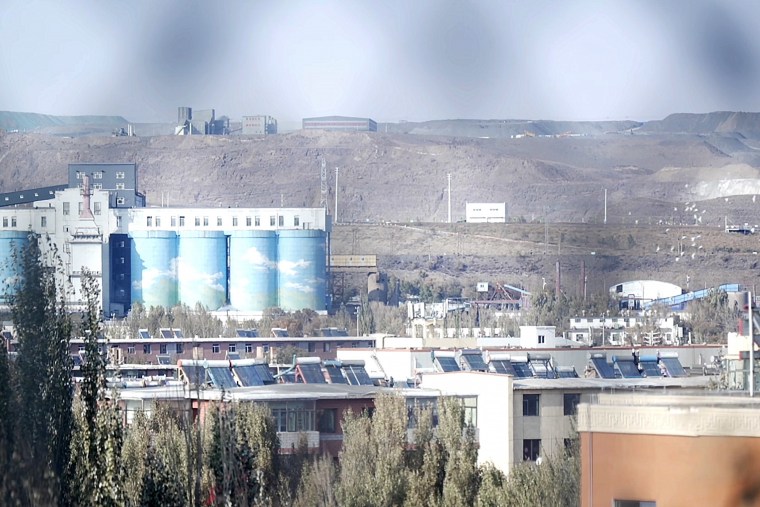
YEONGWOL COUNTY, South Korea — The United States is searching for tungsten, a crucial metal for military applications, as it depletes its weapon stockpiles in the conflict with Iran. This search is critical due to China’s dominance in tungsten production and refining. Tungsten is vital for national defense, used in fighter jets, advanced missiles, and armor-piercing rounds. Despite its importance, the U.S. hasn’t had an active commercial tungsten mine since 2015. The Trump administration is focused on reducing reliance on the Chinese supply.
A viable source of tungsten is a mine in the mountains of eastern South Korea, owned by a U.S. company that holds millions of tons of tungsten ore. “There are very few large-scale tungsten mines on the planet,” stated Lewis Black, CEO of Almonty Industries, which reopened the Sangdong mine three decades after it closed due to Chinese competition. Black emphasized tungsten’s historical role as a “war metal” and its growing importance in technology sectors, such as semiconductors and smartphones.
Steve Allen, Almonty’s COO, noted the increasing demand for tungsten and the need for a resilient supply chain. The U.S.-Israeli war with Iran, which started in February, further pressures the global tungsten supply, affecting the stockpiling of munitions essential for potential conflicts involving China. According to Mark Cancian, a senior adviser with the Center for Strategic and International Studies, restoring munitions could take nearly four years.
This weapons shortfall also impacts U.S. allies like Japan, which uses Tomahawk missiles, and South Korea, which hosts the THAAD missile system. Taiwan is awaiting a $14 billion U.S. arms package, delayed due to the Iran conflict.
China, with government subsidies, low labor costs, and relaxed regulations, has long led the global tungsten industry, making over 80% of the world’s supply. The U.S. depends largely on recycling and imports, bringing in more than 6,000 metric tons of processed tungsten annually as per the U.S. Geological Survey. During a trade standoff, China imposed export controls on rare earths and critical minerals, including tungsten, pushing prices to record peaks.
The extraction and processing of tungsten, a dense and delicate metal, involve significant challenges due to hazardous waste and environmental impact. “People in America don’t want to do that,” observed Ret. Col. Steve Warren, a senior aerospace and defense executive. “The Chinese are very willing to do that and at a low cost.”
The U.S. tungsten industry is effectively starting anew after years of inactivity. “There’s no knowledge, no consultants, no reference books—everything died in the ’90s,” Black explained, highlighting that China not only captured the market but also the expertise.
At the Sangdong mine, engineers find new tungsten deposits daily, indicating abundant resources. With advanced safety features, the mine is now operational again, pledging a potential century of activity. Almonty’s aim is to process about 1.2 million tons of tungsten ore annually at this site and reopen another mine in Montana to ensure U.S. self-sufficiency.
“Re-establishing a tungsten mine in the U.S. is absolutely critical for now and the future,” affirmed Steve Allen.