
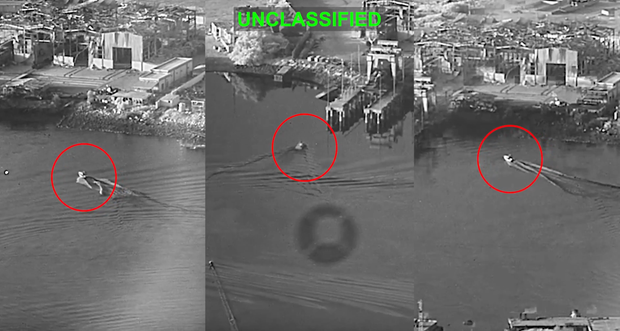
The U.S. military utilized one-way attack sea drones in a combat operation for the first time during an assault on an Iranian naval port. The strike occurred on Sunday, targeting the Bandar Abbas Naval Base in the Strait of Hormuz. According to a statement from U.S. Central Command (CENTCOM), several drones were deployed to attack a submarine and ship maintenance facility located on Iran’s coast.
A video released by CENTCOM depicted an aerial view of three small sea drones approaching a raised dock that housed a small submarine, followed by explosions. Although the exact extent of the damage remains unclear, the video captured towering smoke plumes resulting from the blasts, with the final explosion igniting a significant fire.
CENTCOM labeled the attack as successful, asserting that it had reduced Iran’s capability to continue assaults on commercial shipping in the region. The operation involved the Corsair Autonomous Service Vehicle, produced by Saronic, a Texas-based weapons manufacturer. The company expressed pride in supporting the mission and ensuring the safety of U.S. armed forces personnel through their technology.
The Corsair drone, according to the manufacturer’s website, can carry a payload of up to 1,000 pounds, travel more than 1,000 nautical miles, and achieve a top speed of 35 knots. Unveiled in October 2024, the drone became the focus of a $392 million production contract with the U.S. Navy by December 2025, transitioning from prototype to production in under a year.
Globally, drones have become definitive elements in contemporary warfare, gaining prominence in the ongoing conflict in Ukraine since Russia’s invasion over four years ago. The attack on Iran mirrors Ukraine’s strategy of using sea drones against Russia’s navy in the Black Sea.
CENTCOM spokesman Captain Tim Hawkins stated that the U.S. forces in the Middle East have been deploying new capabilities as the conflict progresses. He emphasized the importance of quickly providing warfighters with advanced tools to enhance combat effectiveness, marking it as a priority for U.S. Central Command.