
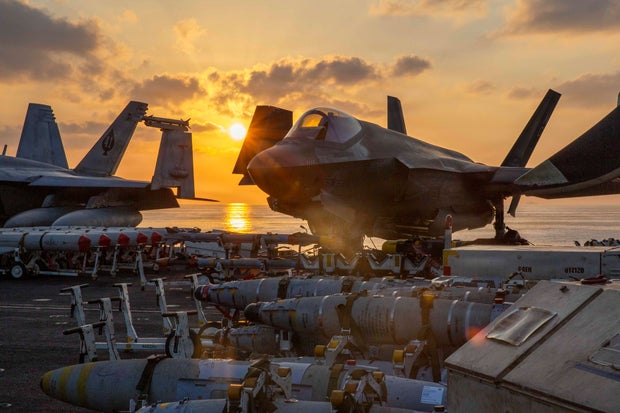
The Defense Department’s inspector general reported on Monday that the United States is experiencing a shortage of ammunition due to its expensive war in Iran. This mandatory report to Congress is the first of its kind and highlights the financial impact of Operation Epic Fury. From February 28 to June 30, the operation cost an estimated $33.4 billion, with $22.3 billion allocated to munitions expenses.
The report mentioned that the large expenditure on munitions has led to strategic inventory shortfalls and highlighted bottlenecks in the industrial base for munitions resupply. During the operation, the U.S. faced significant asset losses, including four F-15 fighter jets destroyed, one F-35 damaged, seven KC-135 tanker aircraft damaged, and up to 30 MQ-9 Reaper drones destroyed.
President Trump has dismissed concerns regarding depleted weapon stores throughout the six-month conflict, asserting that the U.S. has “virtually unlimited” ammunition. He reiterated on his Truth Social platform that the U.S. is producing “more Exquisite and Elite Weapons than at any time in our History.”
On the first day of the war against Iran, U.S. Central Command (CENTCOM) reported over 1,000 target strikes. However, such large-scale attacks have not been repeated in recent months. The report also noted that Iranian strikes resulted in damages to hundreds of buildings and structures at U.S. bases in multiple countries, but these costs are not included in the current estimates. It’s unclear if all the affected bases will be rebuilt and who will bear the expenses.
Recently, CBS Sunday Morning visited Lockheed Martin’s production facility in Arkansas to observe the creation of the latest Patriot air defense missile, which is designed to intercept incoming ballistic missiles. Each missile costs approximately $4 million, and Lockheed Martin is producing about 750 of them annually.
In response to questions about weapon availability, Mark Cancian from the Center for Strategic and International Studies mentioned that while the U.S. has enough arms for the war against Iran, a conflict with China would pose a significant challenge in the long term. While the Pentagon denies munition shortages, Defense Secretary Pete Hegseth is pressing the defense industry to boost weapon production. Lockheed Martin’s Tim Cahill, head of the missile division, describes the situation as “controlled chaos,” emphasizing the need to move quickly and overcome obstacles.