
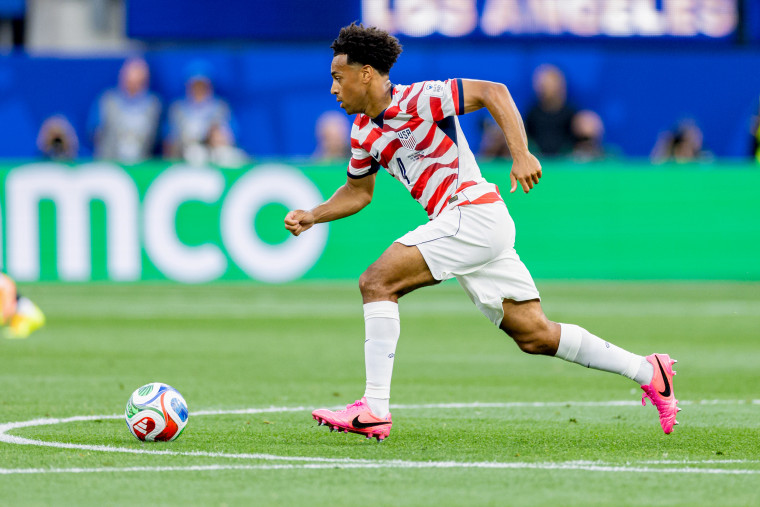
Growing soccer doesn’t always require traditional grass fields. Tyler Adams of the U.S. men’s national team is actively working to expand the sport by constructing mini-pitches across the country. These fields feature blue hard courts instead of grass, which is often difficult to maintain.
Adams expressed his thoughts on NBC and Telemundo’s “My New Favorite Futbolista,” saying, “When you go down to a park, no matter what surface you’re on, as long as you have a ball, you’re happy.”
The mini-pitches are approximately the size of basketball courts, needing much less space than traditional soccer fields. They also have permanent metal goals that require no upkeep.
“When I think back to the idea of a mini-pitch,” said Adams, “it’s so simple. It’s so easy to set up. It’s so easy to build.”
This simplicity can have a significant impact on children, especially in areas lacking recreational facilities. In these communities, mini-pitches can provide opportunities where none existed.
Adams elaborated, “The idea with the mini-pitches is that we can give access to these kids, especially in inner cities, and they can realize that hey, instead of doing something after school that gets you up to no good, you can walk down the street and find a soccer field and be able to play.”
As the first Black player to captain the USMNT at a FIFA World Cup, Adams spoke about his childhood in Hudson Valley, New York. Parks were a place he frequented. Today, playing for AFC Bournemouth in England, he notes the stark availability of pitches in Europe compared to the U.S., which has around 53,000 soccer pitches, according to OpenStreetMap. This number translates to about 158 fields per million residents. In contrast, Germany has 543 and France offers 469 pitches per million residents.
“Here in Europe, it’s free to play at such a young age,” Adams noted, comparing to the U.S., where basketball and American football are more accessible at a young age.
Overall accessibility in the U.S. is limited. The U.S. Soccer Foundation aims to address this by planning to install 1,000 mini-pitches in underserved areas by 2026. They report that 70% of predominantly Black and Hispanic communities lack such facilities.
A U.S. Soccer Federation study indicated that 99% of respondents cited increased community activity post-installation of a mini-pitch. Additionally, 98% felt their communities were safer.
Adams reflected on these positive changes, stating, “The memories that you make from playing a game like soccer, the places that it brings you, the cultures that you’re around and that you learn about, the game just has so many things to offer.”
Success stories like Valentino, a 10-year-old from Detroit, demonstrate the impact. Before a mini-pitch opened nearby, practicing soccer happened in his living room. Valentino expressed gratitude, stating, “Thank you for bringing this small pitch to my community.”
Adams also champions Black Star Soccer, a platform started in 2021 to foster soccer’s growth specifically among America’s underserved and Black communities.
Patrick Rose, Black Star Soccer’s general manager, emphasized the inspiration Adams provides, especially for Black youth. Rose shared his personal experience of being one of the few Black kids in high-level club environments.
“I know that even like myself growing up… there weren’t a lot of kids that looked like me,” Rose said. “Being able to see somebody like Tyler would have just given me… a boost of inspiration.”
Through these initiatives, Adams envisions more diverse soccer matches, akin to those represented by the U.S. men’s national team’s diversity on World Cup fields.
“When you look at our team and our squad, you see how diverse it is,” he said. “And I think it’s an amazing thing to see… because we represent so many different communities, so many different ethnicities, so many different backgrounds.”
You can hear more from Adams and other soccer stars on “My New Favorite Futbolista,” available on various podcast platforms.