
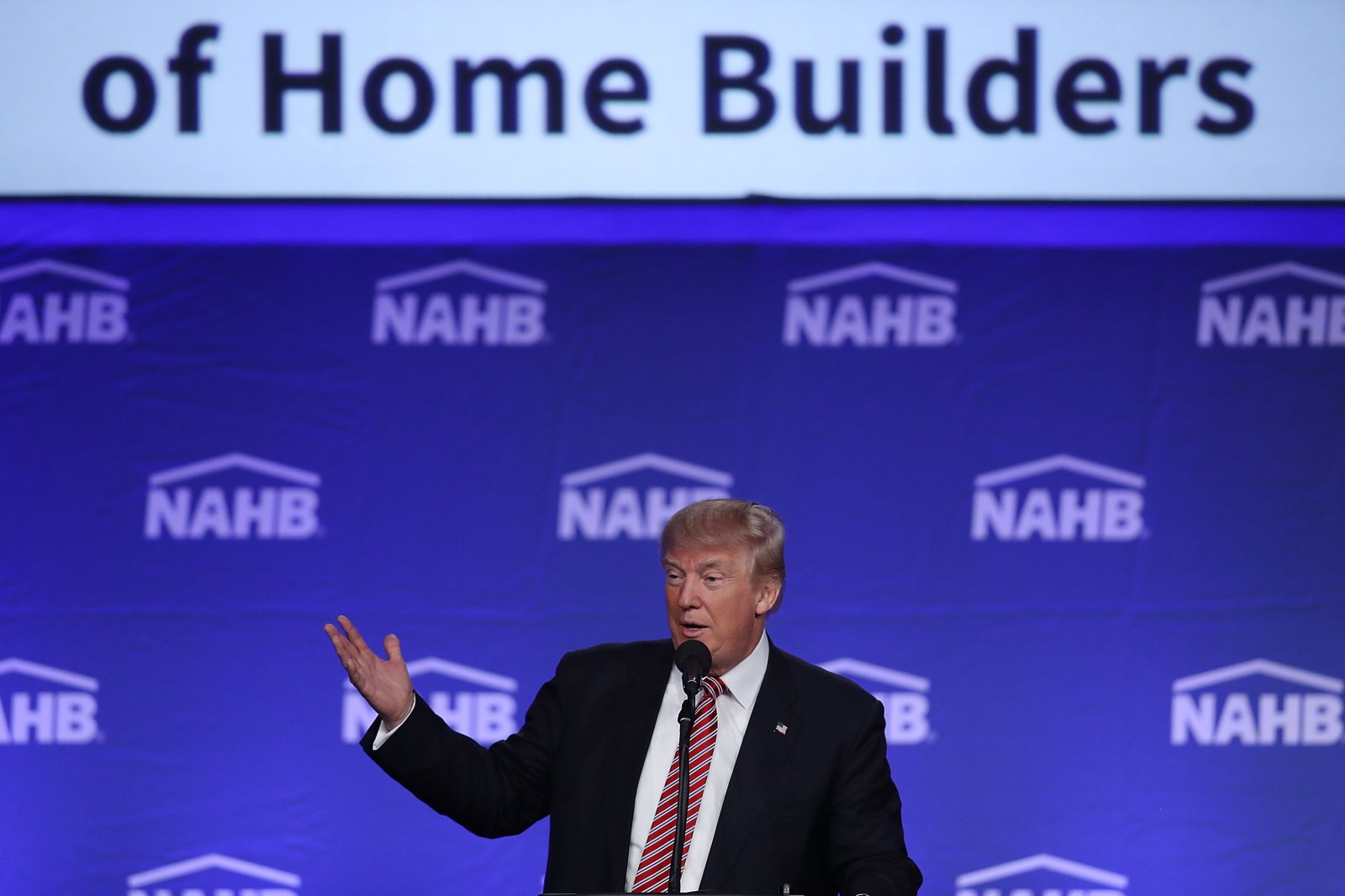
President Donald Trump’s recent trade actions against Canada have triggered tensions with a key Republican ally, the nation’s home builders. On July 20, the White House announced tariffs of 50 percent on certain Canadian imports via Section 338 of the Tariff Act of 1930. These tariffs, targeting products like wine, hockey sticks, and cement, are set to begin on August 19 and apply regardless of qualifications under the United States-Mexico-Canada Agreement.
The tariffs affect about $20 billion in annual imports. The National Association of Home Builders (NAHB) expressed concern that this move would increase uncertainty over building material supplies and prices. Materials such as cement, plywood, and furniture are of particular concern. NAHB emphasized the need to exempt certain building materials to prevent exacerbating the housing crisis.
Recent tariff developments could create more uncertainty for home builders over building material supply chains and pricing.
The NAHB has significant influence. In the 2024 election cycle, its political action committee contributed over $1.6 million to Republican candidates, accounting for more than 80 percent of its political donations, according to OpenSecrets. Overall, they spent over $3.3 million and reported $3.45 million in lobbying efforts that year.
Efforts to exclude construction inputs from tariffs have been ongoing. Earlier in the year, NAHB collaborated with Senators Jacky Rosen and Chris Coons on the Housing Tariff Exclusion Act. This legislation aimed to exclude home building materials from tariffs. NAHB data indicated that about 60 percent of builders had already faced cost increases due to previous tariffs, with an average impact of $10,900 per home.
Canada plays a crucial role in the U.S. supply chain. It supplies 85 percent of U.S. softwood lumber imports. Current duties on softwood lumber and other materials remain unchanged, although tariff cuts on Canadian softwood are expected in mid-August.
Builder sentiment has reflected the challenges. NAHB’s index, in collaboration with Wells Fargo, showed a decline. It remained below 40 for 15 months, the longest stretch since 2012. Many potential buyers await lower mortgage rates, according to NAHB Chairman Bill Owens.
Republican lawmakers also expressed concern over the tariffs. Senate Majority Leader John Thune stated that he needed to hear the purpose behind such tariffs. Senator Mike Rounds highlighted the impact on affordability and inflation concerns.
The tariffs were introduced as a response to perceived Canadian discrimination against U.S. exports, including cars, alcohol, and dairy. Canadian Prime Minister Mark Carney described the tariffs as a breach of the North American trade agreement, likely leading to negotiations in the upcoming weeks.
Public sentiment about the tariffs and economic policies is mixed. Polls indicate substantial public disapproval of Trump’s economic management. A July survey noted that 65 percent of adults disapproved of his handling of the economy. Another survey showed that 66 percent found groceries unaffordable. Additionally, 28 percent of Republican voters felt his policies worsened the economy, up from 18 percent earlier.
In general, tariffs pose ongoing challenges. While Republican voters support them more than the national average, the support varies. A February Pew survey recorded 71 percent GOP approval for tariffs, but this drops among non-MAGA Republicans. Concerns about worsening inflation remain a significant issue.
Affordability is affordability, and voters get frequent reminders of how affordable things are or are not, gas, food, electricity bill, etc.
Contact Newsweek editors Jenni Fink and Sam Wilson for further information on this story.