
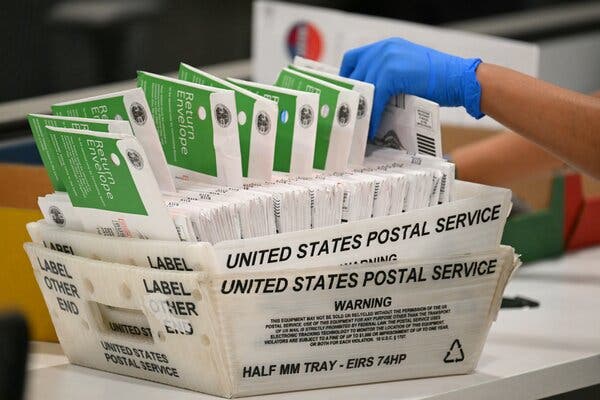
President Trump continues his campaign against mail voting with false claims of fraud. His efforts to limit the practice were stopped by various court orders including the Supreme Court. Despite these obstacles, he remains vocal in opposing mail-in ballots ahead of November’s midterm elections.
The issue of mail voting has stirred a range of opinions within the Republican Party. Historically, Republicans supported absentee voting, using it strategically in past elections. This shift in stance highlights changing dynamics in mail voting usage between political parties.
Claims of Fraud in Mail Voting
For several years, Trump labeled mail voting as corrupt, advocating against it despite using mail voting in several elections himself, such as in 2018, 2020, and recently in March. He reiterated his stance during a prime-time speech, asserting, “mail-in ballots are inherently corrupt.”
Contrary to these assertions, election officials and extensive research show no evidence of widespread fraud in mail voting. The Heritage Foundation, a conservative organization, tracks around 300 proven cases of absentee ballot fraud spanning 43 years. Moreover, the Brookings Institution in 2025 reported fraud in only four out of 10 million mailed ballots.
Strategic Motivations
Trump has acknowledged that targeting mail voting is not solely about preventing fraud. In conversations with Republican lawmakers, he suggested that enforcing strict voter identification laws on mail ballots, now predominantly used by Democrats, might secure electoral advantages.
Historical Context
Previously, Republicans commonly benefited from mail voting programs. In the late 20th century, John C. Fortier of the American Enterprise Institute noted that mail voting was typically associated with Republican voters. This historical perspective shows a notable evolution in the political landscape regarding mail voting.