
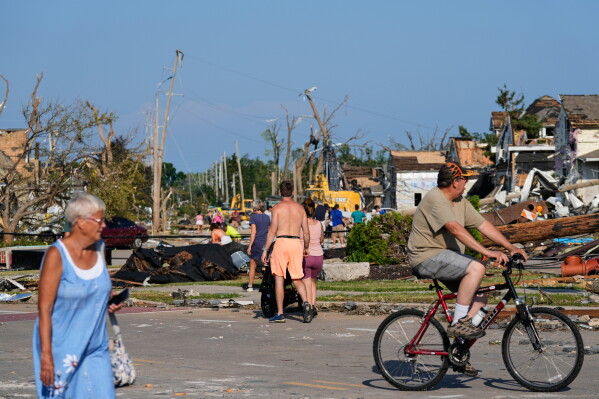
On Monday, northeastern Wisconsin experienced a tornado that darkened the sky and forced workers into basements for safety. The storm caused significant damage, leaving over 30,000 people without power. Emergency services are still checking for casualties, reported Gordon Hintz, Winnebago County’s top official.
The National Weather Service confirmed the tornado hit Winnebago County, about 90 miles from Milwaukee. Significant damage was noted in Appleton and Menasha, as stated by Police Chief Matt Albrecht.
This tornado was part of a larger storm system fueled by heat and humidity, explained Scott Berschback, a meteorologist with the National Weather Service. According to Hintz, it may take days to restore power in the affected areas.
“There’s nothing left,” said Heather Schroeder, highlighting the destruction of nearby buildings like a laundromat, a bakery, and a tavern.
The storm caused vehicles to overturn and roofs to be ripped off homes near Lake Winnebago in Menasha, with reports of a gas leak at the laundromat.
Greg Van Driest, present in Appleton during the storm, described the sky as ominously dark. Emergency warnings had been activated to encourage people to seek shelter, said Hintz.
Holley Kamba, a meteorologist from the National Weather Service, reported substantial damage in southern Outagamie County and eastern Winnebago County, where trees and power lines were down.
Wisconsin Governor Tony Evers stated the state is ready to help affected communities. The weather service issued a tornado warning for the Fox Cities region at 11:59 a.m., indicating possible winds of 60 mph.
Images showed extensive destruction in Appleton, with homes missing roofs and tree debris scattered across streets. Power outages were reported across Menasha and other areas.
Outagamie County Executive Tom Nelson acknowledged severe damage in Menasha and Fox Crossing, while Albrecht mentioned that Menasha was completely without power. Roads were impassable, prompting authorities to set up a shelter at a church.
Residents were advised to avoid affected areas due to hazards like downed power lines and trees. Later, the storm moved south of Milwaukee toward Chicago, diminishing as it progressed.
Contributions were made by Mayes-Osterman from Chicago, Seewer from Toledo, and other reporters across different states.