
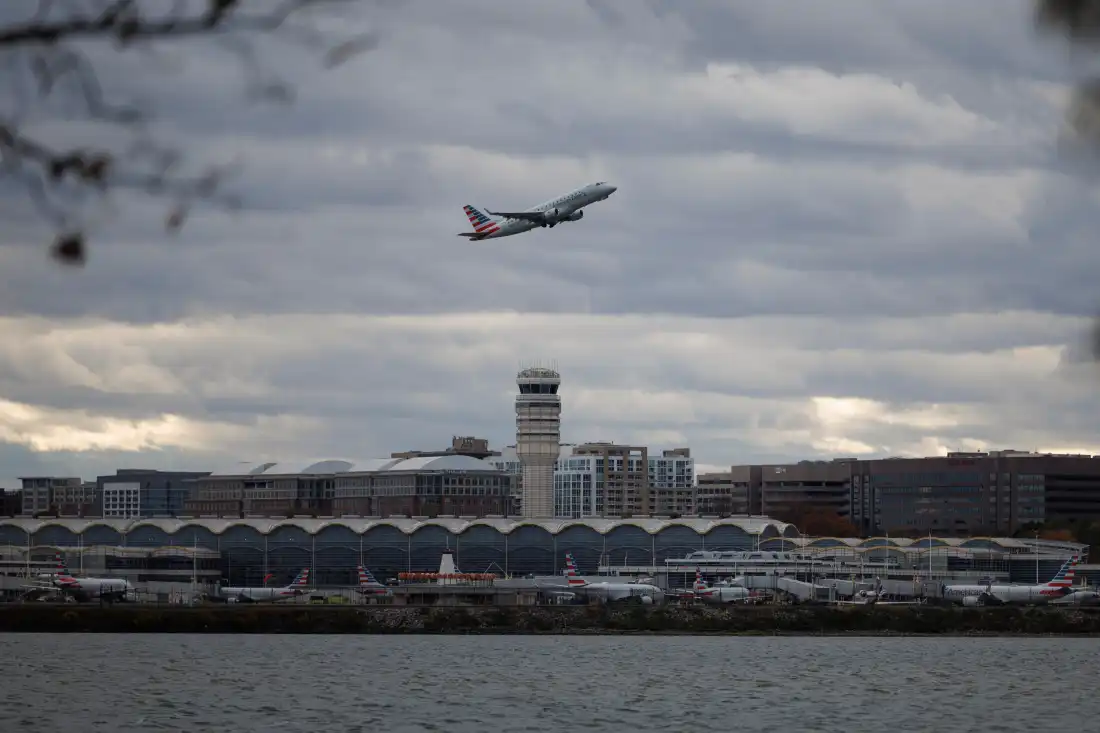
Aircraft gathered at Ronald Reagan Washington National Airport in Arlington, Va., following a nationwide grounding of flights by the Federal Aviation Administration (FAA) on Saturday, Nov. 14, 2026. Thousands of travelers continue to wait for airlines to reschedule canceled flights after Friday’s ground stop.
As of Sunday evening, more than 2,300 flights were canceled and over 8,000 flights within, into, or out of the U.S. faced delays, according to FlightAware.com. Airports in Dallas-Fort Worth and Atlanta experienced the highest delay numbers, each with more than 250 affected flights.
Efforts to Normalize Operations
U.S. Transportation Secretary Sean Duffy indicated expectations for operations to return to normal soon. “By the end of today, end of tomorrow, I think we will be back to normal,” he stated in an NBC Meet The Press interview. Duffy explained that the ground stop caused airplanes and crews to be out of position, necessitating time to reorganize schedules.
Duffy attributed the disruption to faulty maintenance by L3Harris Technologies Inc., a federal contractor. They were swapping older copper wire sections for fiber-optic cables, during which the FAA’s legacy equipment was overloaded, disrupting communications. Investigations pointed to issues at a radar site in Amarillo, Texas, and a radio communications site in El Dorado, Arkansas, as potential causes.
Company and Government Responses
L3Harris emphasized its commitment to safety and reliability, acknowledging the ground stop’s impact. The company said it had completed over 70% of its planned airspace communications update to a fiber-optic system and expressed support for the FAA’s investigation.
President Trump called on Congress to allocate additional funding for air traffic control system enhancements, highlighting the need for complete overhauls rather than incremental updates. In 2025, $12.5 billion was approved for upgrades, and on Friday, a request for $50 billion in emergency funding was made by Duffy and the White House.
Duffy highlighted the importance of investing in an outdated network to ensure future resilience. However, Congress members, including Rep. André Carson and Rep. Rick Larsen, pointed out that only a fraction of previously allocated funds was spent, questioning the new funding request.
Air Traffic Controllers’ Role
Nick Daniels, president of the National Air Traffic Controllers Association, supported efforts to identify the root cause of the ground stop and expressed gratitude towards air traffic controllers’ actions during the crisis. Daniels noted the controllers’ exemplary performance despite working with unreliable equipment, underscoring the unexpected nature of the situation.