
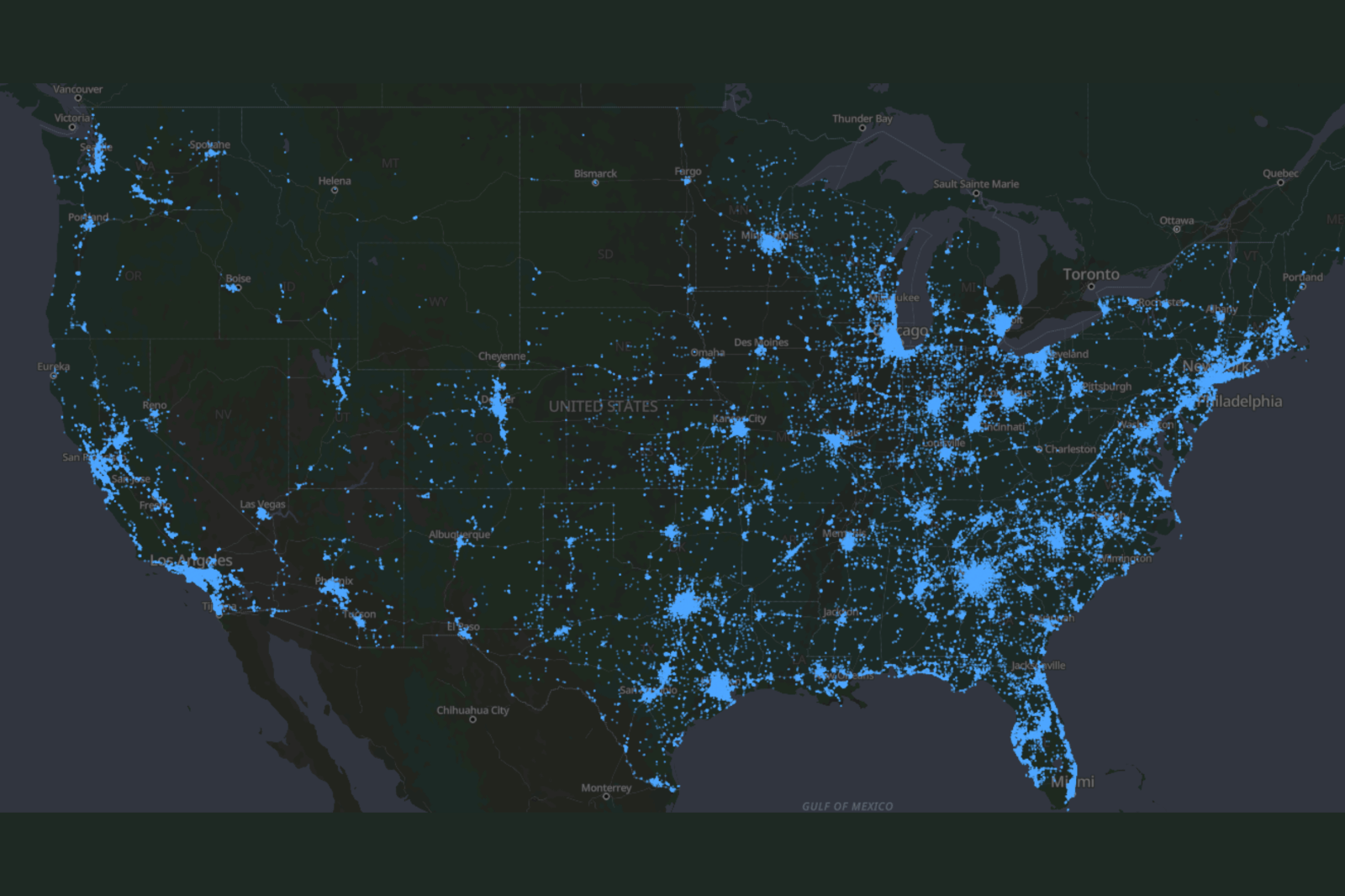
Flock Safety operates a network of automated license plate reader (ALPR) cameras. These cameras are installed on roads, intersections, and neighborhood entrances. They collect license plate information along with a vehicle’s color, make, model, and other characteristics. Law enforcement agencies participating in the program can search this information.
Supporters view the system as an essential investigative tool. Law enforcement agencies across the country credit Flock cameras with aiding suspect identification, recovering stolen vehicles, and generating leads in investigations. These benefits have driven Flock’s rapid expansion, now operating in thousands of communities nationwide. DeFlock, an anti-surveillance group, claims to have mapped over 122,000 license plate reader cameras across the country.
Controversy Over Flock Cameras
The controversy primarily stems from the cameras’ ability to track vehicle movements over time. Critics warn that while a single camera captures a brief snapshot, a network can create a detailed record of movements. Privacy advocates assert these systems could reveal personal information such as residence, workplace, religious affiliations, medical visits, or political activities.
The debate has intensified with opposition spreading beyond privacy groups. Some communities have rejected, or dismantled, Flock cameras over surveillance and civil liberties concerns. Concurrently, Republican lawmakers have proposed laws to regulate automated license plate reader technology, citing privacy and constitutional rights, particularly the Fourth Amendment.
Misuse concerns are also present. In various jurisdictions, officers have faced allegations of improperly accessing license plate databases. Critics argue safeguards to prevent abuse might not function effectively. Yet, supporters counter that isolated misuse cases should not overshadow the technology’s crime-solving capabilities. They advocate for stronger oversight, auditing, and access controls to prevent abuse.
Fourth Amendment Challenges
The constitutional debate involves the Fourth Amendment, which protects against “unreasonable searches and seizures.” Historically, courts have ruled that individuals have no privacy expectation in information exposed publicly, such as license plates. Therefore, recording a license plate is generally not considered a Fourth Amendment search.
Flock camera supporters depend on this reasoning. Critics argue that modern surveillance fundamentally alters this premise. They focus on whether the government can amass numerous observations into a comprehensive, searchable database. This argument reflects the Supreme Court’s 2018 decision in Carpenter v. United States. The Court found that while cellphone location records are held by carriers, they reveal so much about daily life that individuals maintain a privacy expectation.
Privacy proponents argue that extensive ALPR systems raise similar issues by disclosing long-term movement and association patterns.
Legal Rulings on Flock Cameras
No court has yet ruled Flock cameras unconstitutional. A significant legal challenge is Schmidt v. City of Norfolk. In this case, plaintiffs argued that collecting and storing location data from drivers constituted a warrantless search in breach of the Fourth Amendment. In January 2026, a federal judge ruled in favor of the city, finding Norfolk’s camera use constitutional. The judge noted that the system relied on publicly visible road information and did not monitor entire movements. The case is now on appeal, potentially testing how privacy protections apply in the context of surveillance technology.
FlockHopper and Surveillance Concerns
Activist projects like FlockHopper aim to expose the Flock camera network’s scale. Privacy advocates claim these projects illustrate how surveillance networks function and how agencies might access vehicle data far from its collection point. Supporters argue that information sharing is crucial for investigating crimes that cross jurisdictions.
Constitutional Implications in the Digital Era
The Flock camera debate encompasses more than license plates. Supporters perceive an effective tool for identifying suspects and solving crimes. Critics view this as a growing surveillance infrastructure tracking millions of unsuspected citizens.
Courts have traditionally held that public roadway observations lack privacy interest. Yet, the unresolved question is whether mass observation collection, with long-term storage and cross-jurisdictional searches, constitutes something different. This issue is under scrutiny in courts, legislatures, and city councils nationwide. Its resolution could define how the Fourth Amendment applies to emerging surveillance technologies.
Newsweek has reached out to Flock Safety and Orin Kerr, a Stanford Law School Professor, for comments.