
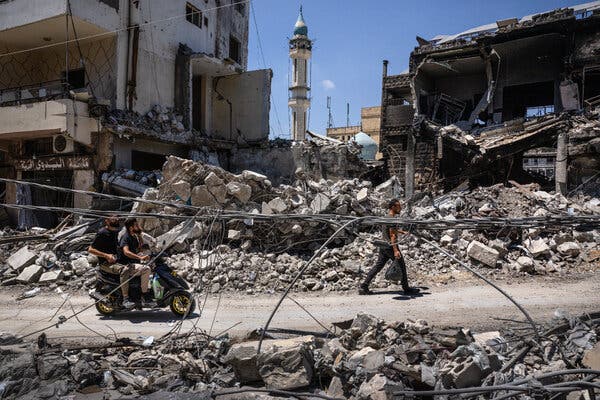
On Tuesday, Israeli soldiers shot and killed two individuals in southern Lebanon, according to Lebanon’s health ministry. This incident rekindles fears that ongoing hostilities may hinder the peace discussions between the United States and Iran.
The Israeli military reported that the shooting followed new orders aimed at minimizing flare-ups in Lebanon, where the conflict with the Iran-backed Hezbollah group poses significant barriers to a wider U.S.-Iran agreement.
Although recent days have seen a reduction in fighting due to the latest cease-fire, experts caution that any attack risks reigniting violence. After the shooting, the Israeli military stated that the men, allegedly Hezbollah operatives posing as civilians, approached Israeli forces while riding a bulldozer. Israeli troops initially issued warning shots before taking further action to “remove the threat.” Hezbollah disputed this account, asserting that the men were civilians and accusing Israel of a cease-fire breach.
Lebanese authorities, as reported by a state-run news agency, identified the deceased as emergency service workers engaged in clearing roads and recovering bodies from earlier Israeli strikes. The incident transpired near Ali al-Taher—a strategic ridge where Israeli troops have progressed recently. Hezbollah reportedly maintains a large underground facility here, serving as its southern headquarters for operations against Israel.
In March, Israeli forces advanced further into southern Lebanon following Hezbollah’s cross-border rocket attacks in support of Iran, which had suffered U.S. and Israeli bombings. Recently, Israeli officials vowed to keep forces within a “security zone,” extending six miles inside Lebanese territory.
Despite this latest shooting, some stability appears to be emerging in southern Lebanon. The U.N. peacekeeping force, UNIFIL, noted the absence of airstrikes since Sunday but reported ongoing “airspace violations, military activities, and freedom of movement restrictions.”
Lebanese and Israeli representatives planned further meetings on Tuesday, continuing weeks of U.S.-mediated negotiations alongside U.S.-Iran discussions. However, these talks have not mitigated conflict. Hezbollah’s exclusion from—and rejection of—these talks undermines Lebanon’s government authority to enforce cease-fires.