
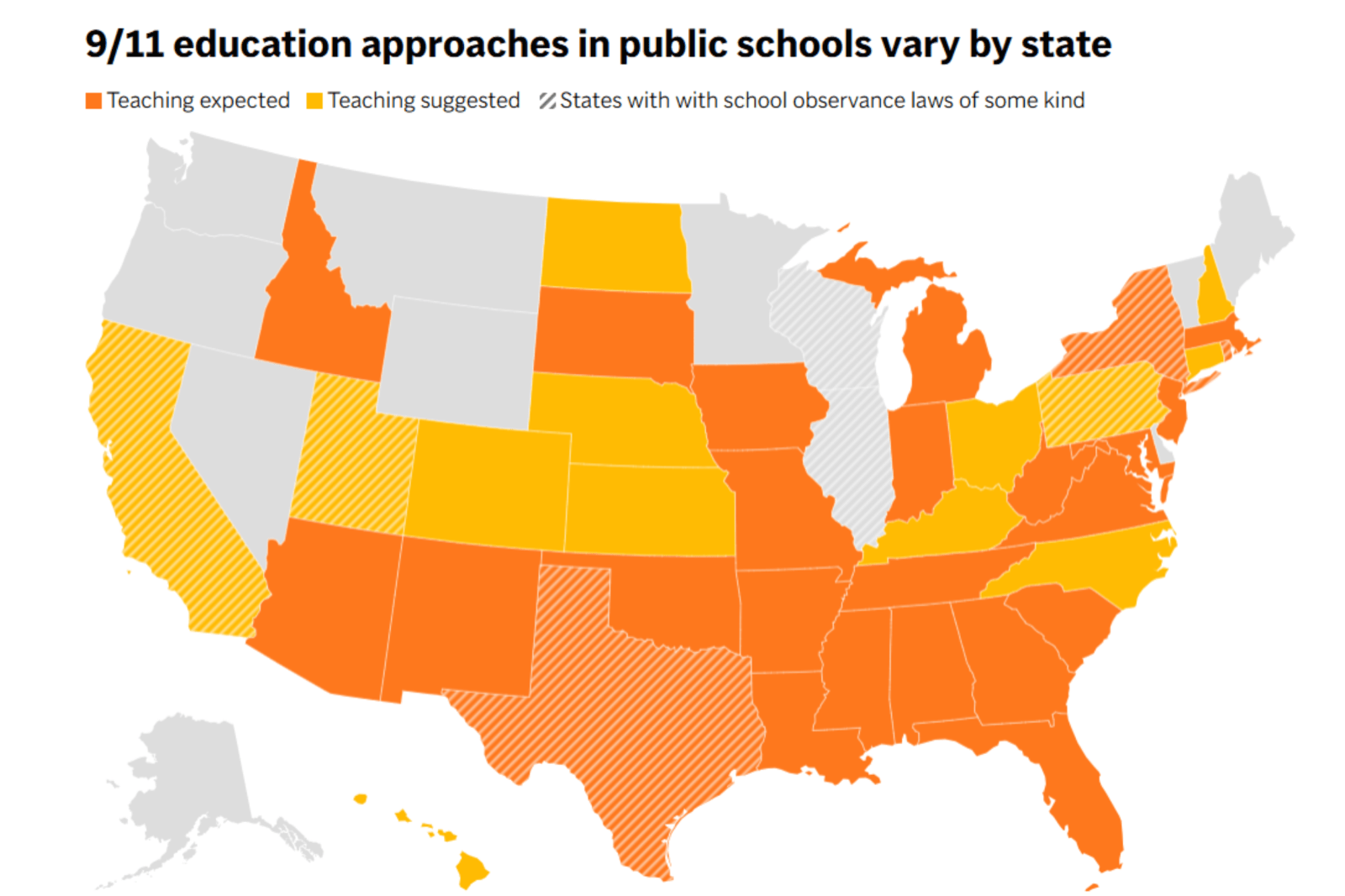
As the United States prepares to commemorate the 25th anniversary of the September 11 terrorist attacks, there is a notable trend of states implementing or suggesting educational policies for schools to instruct students on this pivotal event in American history. According to research by The Associated Press, at least 40 states expect or encourage public schools to address 9/11, with 25 of those states having laws or education standards that specifically mandate or expect such instruction. Another 13 states provide optional references to 9/11 within educational guidelines. Additionally, several states advocate for observances like moments of silence, expanding the total number of states with some form of 9/11-related policy to at least 40.
Approximately one-third of the American population was born after al-Qaida terrorists hijacked four commercial flights, resulting in the deaths of nearly 3,000 people in New York City, at the Pentagon, and near Shanksville, Pennsylvania. This means that today’s students have no direct memory of the tragic events of September 11, 2001. Jeremy Stoddard, an education professor at the University of Wisconsin and researcher of 9/11 education, explained to Newsweek that teachers increasingly view these attacks as historical events rather than lived experiences. They also focus on how post-9/11 policies continue to influence students’ lives today.
States take diverse approaches to teaching about 9/11. Some states require focused classroom lessons on the attacks and their aftermath. Others integrate the topic into broader U.S. history, civics lessons, or discussions on terrorism and foreign policy. A portion of these states only encourage schools to commemorate the anniversary with observances or reflection moments.
For instance, some states mandate that students not only study the attacks but also their long-term effects. In Alabama, students analyze U.S. military involvement following 9/11 and evaluate the effectiveness of America’s response, including the creation of Homeland Security and the Patriot Act. Arizona requires age-appropriate education around each 9/11 anniversary, though limited to grades seven through 12.
Education experts stress the increased importance of 9/11 education as fewer students have personal connections to the attacks. Stoddard mentioned to Newsweek that this generational shift challenges educators, as most students and many teachers lack direct memories of 9/11. Educators discuss how to appropriately teach and remember the details of the events, including the victims and broader historical lessons.
Stoddard noted that classroom approaches have evolved over time. Around the 20th anniversary, educators focused on the anniversary itself by utilizing news footage and personal stories, emphasizing the heroism of first responders and national unity. Recently, there’s been a shift towards historical analysis, allowing students to understand how the response to 9/11, like the Patriot Act, impacts them today.
Stoddard highlighted that more states are integrating the attacks into their curriculum standards now as they become more distant history. A decade after the attacks, about 60 percent of states did not mention 9/11 in their education standards. However, curriculum requirements have expanded notably, leading to more depth in the coverage of the attacks.
The national picture is not simply a divide between states that “teach 9/11” and those that do not.
Key takeaway: Requirements largely fall into three categories:
- Dedicated instruction: States like Arizona and Florida require schools to provide specific instruction on the attacks.
- Curriculum standards: States such as Alabama and New Jersey include 9/11 in required social studies content.
- Commemoration: States including California and Pennsylvania have laws concerning moments of silence or observances.
Another group of states, including Colorado and Illinois, offers instructional guidance without a state mandate. Meanwhile, states like Minnesota and Washington have no specific statewide 9/11 policy as identified by the AP.
Stoddard mentioned that various reviews of state standards yield different findings due to differing methodologies. A University of Wisconsin analysis he co-authored found fewer states with explicit 9/11 requirements, focusing only on official standards and legislation. Newsweek previously published a guide on educating children about 9/11.