
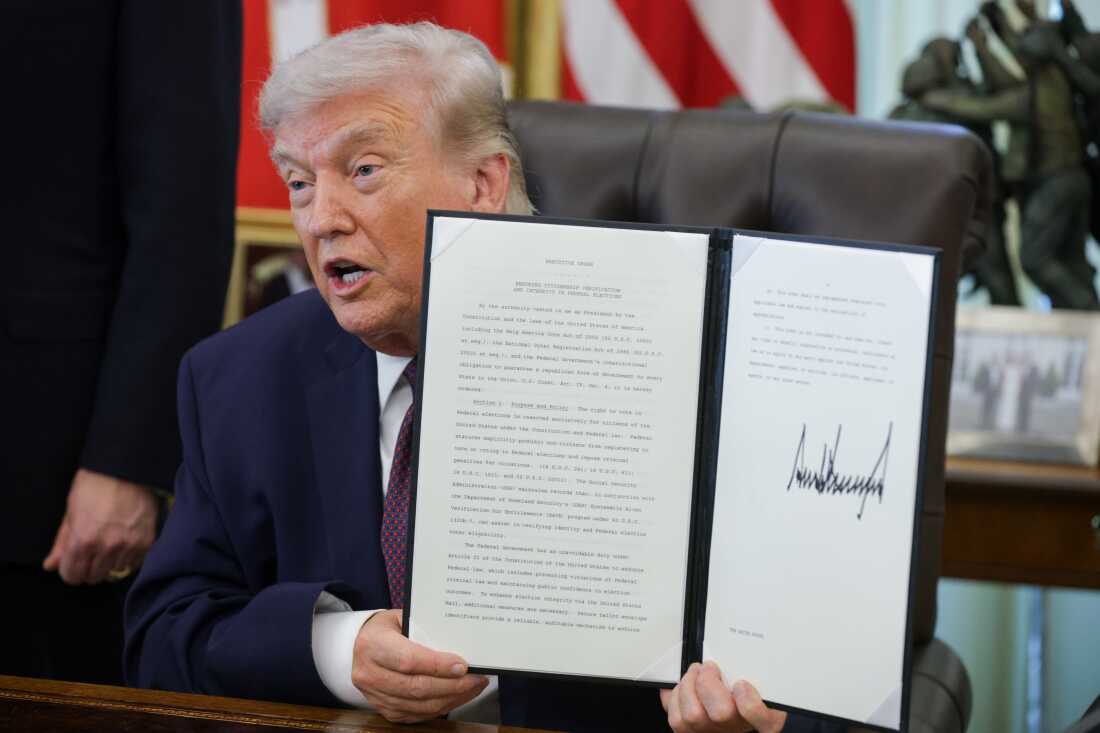
President Trump held an executive order aiming to restrict mail-in voting, an action that faced legal challenges. The Supreme Court has temporarily halted a lower court’s decision that challenged this order, which targeted mail-in voting in various states and Washington, D.C.
Absentee voting for the midterms is approaching, and potential operational issues exist for the U.S. Postal Service and other agencies trying to comply with Trump’s directives. The executive order issued in March aimed to influence election processes, sparking a legal battle. Significantly, the U.S. Postal Service remains barred from implementing Trump’s directives due to a national ruling from U.S. District Judge Indira Talwani in Boston.
The Supreme Court’s decision does not address the legality of Trump’s order. Thus far, the order has not directly impacted the ability of eligible voters to use mail-in ballots. Judge Talwani previously blocked parts of Trump’s order concerning 23 states led mostly by Democrats and Washington, D.C.
Trump’s executive order instructs the Department of Homeland Security to compile lists of U.S. citizen adults, and the Postal Service is tasked with obtaining lists of eligible mail voters. Mail-in ballots should only be sent to individuals on these lists. Election officials are also required to use specific barcodes on mail ballot envelopes as part of the directive. The Postal Service responded with a final rule for federal ballot mail following Trump’s order.
Research indicates illegal voting by non-U.S. citizens in federal elections is exceedingly rare, despite Trump’s argument aiming to prevent it. Talwani’s June ruling determined Trump exceeded presidential authority, which traditionally entrusts federal election rules to state legislatures and Congress. Furthermore, the USPS, separate from presidential control, lacks legal oversight over mail-in voting.
The Supreme Court approved emergency requests from the administration and some Republican-led states to suspend Talwani’s June ruling without deliberating on Trump’s order’s legality. The order’s influence on mail-in voters remains uncertain. The legal dispute will likely continue, with lawsuits from Democrats and voting rights groups ongoing as the midterms approach.
The administration recognized limited time for executing Trump’s order before the midterms, as noted in a July court filing by U.S. Solicitor General D. John Sauer. He pointed out that efforts need to start by early or mid-August to be feasible for the 2026 election, since mail-in voting commences weeks before Election Day in certain states.
Editor’s note: The USPS financially supports NPR.