
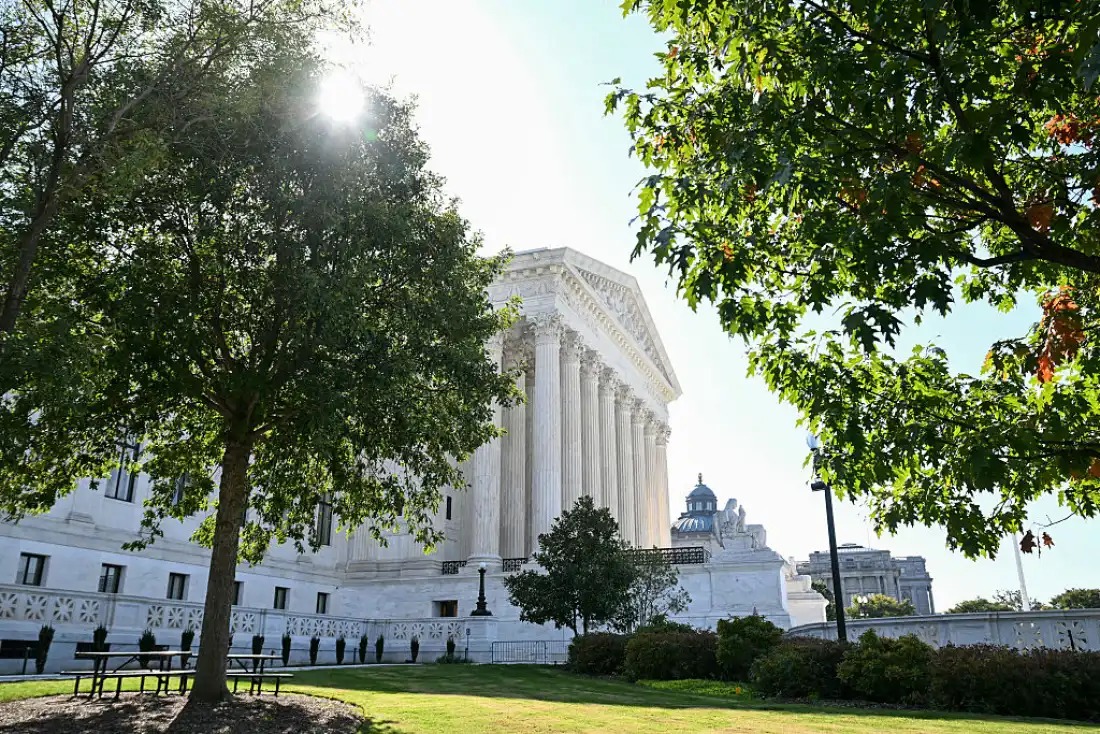
The Supreme Court in Washington, D.C., recently heard arguments concerning a case involving the Catholic Church and Colorado’s taxpayer-funded preschool program for all 4-year-olds. The central issue is whether religious schools can deny admission to children of gay and trans parents, which would conflict with a state law prohibiting such discrimination.
The Bill of Rights begins with: “Congress shall make no law respecting an establishment of religion, or prohibiting the free exercise thereof.” This clause has long been interpreted to uphold a separation of church and state. This interpretation shifted about a decade ago with the Supreme Court’s conservative majority focusing on the free exercise of religion.
Michigan State University law professor Frank Ravitch highlights a significant doctrinal shift where the court’s emphasis has moved away from separation towards the free exercise of religious beliefs.
A historic example includes the Supreme Court’s 1983 decision, with an 8-to-1 vote, to strip Bob Jones University of its tax-exempt status. This was due to the university’s policies against interracial dating and marriage, which were deemed discriminatory.
Douglas Laycock, an emeritus law professor from the University of Texas at Austin, notes the uniqueness of race in U.S. history with 250 years of slavery and a civil war, unlike other groups. He acknowledges the Denver Archdiocese is practicing discrimination by citing it under religious rights.
The Supreme Court currently focuses on religious rights against state and federal laws banning discrimination based on race, sex, religion, and other protected categories. In Colorado, this relates to a universal pre-K education program ensuring access for all children, funded through a tobacco tax with a $6,300 annual benefit per child.
Colorado’s program is broad, encompassing religious schools if compliant with the anti-discrimination law. Emily Sirota, a sponsor of the universal pre-K bill, emphasizes the state’s goal of giving parents extensive choices for their 4-year-olds’ education.
Despite initial support, the Denver Archdiocese challenged the inclusion requirement, with representation from the Becket Fund for Religious Liberty. Mark Rienzi argues that the law unfairly discriminates against religious schools for their beliefs.
Contrastingly, Tim Uhl, interim director at Notre Dame High School, supports the law, highlighting the educational value of embracing diverse opinions.
However, Archbishop James R. Golka argues against the law, citing a 20% enrollment drop and closures of preschools serving minority and low-income families. He warns of cultural implications, stating that secularism threatens religious education.
The Supreme Court’s decision could reframe religious rights. The conservative majority, including Trump’s appointees, has been leaning towards expanding religious rights.
Berkeley Law School dean Erwin Chemerinsky raises questions about the extent of court intervention in supporting religious school funding and whether taxpayer money will extend to religious charter schools.
Notably, charter schools are publicly funded but operate independently. The recent approval of a taxpayer-funded Jewish charter school in Oklahoma by a federal district judge could set new precedents.
The Supreme Court’s ruling on the Colorado case will potentially broaden the scope of religious funding and charter school policy.