
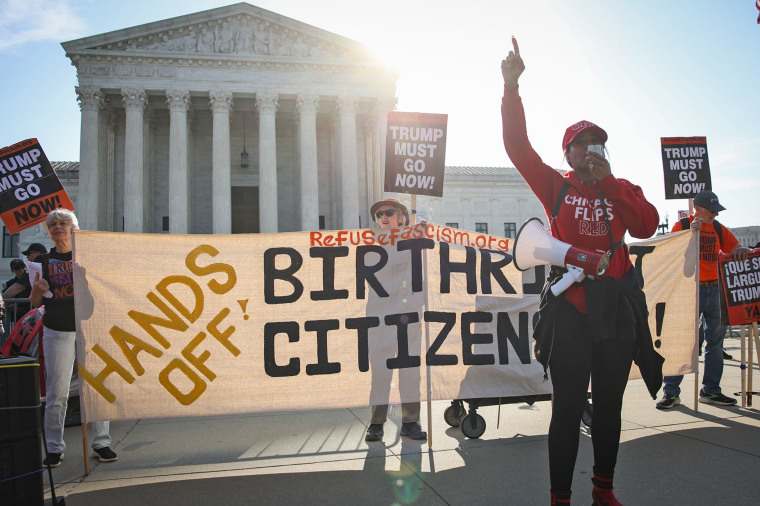
The Supreme Court has halted President Donald Trump’s controversial attempt to restrict birthright citizenship for those born in the U.S., handing him a significant defeat. The court, in a 6-3 ruling, declared the executive order from Jan. 20, 2025 — the start of Trump’s second term — unconstitutional.
Five justices agreed that Trump’s directive contradicted the 14th Amendment of the Constitution, which has consistently been interpreted to grant citizenship to nearly anyone born in the U.S. Brett Kavanaugh, a conservative justice, believed the order breached federal law but not the Constitution.
The defeat marks the third major Supreme Court setback for Trump recently, following the February decision overturning his extensive tariffs and Monday’s ruling prohibiting him from swiftly removing Lisa Cook from the Federal Reserve.
Chief Justice John Roberts, writing for the majority, commented that the Trump administration provided insufficient evidence to support its reinterpretation of established law. According to Roberts, “Citizenship, both then and now, defined the right to have rights — to fully engage in our political community.” He emphasized that the 14th Amendment, established post-Civil War, was designed to guarantee such rights to all, including former slaves.
Three conservative justices — Clarence Thomas, Samuel Alito, and Neil Gorsuch — favored Trump’s stance, arguing that the 14th Amendment could accommodate his executive order.
The 14th Amendment states: “All persons born or naturalized in the United States, and subject to the jurisdiction thereof, are citizens of the United States.”
Trump’s proposal sought to limit birthright citizenship to children with at least one parent as a U.S. citizen or permanent resident, excluding children born to temporary visitors or those who entered illegally.
Thomas, in his dissent, indicated that the amendment principally addressed Black people formerly enslaved, stating, “Blacks were entitled to citizenship due to being Americans. They lacked any foreign allegiance.” He argued this couldn’t apply to children of foreign visitors.
The executive order didn’t go into effect, as lower courts quickly blocked it post-signature.
Cecillia Wang, the ACLU’s National Legal Director, praised the ruling, stating, “The court’s decision upholds a fundamental American promise — birth equates citizenship. A president can’t alter the Constitution via executive action.”
The 14th Amendment’s applicability to U.S-born individuals, barring exceptions like diplomat’s children, has been a century-old assumption. Moreover, a similar phrase, “subject to the jurisdiction thereof,” appears in a federal immigration law established later.
An 1898 Supreme Court decision in United States v. Wong Kim Ark affirmed this interpretation, recognizing a man born in San Francisco to Chinese parents as a U.S. citizen.
Civil rights groups and liberal states, opposing Trump’s order, raised challenges in various courts, and each court ruled against the administration.
In December, the Supreme Court agreed to review a New Hampshire case, with ACLU representing affected individuals, including newborns potentially impacted by the executive order.