
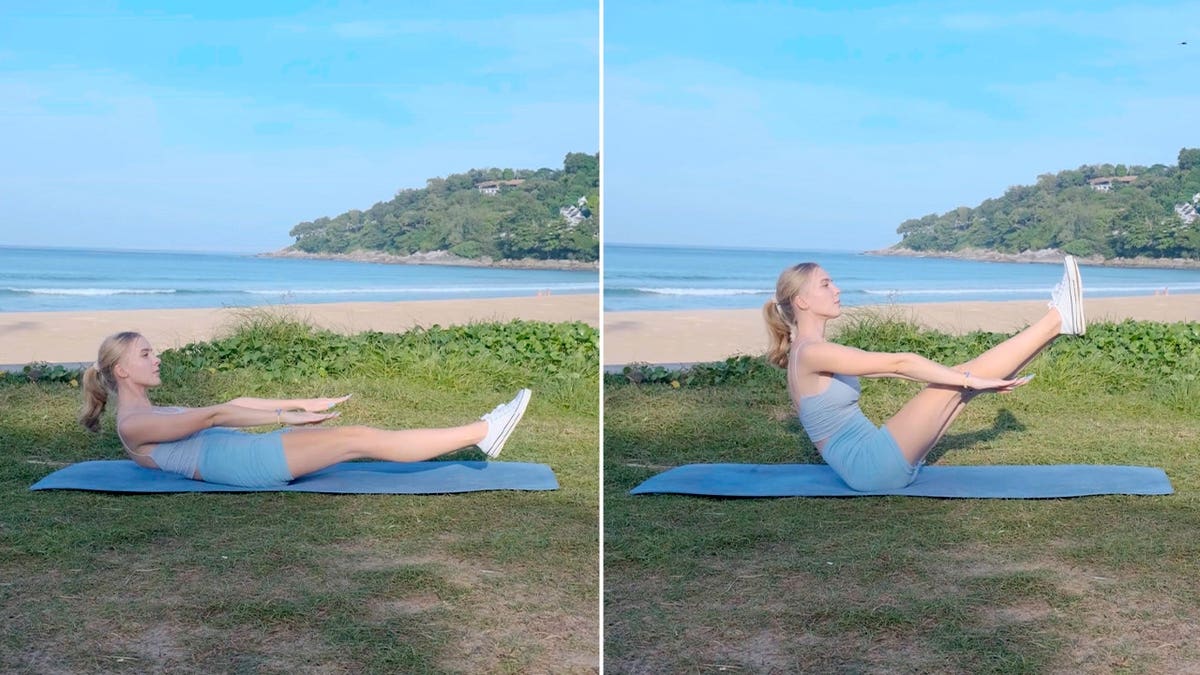
Strengthening your core enhances balance and stability, essential for movement and physical performance. Experts advise that while traditional abdominal exercises help, certain yoga poses offer additional advantages.
Benefits of Boat Pose
The boat pose, also known as Navasana, challenges multiple muscles involved in core stability. Melissa Leach, a certified yoga instructor and strength coach, highlights its importance. A strong core forms the basis for effective exercise and daily activities.
Leach notes that abdominal exercises target key muscles such as the obliques, lower back, and deep stabilizers like the transverse abdominis. These muscles collectively stabilize your spine. This creates a foundation that allows for efficient force transfer between your upper and lower body.
A yoga instructor demonstrates boat pose, showcasing core engagement and muscle coordination. (Yoga-Go)
Core Muscle Engagement in Daily Activities
Routine activities, like carrying groceries or rising from a chair, rely on core muscles. These muscles stabilize the trunk, maintain balance, and support controlled movements.
A well-conditioned core can help reduce the risk of lower back pain. It improves spinal stability and provides control during lifting and demanding movements. While core strength isn’t the sole determinant of injury risk, it offers crucial support.
Functional Strength Development
Leach explains that the boat pose targets the abs while engaging hip flexors, glutes, and back muscles. This approach builds functional strength across the core rather than isolating one muscle group.
Compared to traditional sit-ups, which operate in one plane of motion, boat pose requires the entire core to balance and lift. This increases demands on stability, balance, and control.
Whether held static or performed dynamically, boat pose trains muscles crucial for spinal and pelvic stability. (iStock)
Steps to Perform Boat Pose
To safely and properly execute the boat pose, follow these steps:
- Position yourself on a mat or floor with bent knees and flat feet.
- Lean slightly back, maintaining a straight lower back.
- Lift your feet, ensuring shins are parallel to the floor; fully extend legs if possible.
- Reach arms forward, parallel to the ground.
- Engage core muscles to maintain balance.
An instructor demonstrates an active boat pose, showcasing dynamic core involvement. (Yoga-Go)
Modifications for Beginners
Leach suggests modifications for those new to the pose. Beginners can keep legs bent for half boat pose, reducing strain and effort.
- Hold thighs for added support and balance assistance.
- Sit on a folded blanket or cushion to tilt the pelvis forward.
- Situate the back close to a wall for reassurance without obstructing movement.
For seniors or individuals with limited core strength, try a chair-assisted version. Sit at the front of a sturdy chair, hold sides for support, lean back slightly, and lift feet a few inches. This facilitates engagement without the need for unsupported balancing.
This method allows progression to floor-based versions as stability improves. (iStock)
Angelica Stabile reports on lifestyle topics for Fox News Digital.