
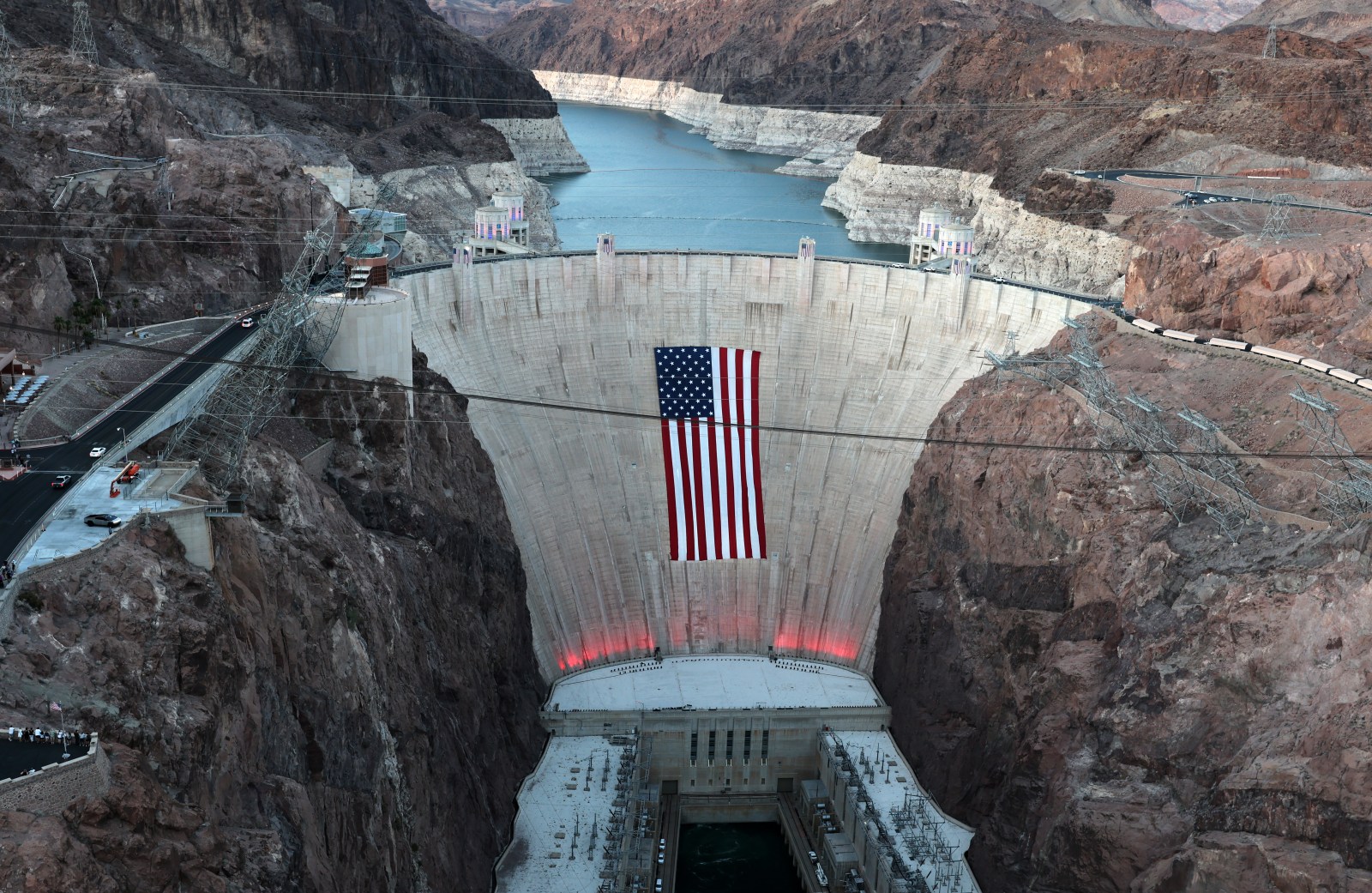
Negotiations over the future operations of the Colorado River remain unresolved. Water levels at key reservoirs, Lake Mead and Lake Powell, are far below historical averages. Policymakers, water managers, and researchers are considering various proposals to stabilize the river system.
Dwindling Water Levels
The reservoirs face pressure from over two decades of drought in the Colorado River Basin, with water demand consistently exceeding supply. The river is vital, irrigating millions of acres and supplying water to tens of millions in the Western United States.
As reported by the U.S. Bureau of Reclamation (USBR), Lake Mead is 27% full, and Lake Powell is at 23%. Compared to average water storage for this time of year, these levels are notably low, at 46% and 34%, respectively.
Decreasing reservoir levels raise concerns about hydropower generation. Glen Canyon Dam at Lake Powell and Hoover Dam at Lake Mead are significant electricity sources, and lower water levels can impact power generation capabilities.
Water Savings Initiatives
Arizona, California, and Nevada proposed a plan to conserve up to one million acre-feet of Colorado River water through 2028, complementing existing reduction commitments by these states and Mexico. This collective effort aims to save 3.2 million acre-feet—enough for over 25 million people annually.
The plan entails Arizona and Nevada using about a third less water than their Lake Mead entitlements, while California would reduce its use by roughly 13%, given its senior water rights.
Impact on Agriculture
Agriculture plays a crucial role in water management, accounting for about three-quarters of direct human water use and over half of the total water usage in the basin. According to a 2024 study, agricultural productivity in the basin must undergo changes.
Experts stress that urban water conservation alone cannot rectify the supply-demand imbalance. Agriculture must be a part of any effective reduction strategy, even though permanent cuts face political challenges.
Strategies like compensated fallowing and crop diversification—shifting away from water-intensive crops—are being explored. The Colorado River Resilience project suggests less water-intensive crops, improved irrigation infrastructure, and voluntary fallowing as measures to alleviate strain on the system.
In Southern California’s Imperial Irrigation District, farmers have discussed paid conservation programs. However, some express that current compensation is insufficient to offset the cost of reduced crop production.
Proposal to Drain Lake Powell
An alternative strategy might involve transferring water from Lake Powell to Lake Mead, retiring Lake Powell as a primary reservoir under a plan known as “Fill Mead First.” This would mean moving water from Lake Powell to Lake Mead in stages.
Proponents argue this could protect the environment and infrastructure of the Colorado River system by concentrating most long-term storage at Lake Mead. Doing so requires substantial engineering changes at Glen Canyon Dam.
Desalination and Water Recycling
Federal and state agencies are assessing if desalinated seawater could alleviate pressure on the river system. A memorandum of understanding was signed to explore interstate water exchanges involving desalinated or recycled water.
This approach doesn’t involve building new pipelines. Instead, it could employ existing infrastructure to manage water transfers on paper, optimizing resources without costly new systems.
Wastewater recycling is another potential solution. A UCLA report found that, on average, 26% of municipal wastewater was recycled in the Colorado River Basin in 2022, with significant variation among states. Increasing this reuse could significantly contribute to addressing water shortages.
Cloud Seeding
Cloud seeding aims to enhance snowfall in areas feeding the Colorado River. The program uses propane generators to release silver iodide into winter storms to increase ice crystal formation, potentially boosting snowfall by up to 15%.
Proponents note that cloud seeding has been part of water management efforts for years. It can potentially add up to 80,000 acre-feet of water annually once snow melts.
The Mojave Desert Water Pipeline
Cadiz Inc. proposes an initiative to pump groundwater from the Mojave Desert for use in the Southwest. This project recently advanced when the Bureau of Land Management approved a plan to convert an old pipeline for water transport, though environmental concerns remain.
Critics argue that the project poses risks to the desert ecosystem and does not directly address the Colorado River’s systemic issues.