
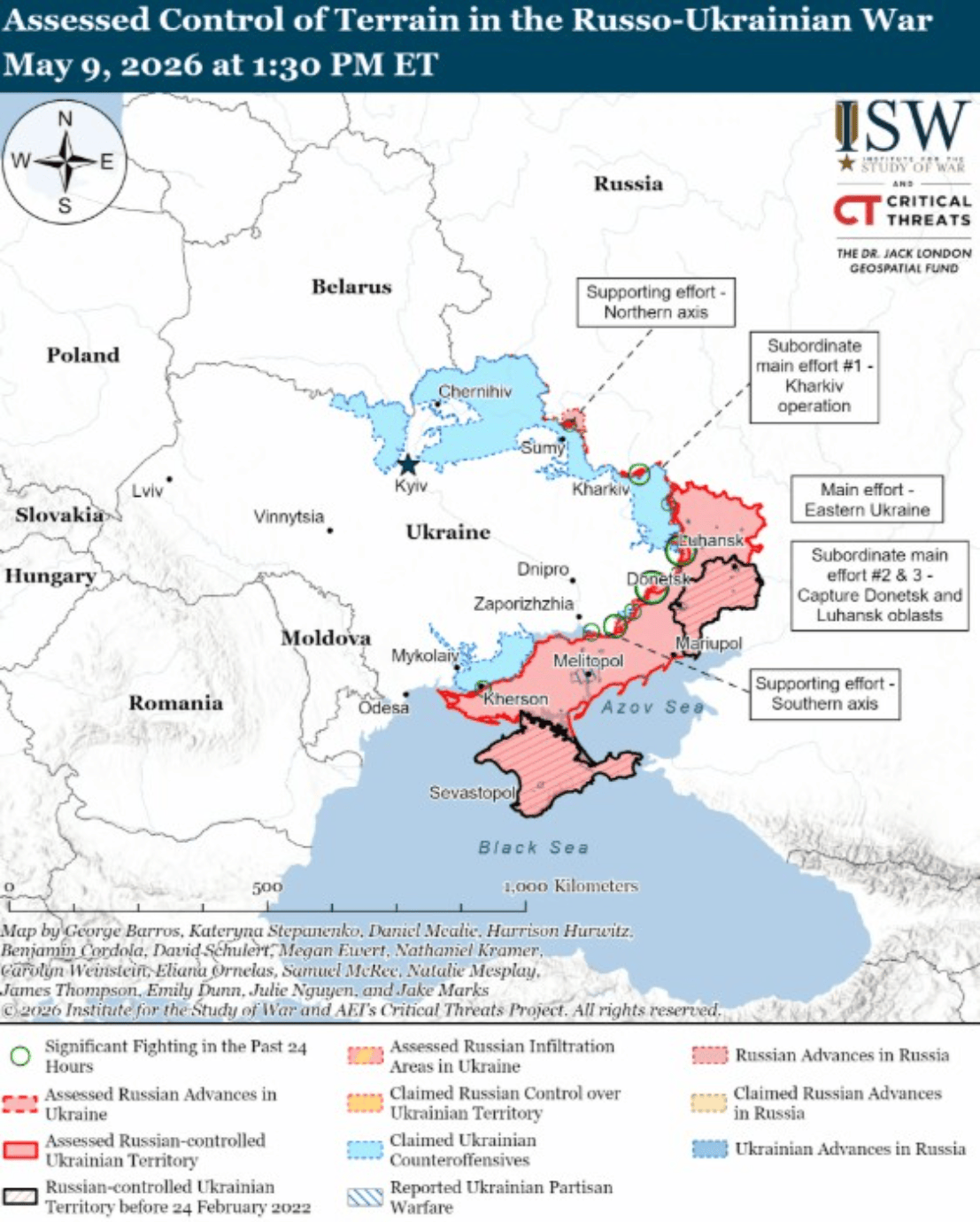
New geographical data highlight minimal changes in the Russia-Ukraine frontlines from May to November. Despite earlier claims of a possible end to the conflict, talks in Abu Dhabi have not yielded significant diplomatic results. Russian President Vladimir Putin suggested in May that negotiations might open the path to new security arrangements for Europe, yet progress remains elusive.
Over six months later, no advancements on the battlefield or in diplomatic relations have emerged. However, negotiations have led to an agreement on a large prisoner exchange between Russia and Ukraine. U.S. diplomats Jared Kushner and Steve Witkoff plan to meet Putin, but the core issue persists: Moscow demands Ukraine’s withdrawal from the Donbas region, a move Kyiv finds unacceptable.
“On the political questions that will determine whether the war ends, however, there was no visible movement,” explained Mark Temnycky, a nonresident fellow at the Atlantic Council’s Eurasia Center.
Maps published by Washington, DC’s Atlantic Council show a stable frontline with Ukraine launching “Operation Vivaldi” in May to counter Russian advances. The operation halted Moscow’s encirclement attempts of the heavily defended cities known as the “Fortress Belt.”
By late 2026, the Ukrainian counteroffensive led to territorial gains around Kupyansk, Oleksandrivka, and Lyman, causing losses for Russia in areas such as Donetsk, a significant target for Kremlin due to its location in the Donbas region.
Giorgi Revishvili, a military analyst, noted Ukraine’s position along the front line had improved compared to the last two years, stabilizing the front. Ukraine marked net gains in February, May, and October 2026. Russian troop losses stood at a record 54,000 in October.
“Putin and Russian political-military leadership continue to set unrealistic military objectives,” commented Revishvili.
Revishvili attributed Ukraine’s success to increased emphasis on controlling operational depth. Efforts focused on impacting Russian logistics centers and disrupting Russia’s ability to sustain operations.
Outcomes from Abu Dhabi Talks
Rustem Umerov, Ukrainian delegation leader, acknowledged an agreement on prisoner swaps and preliminary steps toward broader peace. However, major differences still separate the warring parties. Temnycky remarked the prisoner exchange agreement is vital for Ukrainian families and exemplifies the potential for humanitarian results.
Kyiv aspires to use the discussions to establish ceasefires and eventually pursue a peace summit involving leading figures. Future talks between Witkoff, Kushner, Putin, and Ukrainian President Volodymyr Zelensky are expected to clarify the pathway forward. Temnycky suggested any lack of Russian concessions may prompt the U.S. to reconsider its approach to negotiations.