
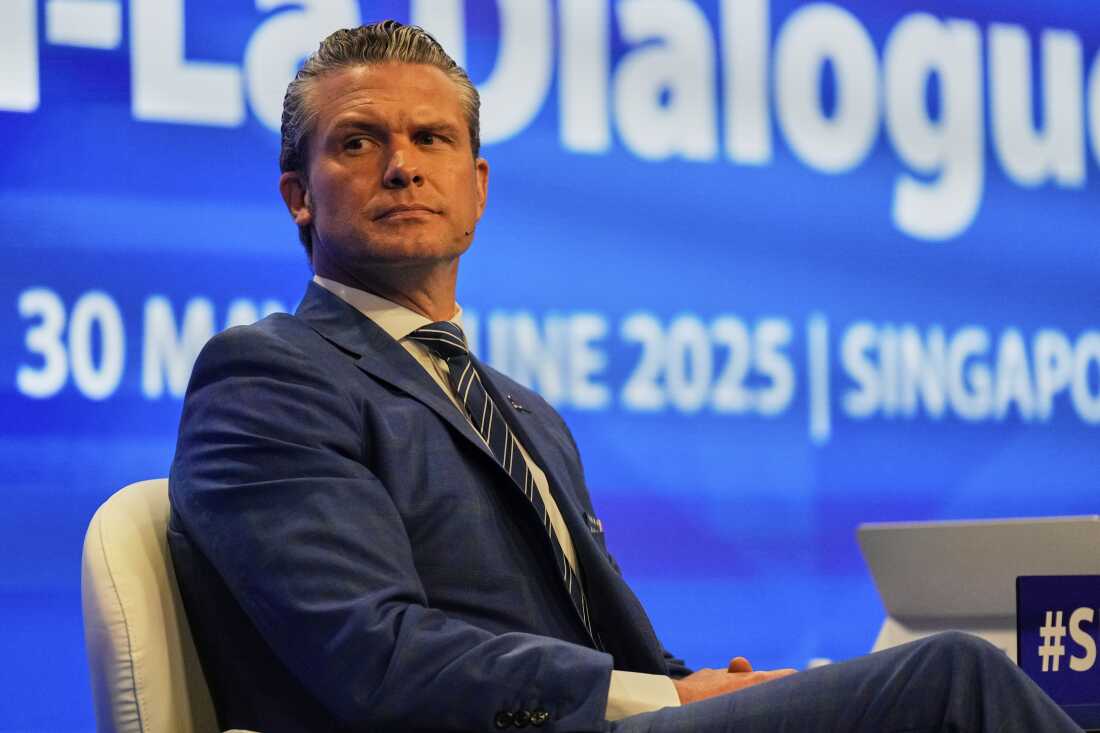
Defense Secretary Pete Hegseth addressed the Shangri-La Dialogue summit in Singapore, urging Asian allies to boost military spending amid China’s growing military activities. Notably, he did not mention Taiwan in his speech, despite regional anxieties about China’s intentions.
Hegseth’s comments follow a recent meeting between President Donald Trump and China’s Xi Jinping in Beijing, described as successful by both parties. Hegseth said that while U.S.-China relations have improved, there remains concern over China’s military operations.
“A Pacific dominated by any hegemon would unravel the regional balance of power and undermine the equilibrium we all seek to preserve,” stated Hegseth to an audience of military and diplomatic officials.
This marks Hegseth’s second attendance at the Asian defense forum. In his previous year’s address, he warned of China’s aspirations to dominate the region. Then, he explicitly criticized China’s treatment of Taiwan, referring to it as harassment.
Post-Trump’s Beijing visit, the president caused alarm with remarks suggesting U.S. support for Taiwan might be reconsidered. Arms sales to Taiwan were described as a strategic leverage point with China. An official later mentioned a pause in these sales due to conflicts in Iran.
Ankit Panda of the Carnegie Endowment for International Peace noted that Hegseth’s speech offered little clarity on Taiwan and Iran. Hegseth reassured the audience of sufficient U.S. weapon stockpiles and stated that future arms sales depend on President Trump’s decision, asserting no change in policy.
Regarding the Middle East, Hegseth echoed Trump’s stance. No deal with Iran would proceed unless it prevented nuclear weapon development. The U.S. remains ready to resume strikes on Iran if necessary, following recent military actions.
Despite expressing enhanced U.S.-China relations, Hegseth acknowledged the ongoing strategic rivalry. Uncertainty looms over how tensions between these powers can be mitigated, a concern echoed by regional countries.
Vietnam’s President To Lam warned of the dangers of “unchecked competition,” emphasizing the need for cooperation over conflict in his speech.
“I think the pathway to avoiding conflict between these two countries remains entirely unclear,” observed Panda, critiquing Hegseth’s focus on dominance and power without offering a clear path to peace.
China, opting not to send its defense minister again, dispatched a group of military experts instead. Zhou Bo, a retired senior colonel, noted Hegseth’s speech was more restrained compared to his previous address. He underscored the importance of Hegseth affirming Trump and Xi’s commitment to a “constructive, strategic partnership,” recognizing China as an equal power.