
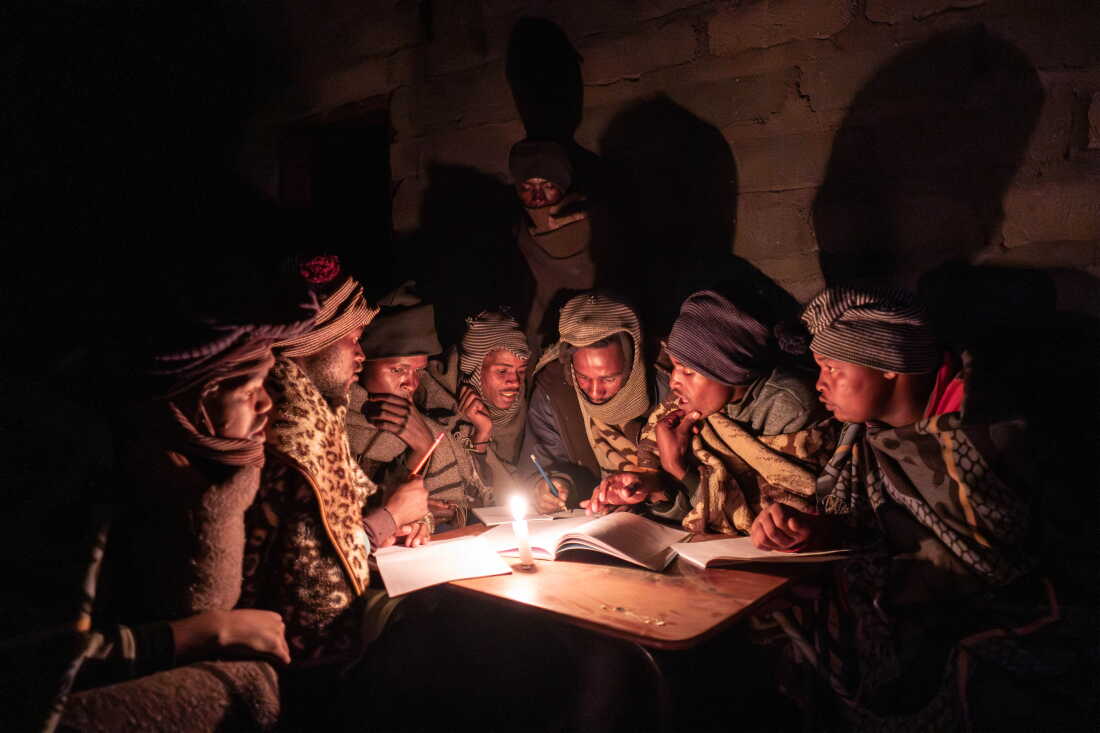
In the highlands of Lesotho, shepherds attend a night school near Mokhotlong. For many of them, these classes are the sole source of education. As the sun sets behind the peaks of central Lesotho, Kabelo Mohai and Lepeli Maapesa begin their long trek to school. Wrapped in wool blankets to shield them from the chill, they navigate rocky paths nearly 8,000 feet above sea level. Far below, rural villages look like tiny specks.
An hour and a half later, under the high moon, they see the distant glow of Semonkong. In the darkness, similar figures make their way down the mountains, singing and chatting on their journey to the Good Shepherd School. Every evening, more than 40 herders gather here for night classes.
Mohai and Lepeli are among the many shepherds in Lesotho, a nation where livestock plays a significant role in the economy. Wool and mohair make up nearly 60% of agricultural exports and support a quarter of the rural populace. Poverty and tradition often compel school-aged boys to tend flocks, keeping them isolated in the mountains. A World Bank report from 2018 revealed that nearly half of all boys in Lesotho engage in herding, often at the cost of their education.
“I started working with animals at the age of 9, and I only finished primary school,” Mohai, now 20, shares. “I want to learn so that I can have a better future.”
To provide education opportunities, several dedicated schools have emerged, operated mainly by volunteers on limited budgets. Classes focus on basic skills like reading, writing, and arithmetic but face financial challenges. For many, these schools are a rare opportunity to envision a different future.
In his early teens, Mohai moved to a cattle post to live with his family’s flock. His isolated shelter contains basic necessities and a dog named Balireng. Despite the solitude, Mohai enjoys the freedom but acknowledges the hardships of mountain life.
Lesotho, known as the “Kingdom in the Sky,” sits entirely over 1,000 meters (3,281 feet) above sea level. Snow is common in winter, while summers can be harsh. Shepherds face these conditions daily, often feeling disconnected from society.
At the age of 15, Mohai found the Good Shepherd Night School and embraced the chance to return to education. Each day after herding, he walks to his Grade 7 class, aiming to improve his skills and pursue his dream of becoming a soldier.
By 8 p.m., the classroom at the Good Shepherd Night School is full. Students dressed in traditional attire study math under the guidance of Sister Rosemary Mokebe.
The night school, founded in 2003 by the Good Shepherd Sisters, serves as a vital educational resource. Mokebe’s efforts focus on teaching basic skills, providing a chance for herders to step out of darkness.
Lesotho government records list about 155 such schools nationwide. Initially supported by NGOs, the Ministry of Education now aims to formalize these volunteer-run classes, although progress faces administrative hurdles.
Despite challenges, the convent in Semonkong has continued its classes for decades. Sister Patricia Neko leads a class with students ranging from young boys to older men. Among them is Motlatsi Monoana, who, due to illiteracy, has faced exploitation and legal troubles.
Monoana, eager to find a path beyond herding, expresses the difficulty of learning at an advanced age. Yet, he holds hope for his future outside herding.
One young student, Ketso Mokoena, managed to continue his education despite difficulties. Once bullied for his background, Mokoena’s determination saw him complete secondary education, with aspirations to study chemistry and physics.
While many herders may not achieve a high school diploma, these schools offer more than education. They provide a space for young boys to socialize and develop outside the isolation of herding life. Former LANFE head, Lisemelo Mosakeng, emphasizes the importance of these social skills in resolving conflicts and reducing violence.
The schools also host programs addressing health issues like HIV and tuberculosis, crucial for the boys’ development.
Elsewhere in Lesotho, teacher Mampho Makha witnesses firsthand the impact of education on her community. Inspired by a personal family experience, she runs two night schools, offering life-changing literacy skills to her students.
Makha’s resolve has remained firm despite financial uncertainties, providing dedicated support to those eager to learn. Her students face challenges, including limited resources and basic conditions, but persist in their pursuit of education.
As night classes end, and the students return home, Makha, along with her flashlight, faces another journey home. Her commitment to education remains steadfast, as she continues serving her community.