
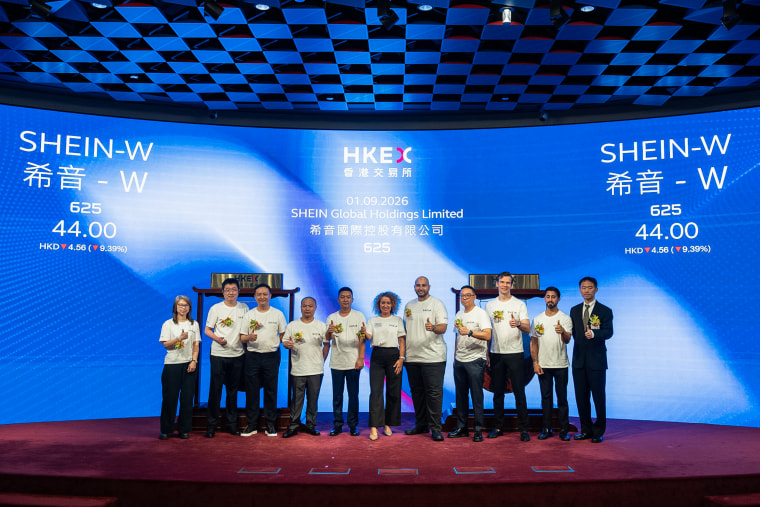
Shares of online fast-fashion retailer Shein dropped by 8% during their first day of trading in Hong Kong on Tuesday. Concerns regarding the company’s previous setbacks, which delayed its listing, appear to have impacted investor sentiment. Shein is known for selling budget-friendly apparel, like $5 tops and $10 dresses.
The retailer faced challenges due to changes in tariffs and duties in the U.S. and Europe. These difficulties, alongside scrutiny of its business practices, hindered attempts to list the company in New York and London. Both listing attempts were blocked by Chinese authorities.
Shein’s stock traded around 44.6 Hong Kong dollars ($5.68) in morning trade, giving the company a market valuation of approximately $24 billion ($3 billion). This is significantly lower than its 2022 valuation peak of nearly $100 billion ($12.8 billion). Meanwhile, the Hang Seng Index in Hong Kong fell by 0.6%.
At the opening ceremony, Shein’s Chief Financial Officer, Leigh Gui, stated that the company intends to continue innovating and optimizing its collaboration with supply chain partners.
As a new company listed in Hong Kong, we will continue to innovate, optimize and cooperate with our supply chain partners for mutual benefit and win-win results,Gui said.
Founder and CEO Sky Xu did not speak at the event, though he later posed for pictures with employees. He declined to answer questions from Reuters.
Charu Chanana, chief investment strategist at Saxo, commented that despite a significant reduction in Shein’s valuation, investors still do not perceive the stock as undervalued.
I think the weak debut shows that even after the huge valuation reset, investors still don’t see Shein as obviously cheap,Chanana noted.
The company was evaluated at 15 times its forward earnings, significantly higher than the valuation for PDD, which owns competing brand Temu. Investors are paying a premium for Shein, despite uncertainties in growth and risks related to regulations and trade.
Shein’s IPO demand was less compared to those in the AI and robotics sectors. The retail segment was subscribed 5.63 times, while the international segment was subscribed 2.59 times. Cornerstone investors accounted for about one-fifth of the IPO, with their holdings locked up for six months, leaving around 5% to be freely traded.
Recent regulatory changes have hurt Shein’s model. In 2022, the U.S. ended the duty exemption for e-commerce shipments under $800, impacting direct shipping. The European Union also imposed fees on low-value packages. Consequently, Shein’s net income dropped by 39% last year, and the company reported a loss in the first quarter.
Slein anticipates its first-half operating profit margin will be slightly lower than in the first quarter. This forecast comes amidst higher costs related to customs duties, tariffs, fees, and logistics in Europe and the Middle East.
Lorraine Tan, director of equity research at Morningstar, mentioned that new markets might help counteract slow growth in the U.S. and Europe, although spending power in developing areas might remain limited, especially if delivery costs remain high.
New markets could help offset slower growth in the U.S. and Europe, but lower spending power in developing markets may limit the benefit if delivery costs stay high,Tan said.
Shein seeks to expand beyond its ultra-cheap fast-fashion offerings. The company has developed its third-party marketplace and acquired U.S. apparel brand Everlane in May. It has also diversified by purchasing brands like French Pimkie and British Missguided in 2023.
The IPO served to compensate early investors who had invested at higher valuations. Shein agreed to make cash payments totaling about $3.5 billion and share adjustments for certain preferred shareholders.
Jianggan Li, CEO of consultancy Momentum Works, commented on the broader implications of the IPO.
This IPO is not just a fundraising event — it is also, and probably more of, a capital-structure event,Li stated.