
Senate Republicans successfully united to advance President Donald Trump’s $70 billion package for immigration enforcement, although internal divisions over his agenda surfaced after a lengthy day of votes. This budget reconciliation package focuses on financing Immigration and Customs Enforcement (ICE) and Border Patrol for the next three and a half years, concluding a prolonged Senate debate that began during the longest government shutdown in history.
Throughout the day, Senate Republicans highlighted a key point that Senate Minority Leader Chuck Schumer, D-N.Y., and Democrats had pressured them into this situation by refusing to fund immigration initiatives without a range of reforms. Senate Majority Leader John Thune, R-S.D., stated, ‘Democrats would not agree to anything, and eventually they walked away altogether, presumably because they thought that it would serve them better to have an issue for November.’
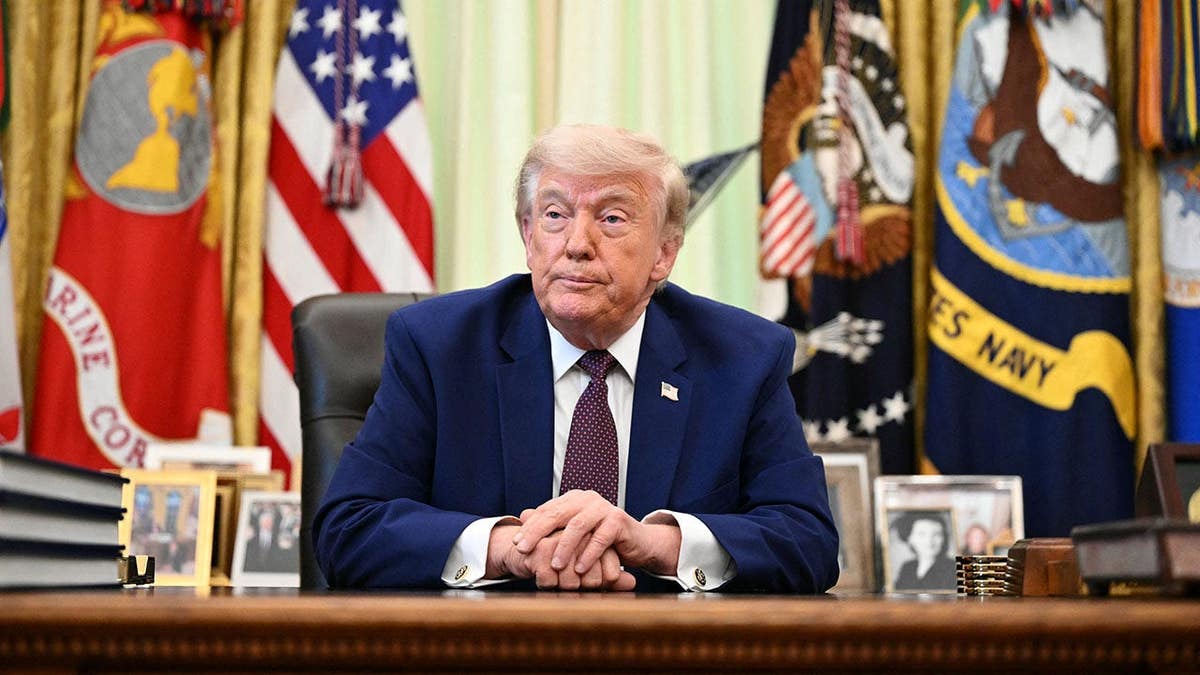
President Donald Trump addresses the press in the Oval Office on June 3, 2026. (Mandel Ngan/AFP)
The proceedings revealed a growing divide between Senate Republicans and the Trump administration, posing a risk to the legislative process. Initially, the inclusion of $1 billion for security updates to Trump’s ballroom was a point of contention, eventually removed from the package.
The Department of Justice’s (DOJ) announcement of a nearly $2 billion ‘anti-weaponization’ fund also contributed to turmoil. This fund was meant to assist individuals who felt targeted by the government, stirring concern among several Senate Republicans regarding its potential misuse by Jan. 6, 2021, rioters convicted of assaulting police.
Schumer and Democrats seized this issue, seeking to abolish the fund permanently, despite Acting Attorney General Todd Blanche’s promise that the administration would cease pursuing it. Schumer questioned Trump’s integrity regarding the fund, stating, ‘Do we believe that Donald Trump, who has lied to us day in and day out, will be able to resist getting his sticky fingers in the slush fund when it would benefit himself and his family? No way.’
Senate Health, Education, Labor and Pensions Committee Chairman Bill Cassidy questions National Institutes of Health Director Jayanta Bhattacharya during a hearing on February 3, 2026. (Chip Somodevilla/Getty Images)
Amendments proposed by Democrats put Republicans facing reelection, such as Sens. Susan Collins, Jon Husted, and Dan Sullivan, in challenging positions. Republicans also sought to eliminate the fund, leading to increased tension on the Senate floor. Sen. John Kennedy, R-La., commented on the situation, saying, ‘It’s not that tense. I mean, I’ve seen worse. Nobody’s stabbed anybody yet.’
At the outset of the vote marathon, efforts led by Sen. Bill Cassidy, R-La., aimed to ensure GOP proposals to end the fund would be voted upon. Cassidy said, ‘I just wanted to optimize the chances of success.’
In the end, despite a dozen Republicans supporting Sen. Thom Tillis’ amendment, all efforts to prevent future attempts to restart the fund were unsuccessful. Additionally, the ballroom issue resurfaced when six Republicans joined Democrats to block its construction without congressional approval.
Further complications arose with Sen. Lindsey Graham’s attempt to add the SAVE America Act to the package, which faced Republican opposition and was ultimately unsuccessful. The package now moves to the House, where Republicans anticipate passing it by week’s end.
Alex Miller is a writer for Fox News Digital, focused on covering the U.S. Senate.