
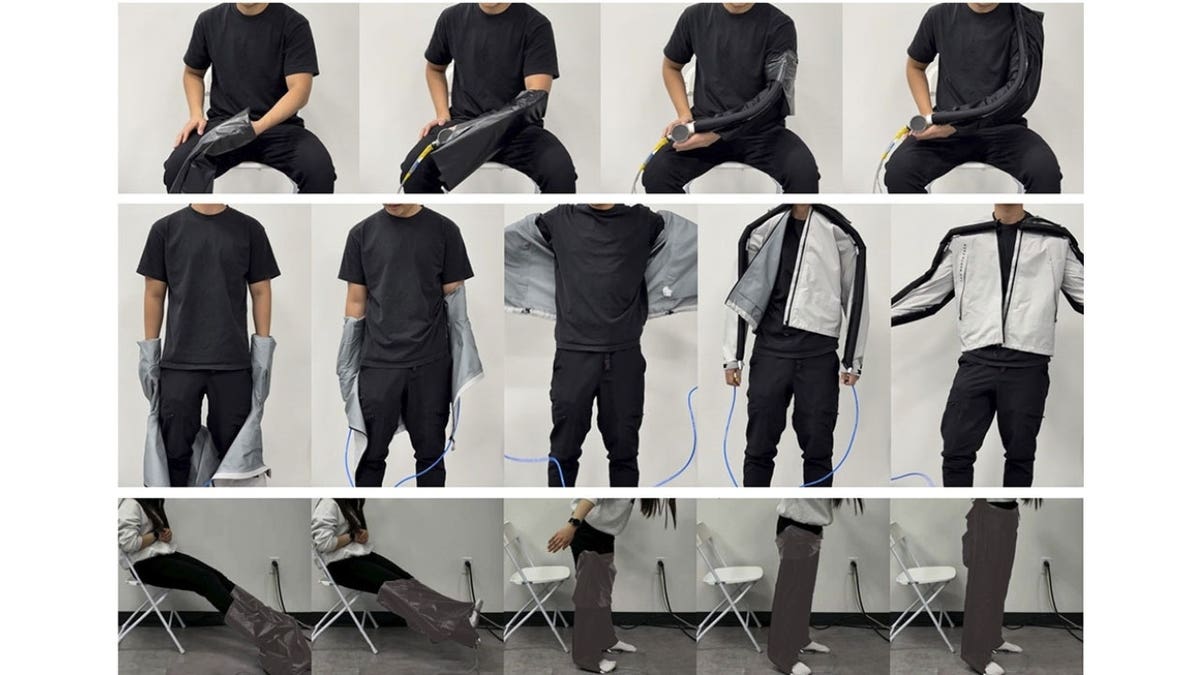
Most people don’t think about the effort involved in getting dressed each day. Yet, tasks as simple as putting on a shirt can be challenging for individuals with shoulder stiffness. Balance issues can add stress to wearing pants. This is where South Korea’s KAIST and Stanford University’s new innovation becomes noteworthy.
Researchers have developed self-dressing clothes using soft, air-driven robots embedded in the fabric. These garments activate and move along the body, helping position themselves as the wearer moves. Although this technology is still in its research phase, it hints at how future clothing might aid older adults in dressing independently, potentially extending their ability to live autonomously.
How Self-Dressing Technology Operates
The self-dressing system integrates soft, air-powered robots to guide clothing such as sleeves, jackets, and pants around the body. These mechanisms assist individuals with limited mobility, including the elderly and those recovering from surgeries.
Stanford University emphasizes the significance of dressing assistance for future home robots, suggesting that assistive technology could help older adults remain in their homes as their need for caregiving grows.
Challenges in Traditional Dressing Methods
Many aspects of dressing demand more movement than people might realize. Tasks like reaching behind the body, lifting arms, and shifting weight are common. Conditions like arthritis can aggravate these activities by making gripping and pulling clothes painful.
Shoulder problems may restrict reach, while recovery from hip or knee surgery can limit bending. Balance issues are another concern; pulling on pants often requires standing on one leg or bending over. Self-dressing clothes may reduce some stretching and reaching, though researchers need clinical studies to test its effectiveness for those with real mobility limitations.
Robotic Clothing Design by KAIST and Stanford
Called SWAG—Self-Wearing Adaptive Garment—the system utilizes flexible robotic tubes built into the clothing. As air pressure flows through, these tubes unfold and extend along the body, progressively dressing the person.
The innovation allows the garment to adapt to the wearer’s shape, minimizing friction between fabric and skin. This soft robotic mechanism unfolds like plants growing, advancing from tips rather than dragging along its length.
Potential Uses for Self-Dressing Clothing
The technology primarily targets older adults and those with disabilities, offering rehabilitation patients temporary assistance post-injury. The applications extend beyond households. Industrial environments might adopt this technology first, with semiconductor workers donning cleanroom attire or emergency personnel quickly suiting up.
The air-powered garments may simplify the process of donning protective clothing without heavy reliance on the hands.
Remaining Hurdles for Robotic Garments
Though promising, the self-dressing system remains a prototype linked to a pneumatic base. There is no announced consumer price or release date. Questions remain around fitting various body shapes, movement compatibility, maintenance, and air power portability.
Future versions may employ elastic materials to accommodate more body types. Automating the garment-loading process and refining controls are goals of ongoing research.
Clinical trials with impaired mobility participants will be essential. This testing will confirm comfort, reliability outside labs, and future automated garment removal.
This technology provides a glimpse into how clothing might assist in preserving independence. Although not available for purchase now, its potential benefits are apparent, offering control over personal routines and reducing caregiver reliance.