
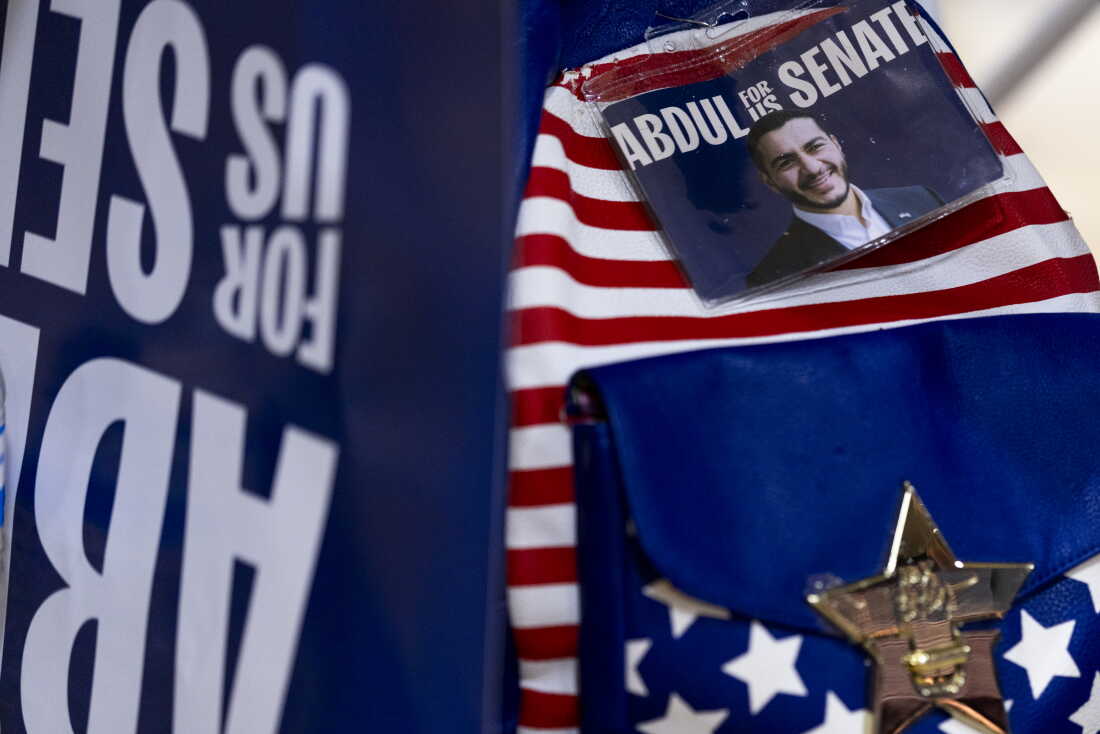
Expressions of support for Abdul El-Sayed, a Democratic Senate candidate, were visible during a town hall event in Waterford, Michigan, on September 3, 2026. Upon his primary victory, anti-Muslim rhetoric increased significantly, echoing reactions similar to those after New York Mayor Zohran Mamdani’s electoral win the previous year.
Alabama’s Sen. Tommy Tuberville immediately labeled El-Sayed a ‘terrorist,’ describing him as a ‘RADICAL ISLAMIST’ intent on harming America. This statement fits into a broader pattern of anti-Muslim and anti-Arab rhetoric that has intensified over the last two years.
Nazita Lajevardi, a political science professor at the University of Michigan, commented that what once was shocking racism in political discourse has become disturbingly common. Campaigns across the nation have utilized themes targeting ‘Radical Islam’ and ‘Sharia law’ with claims that ‘Islamic movements have taken a foothold.’
Although Muslims represent slightly over one percent of the U.S. population, the Center for the Study of Organized Hate (CSOH) notes a significant rise in anti-Muslim sentiment following El-Sayed’s primary win. CSOH’s analysis from February 2025 to March 2026 found that 46 GOP officials posted over 1,100 social media messages spreading bigotry and conspiracy theories about Muslim Americans.
Raqib Naik, CSOH’s executive director, remarked that social media amplifies fear-driven claims, translating into publicity, revenue, and influence for those pushing such narratives. He pointed out the shift from views of Muslims as security threats to civilizational threats, demonstrating the growing vitriol.
Posts from figures like Rep. Nancy Mace further exemplify the situation. Mace’s statement branding Muslims in public office as threats reflects a pervasive narrative among politicians. Former President Trump has also referred to Democrats electing ‘jihadists.’
Bo French, a Texas Railroad Commission nominee, perpetuates fears by discussing an ‘Islamic invasion,’ tying various conspiracy theories to the presence of Muslim communities.
Naik explains that these narratives stem from the ‘great replacement’ conspiracy, which falsely asserts white populations are being politically replaced by nonwhite groups. This belief has fueled violent attacks and is tied to broader claims against Muslims.
A focal point in Texas
Victories by Muslim politicians, like Mamdani and El-Sayed, are manipulated by GOP critics to present them as proof of infiltration or Islamification. The situation escalated in 2025 when Texas Gov. Greg Abbott shared claims about a Muslim development project in East Plano, portraying it as a ‘Sharia city.’
Sharia encompasses Islamic religious and ethical practices, not a legal imposition over U.S. laws contrary to GOP assertions. Abbott’s focus initiated investigations and lawsuits against the project, with Texas pushing an aggressive anti-Muslim legislative agenda.
The Republican Party of Texas adopted a platform resolution titled ‘Don’t Sharia My Texas,’ urging federal actions against Sharia law advocates. Abbott further targeted religious washing stations in airports arguing favoritism toward Islam.
The animosity signals to other GOP politicians this is a pertinent issue for their base. Maya Berry of the Arab American Institute notes that warnings about Islamification increasingly intertwine with fears of communism or socialism, demonstrating a strategic push to garner fear-based engagement.
Berry criticizes the agenda’s intellectual dishonesty and immoral impact, highlighting the harms inflicted on young Muslims as communities face increased scrutiny.
After Mamdani’s win, more Republicans joined the Sharia-Free America caucus, furthering divisive rhetoric. Rep. Andy Ogles faced backlash for commenting Muslims are unfit for American society, accentuating the narrative shift.
Berry observes a progression in public rhetoric from coded language denying bigotry to assertive claims about Muslims’ place in America. She contrasts these tactics with past incidents, such as President George W. Bush’s post-9/11 appeal to prevent scapegoating, emphasizing the consequences of current political strategies.
Despite political dynamics, the anti-Muslim rhetoric may backfire in areas like Michigan, impacting electoral campaigns aiming for diverse voter appeal. Lajevardi notes some Muslims and Arab Americans found previous Trump campaign messaging persuasive, but broad stigmatization erodes these connections.
Republican consultant Vinny Minchillo acknowledges the potent mobilizing effect of fear-based messaging for some voters. He outlines the strategic motivation to prioritize issues beyond economic concerns, capitalizing on emotive narratives in political communications.