
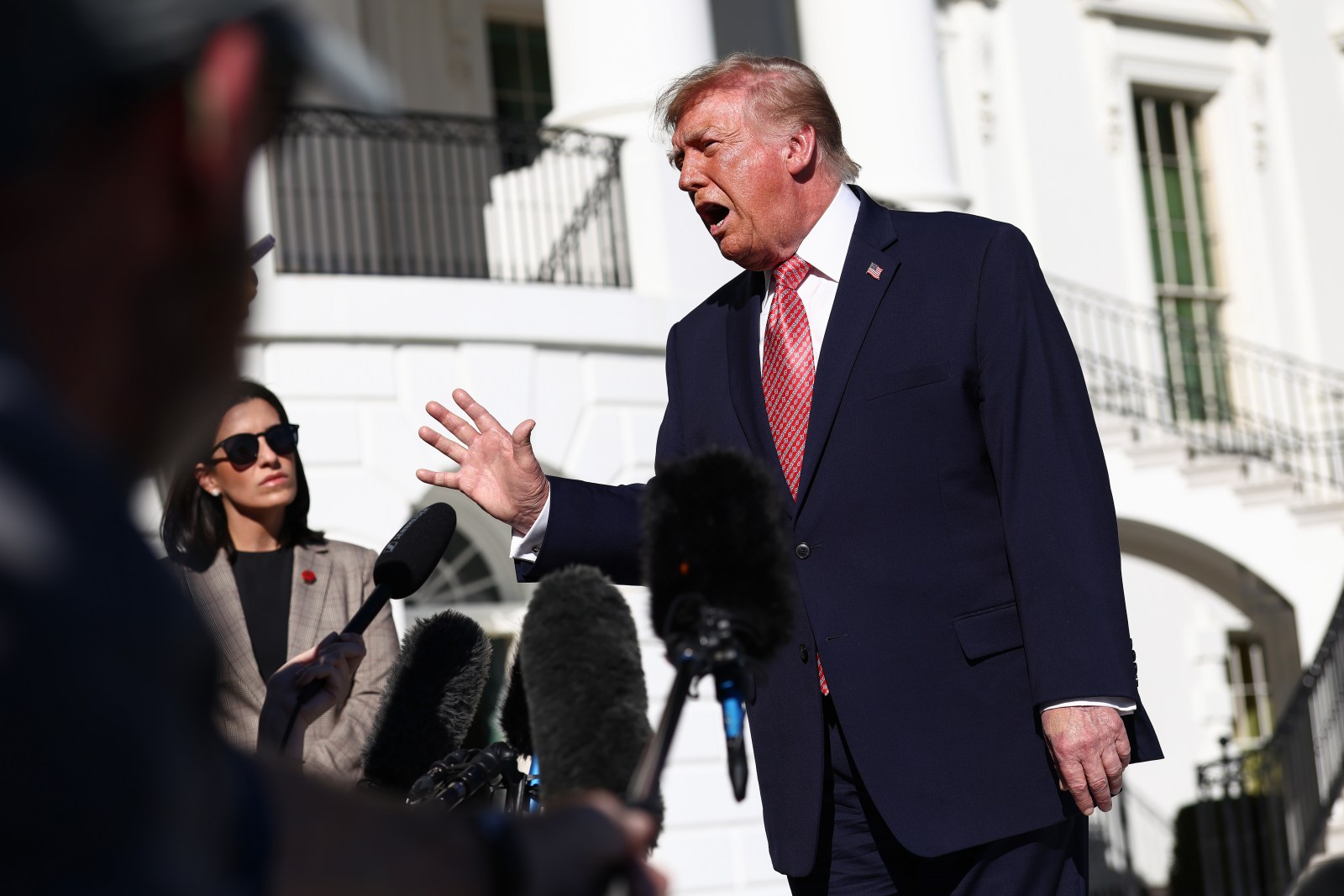
A significant number of Republicans are expressing unease with President Donald Trump’s decision to suspend new sanctions and tariffs targeting Russia. House Speaker Mike Johnson highlighted concerns about potential “unintended consequences” warned to the White House.
Trump issued an executive order on Friday that waived crucial measures under the Lindsey O. Graham Sanctioning Russia and Iran Act. This legislation, signed by Trump in September, aimed to intensify economic pressure on Moscow due to its involvement in Ukraine. Trump’s order states, “I am hereby waiving the application of such sanctions, restrictions, and duties provided for in the Graham Act.” He had informed Congress that the waiver served “the national interests of the United States.”
The Graham Act initially imposed a 500 percent tariff on Russian goods and considered 100 percent tariffs on goods from major buyers of Russian oil and gas. These measures were expected to start on October 18, 30 days after Trump signed the law. However, Trump’s waiver delayed these duties before their implementation. These waivers will hold until Trump or the Secretary of State decides that further action is necessary.
The current executive order does not affect earlier Russia-related sanctions. Moreover, this move has caused a rift within the Republican ranks; their criticism varies from strong condemnation to careful disagreement.
Trump defends the waiver as a negotiation strategy to end the war and to address elevated diesel and gasoline prices before the midterm elections. On Truth Social, Trump mentioned his efforts to negotiate peace in the Russia-Ukraine conflict and expressed his wish not to alienate Russia from negotiations.
This is how Russia responds to sanctions waivers and reduced pressure,” said Ukrainian President Volodymyr Zelensky on X, criticizing recent Russian drone attacks.
Energy Secretary Chris Wright supports the endeavor as a strategy to lower fuel prices, seeing it as a “carrot” to Moscow. However, opposition from within the U.S. and abroad continues to mount.
Key Republican Responses
House Speaker Mike Johnson
Johnson voiced his objections to the White House, urging them to weigh the possible outcomes of waiving these sanctions. He noted that while Congress decisively voted for sanctions, the White House should keep in mind Russia’s untrustworthy track record.
Mike Rogers
Senate candidate Mike Rogers from Michigan expressed his disagreement with Trump’s suspension of sanctions, stressing that he would have voted for stronger measures against Russia.
Senator Thom Tillis
North Carolina’s Thom Tillis labeled Trump’s decision as “beyond irresponsible,” emphasizing the need to enforce laws passed by the Senate and criticizing Trump’s stance as appeasing a “dictator.”
Senator Ted Cruz
Ted Cruz argued Trump made a misstep with the waiver. While acknowledging the effort to combat high fuel prices, Cruz pointed out alternative strategies exist that do not benefit Putin.
Senator John Cornyn
Echoing late Lindsey Graham’s efforts for stringent sanctions, Texas’s John Cornyn noted Graham would “be appalled” at Trump’s decision.
Senator Darline Graham
The successor of Lindsey Graham, Darline Graham, stated her desire to keep pressure on Russia, highlighting her distrust in Putin.
Representative Mike Turner
Mike Turner from Ohio advocated for utilizing the Graham Act sanctions. He advised a selective approach to waivers.
Senator Kevin Cramer
Believing the waiver’s pause won’t be long-lasting, North Dakotan Kevin Cramer aligned with fellow senators and highlighted Zelensky’s plea for full enforcement of the Graham sanctions law.
Representative Jeff Hurd
Jeff Hurd from Colorado questioned the sanction waiver’s impact on lowering American energy costs, suggesting alternative measures to maintain pressure on Russia.
Representative Don Bacon
Nebraska’s Don Bacon argued that Trump’s waiver prolongs Russia’s invasion, describing Trump’s actions as detrimental to allies.
Representative Michael McCaul
Michael McCaul urged Trump to reverse his waiver decision, cautioning that concessions only prompt increased aggression from Russia.
Nikki Haley
Former U.N. Ambassador Nikki Haley characterized Trump’s waiver decision as a “terrible misjudgment,” highlighting Putin’s antagonistic intentions.
Trump’s Defense
Addressing critiques, Trump asserted that his actions supported ending the war between Russia and Ukraine. He accused Zelensky of complicating peace efforts and stressed his aim to prevent further loss of life.
White House spokeswoman Taylor Rogers added that sanctions could disrupt ongoing peace negotiations between Ukraine and Russia. Rogers reiterated that Trump could enforce sanctions any time if it served national interest.
Despite criticism, Trump described the waiver as a pause in sanctions. Secretary of State Marco Rubio mentioned Trump wanted to assess the economic impact of sanctions on the U.S. and global economy amid energy supply concerns. Other administration officials defended the sanctions relief as an incentive in ongoing negotiations with Moscow.
Amidst mixed opinions, Oklahoma Senator James Lankford supported Trump’s decision on NBC’s Meet the Press. Lankford pointed out Trump’s continued support for Ukraine through intelligence and military aid.