
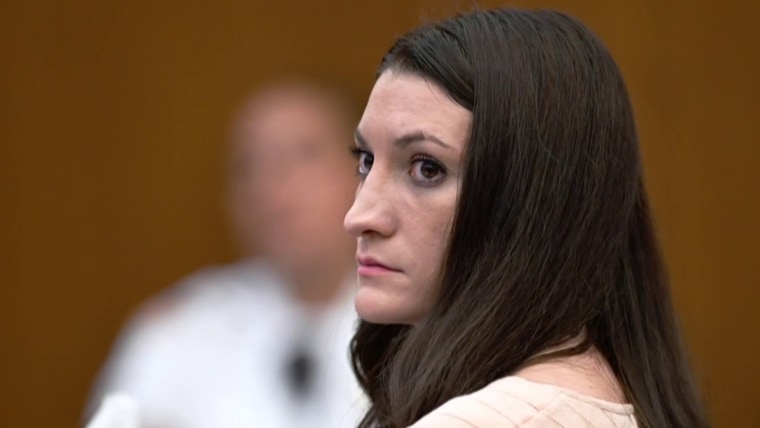
PLYMOUTH, Mass. — Defense attorneys presented testimony from psychologist Paul Zeizel during Lindsay Clancy’s murder trial on Wednesday. Zeizel’s testimony suggested Clancy did not understand the ‘wrongfulness’ of her actions due to her mental health issues.
Zeizel’s insights provide substantial support for the defense, which argues that Clancy, diagnosed with bipolar disorder, should not be held legally responsible for murder. This assertion is based on her mental state, particularly postpartum psychosis, when she killed her three children before attempting to end her own life. Zeizel started treating Clancy post-tragedy at a medical facility.
“She was unable to conform her behavior to the rule of law. She had no appreciation for the wrongfulness of her act,” Zeizel stated.
Clancy, 36, is charged with the deaths of her children, Callan, Dawson, and Cora Clancy, aged between 8 months and 5 years. Postpartum psychosis, often more severe than postpartum depression, affects 1 to 2 per 1,000 women following childbirth. Factors include stress, sleep deprivation, and hormonal shifts.
Prosecutors allege Clancy, a former nurse, premeditated the January 2023 killings by sending her husband for medicine and dinner, thus removing him from their home.
Zeizel, after over 35 hours and numerous sessions with Clancy, as well as a review of her medical files, disclosed her distress. By December 2022, she visited a perinatal clinic, convinced that her ‘brain was damaged,’ contemplating self-harm, and despairing that recovery was impossible. Symptoms of psychosis included paranoia and an irrational fear of losing her children.
“She was worried that her children would be removed from her and that she would never see them again,” Zeizel added.
Even while indicating Clancy could perform routine tasks, such as driving and internet searches, Zeizel maintained this did not negate her psychotic state. On the day of the incident, Clancy managed duties like taking her daughter to the doctor and playing with her children. This suggested capability did not alter her mental state.
“So the fact she is not talking about the unicorns in the corner, she is not slurring her words and she is not unable to walk, to your opinion to a degree of medical certainty, does that mean she is not in a psychotic state?” asked attorney Kevin Reddington.
Zeizel responded: “It does not.”
Prosecution’s Challenge
During cross-examination, prosecutors highlighted errors in Zeizel’s report and questioned his objectivity due to his dual roles of treatment and defense collaboration. They emphasized the lack of record indicating Clancy heard voices directing her actions, though she expressed a desire for death.
They also scrutinized her suicide attempt seriousness. Following the strangling of her children, Clancy’s leap from a second-story window left her paralyzed.
Additionally, prosecutors brought attention to the children’s birthdays and the anniversary of the killings. They noted that hospital records from Tewksbury Hospital, where Clancy resides, mentioned no memorials for her children, despite occasional mentions of family visits or interactions with other patients.
Reddington raised queries regarding any reports of Clancy ‘laughing, and partying and having a good time’ during her hospital stay.
“Lindsay Clancy has bad days and worse days,” Zeizel confirmed.
Zeizel stressed Clancy frequently discusses her children, countering the prosecution’s claim she neglects their memory.
“She really loves them and misses them and thinks of them every single day, almost every moment of the day,” Zeizel affirmed.
If convicted, Clancy faces life imprisonment without parole. If declared not guilty based on lack of criminal responsibility, she would be committed to a state mental health facility.
If you or someone you know is in crisis, reach out by calling or texting 988, or visit 988lifeline.org. Additional resources are provided at SpeakingOfSuicide.com/resources.