
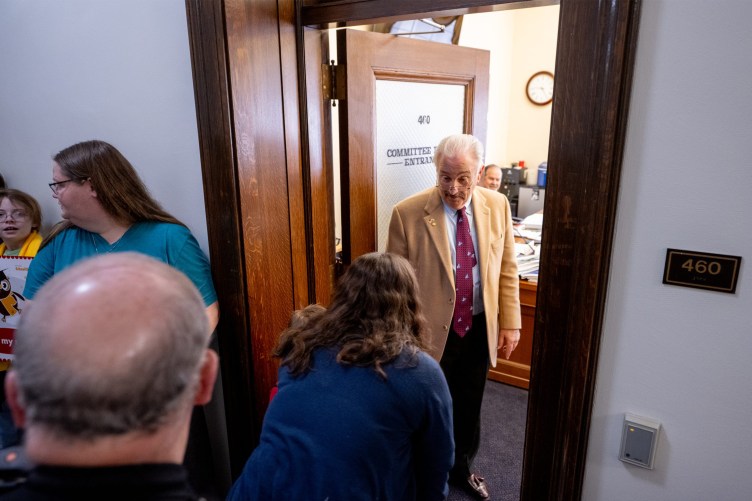
On a cold February morning in West Virginia’s Capitol, parents and children crowded the corridors outside the House Finance Committee room. These families, alongside lobbyists, expressed concerns over a proposal by Delegate Vernon Criss to limit payouts from a voucher program for private education funding. Criss, initially supportive of the Hope Scholarship initiated five years earlier, aimed to ensure state budget stability by curbing the program’s growth. His efforts sparked significant opposition from families who had embraced the program.
The Hope Scholarship, West Virginia’s pioneering educational savings account with no income restrictions, aimed to redirect public funds to private education. With similar programs in 11 other states, its expansion risked growing costs from $9 million in its first year to estimates exceeding $200 million annually by 2026. These concerns coincided with statewide tax cuts, prompting Criss to urge legislative action.
Despite Criss’s legislative efforts, within days, the push to curtail voucher spending faltered. His initiatives faced resistance from local and national school choice advocates capable of substantial financial influence. These groups, supported by the Koch family and billionaire Jeffrey Yass, wielded power through political campaigns and lobbying. The ascent of the Hope Scholarship reflected their broader aim to direct taxpayer funds to private education.
School choice advocacy gained momentum following the Republican takeover of West Virginia’s Legislature in 2015. Politically sympathetic nonprofits championed the cause, culminating in the Hope Scholarship assisting over 26,000 students. Yet, the program’s impact on public school funding raised alarms. Since 2019, the state saw the closure of 70 public schools amid dramatic enrollment declines.
Criss’s proposed measures to impose financial limits on the Hope Scholarship were met with concerted political action. In the 2026 primary, significant campaign spending from three Political Action Committees (PACs) targeted Criss and others wary of unrestrained voucher program expansion. Among those PACs, affiliated with the Koch family and Yass, significant efforts led to Criss’s political defeat.
As advocacy groups contested Criss’s attempts to manage costs, supporters like Jason Huffman of Americans for Prosperity championed school choice. He coordinated efforts to establish West Virginia’s model program devoid of income caps. The Cardinal Institute, another influential body linked to Koch and Yass funding, propelled public funding for private schools as a primary agenda. Together with parents advocating for educational alternatives, they actively countered challenges to the Hope Scholarship.
Opponents feared the scholarship redirected essential funds from public schools. Legal challenges did little to curb its expansion, leading to the West Virginia Supreme Court ruling in favor of the program. This decision bolstered Attorney General Patrick Morrisey as he launched his gubernatorial campaign. With Club for Growth Action’s substantial financial backing, Morrisey secured electoral success and reaffirmed his commitment to expanding the Hope Scholarship.
Criss’s later attempts to introduce budgeting measures faced formidable opposition. Proponents like Katie Switzer mobilized parents online, opposing financial caps on scholarships. Criss’s concerns over inflation eroding scholarship value did not sway organized support. The backlash against him culminated in significant political shifts cemented by campaign efforts from Sugar Maple PAC, School Freedom Fund, and others. Despite targeting various issues, from immigration to education, these campaigns supported candidates more aligned with school choice agendas.
The primary defeat of Criss, who had once stood unopposed, underscored the increasing politicization of educational policy in West Virginia. As PACs invested heavily, candidate portrayals swung from educational debates to broader political implications, reflecting a strategic effort to reconfigure the state’s legislative assembly. As Criss pursued an improbable write-in campaign, the influence of financial contributions on shaping educational policy remained evident.