
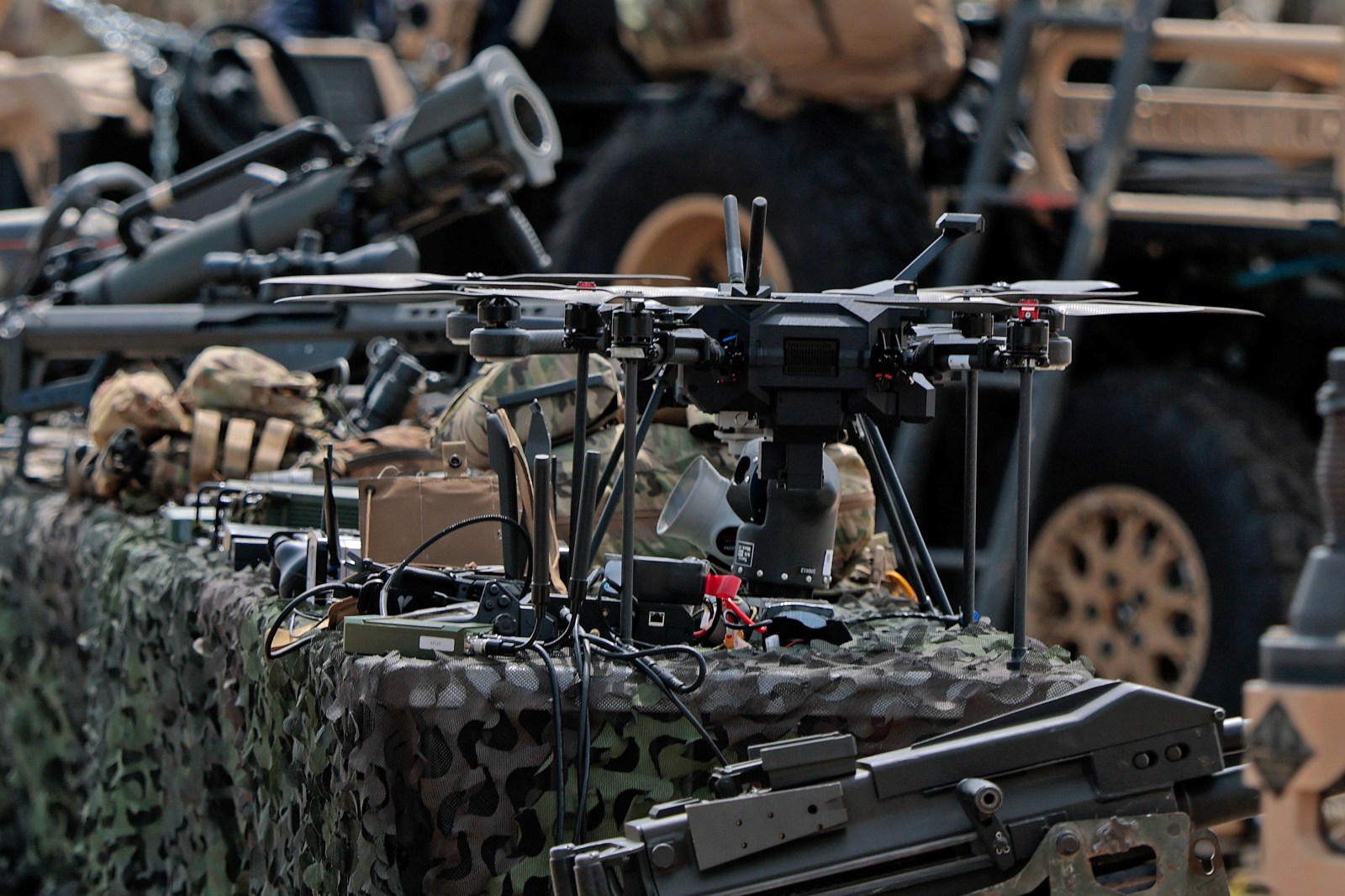
Pete Hegseth envisions a military devoid of individuals he labels as wimps, weirdos, and radicals. Concurrently, he aims for an institution centered on autonomous weapons, superintelligence, robotics, and emerging technologies. Pursuing one could undermine the other.
In his State of the Force address on Wednesday, Hegseth shared plans to ready America for a new warfare era. He introduced Project Agincourt, which aims to establish a new four-star Autonomous Warfare Command, and Project Meridian, which tasks Elon Musk, Anduril founder Palmer Luckey, and former House Speaker Newt Gingrich with forecasting required technological capabilities within 120 days.
Hegseth supports reducing the number of generals, speeding up procurement, and increasing autonomous systems. His personnel criteria are less defensible. “We are no longer the woke department or the weak department,” Hegseth stated. “No fatties. No trannies. No beardos. No weirdos. No wimps. No radicals. Just warriors.”
The military requires diverse talents. Real life is not like high school, where people can be boxed into labels like jocks or weirdos. An engineer designing an autonomous targeting system could also be physically strong. Intelligence should be valued over stereotypes.
America excels in producing elite warfighters and pioneering tech companies by leveraging a wide talent pool encouraged to explore their strengths. Hegseth’s vision of a singular “warrior” archetype in the military risks diminishing this advantage. If he narrows the criteria to one type of individual, he may be disarming himself—and the military.
Parts of the military already value diverse talents. In April, the Department of War introduced the Cyber Registered Apprenticeship Program offering a 12-month paid opportunity to groom cyber specialists. The Army allows experienced civilians to become officers in fields like AI, software engineering, and drone technology. Similarly, the Navy seeks engineers and tech experts for its reserve.
The military isn’t just purchasing tech from the nation’s innovators; they want them as part of the team. Hegseth’s rhetoric risks alienating talented minds who may not fit his “warrior” mold. Losing such individuals would be a strategic error.
Paul emphasized the collaboration between tech firms and the government. A day before Hegseth’s speech, Donald Trump hosted tech leaders at the White House to agree on responsible AI development.
Effective defense strategies rely on brainpower, not brute force. In critical times, America needs its brightest minds, like tech leaders Elon Musk, Mark Zuckerberg, and Jensen Huang, working on innovative solutions rather than being repurposed as traditional soldiers.
Anthropic CEO Dario Amodei exemplifies the value of embracing diverse talents. Before being excluded from military contracts over AI restrictions, his company’s technology supported crucial national security functions. Later, the Pentagon awarded Anthropic a $200 million prototype agreement for AI capabilities.
Projects Agincourt and Meridian are crucial for maintaining America’s technological edge. Yet, Hegseth’s rigid “warrior” concept must adapt to include the unconventional thinkers necessary for success.