
The next stage of peace talks aimed at concluding the conflict in Iran is set to commence on Sunday against the backdrop of ongoing skirmishes in Lebanon and renewed confusion surrounding the Strait of Hormuz.
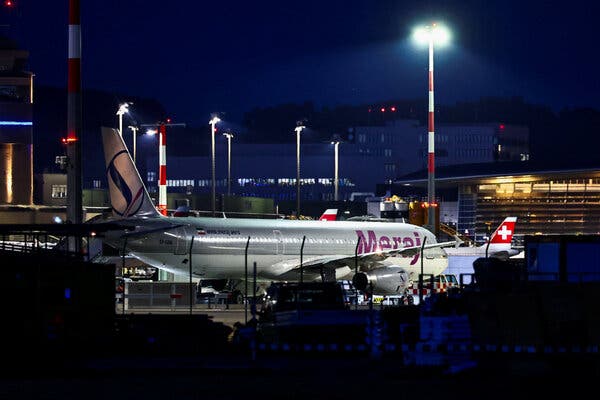
A plane carrying an Iranian delegation landed at Zurich International Airport in Switzerland on Saturday. It was reported that Vice President JD Vance arrived in Switzerland early Sunday in preparation for discussions to firm up the preliminary agreement aimed at resolving the war in Iran, set to begin later in the day.
The Iranian delegation arrived ahead of the U.S. team, including Gen. Mohammad Bagher Ghalibaf, who has been Tehran’s primary negotiator in previous talks, and Abbas Araghchi, Iran’s foreign minister. Mr. Vance informed reporters before his departure from the U.S. that his participation would be brief, stating, “for a day or two.” He leads a negotiating team that is joined by President Trump’s special envoys, Steve Witkoff and Jared Kushner, who are already present in Switzerland.
Pakistan, acting as a mediator in the peace process, announced that “technical talks” would initiate on Sunday, involving Pakistani and Qatari mediators. Pakistan’s foreign ministry mentioned that its delegation would include Prime Minister Shehbaz Sharif and army chief, Field Marshal Syed Asim Munir.
The discussions occur during a sensitive period. The ongoing conflict in Lebanon between Israel and Hezbollah, a group backed by Iran, poses challenges to achieving broader peace and ensuring uninterrupted shipping in the Strait of Hormuz. Initially planned for Friday, the talks between the U.S. and Iran were delayed due to continuous clashes between Israel and Hezbollah in Lebanon. Tehran criticized the Israeli strikes as breaches of the agreement, and Iran’s military went further, alleging closure of the Strait of Hormuz in retaliation. However, the U.S. military assured that marine traffic remained unaffected, claiming Iran does not exert control over the strait.
Numerous challenging topics are anticipated to be addressed during the negotiations. President Trump’s provisional agreement with Iran deferred decisions on Iran’s nuclear program to future discussions. It also overlooked Iran’s missile program and did not settle whether the Strait of Hormuz, the vital maritime trade passage near southern Iran, would continue allowing free transit.
Esmail Baghaei, spokesperson for Iran’s foreign ministry, stated on Saturday that the trip aimed to “follow up on the implementation of the other side’s commitments.” He indicated that “negotiations on a final agreement” would commence only once Iran perceives the United States as adhering to the deal. Tehran accused the U.S. of defaulting on commitments, specifically by not curtailing hostilities between Israel and Hezbollah, which exchanged fire again on Saturday despite a cease-fire announcement in Lebanon the previous Friday. The U.S.-Iran agreement stipulates a cease-fire across all fronts, including Lebanon, although neither Israel nor Hezbollah have endorsed the pact.
Mr. Vance expressed hopes for progress regarding the nuclear issue and Lebanon cease-fire, acknowledging that Iran will likely have additional concerns to discuss. Sanam Mahoozi, Zolan Kanno-Youngs, and Yan Zhuang contributed to this report.