
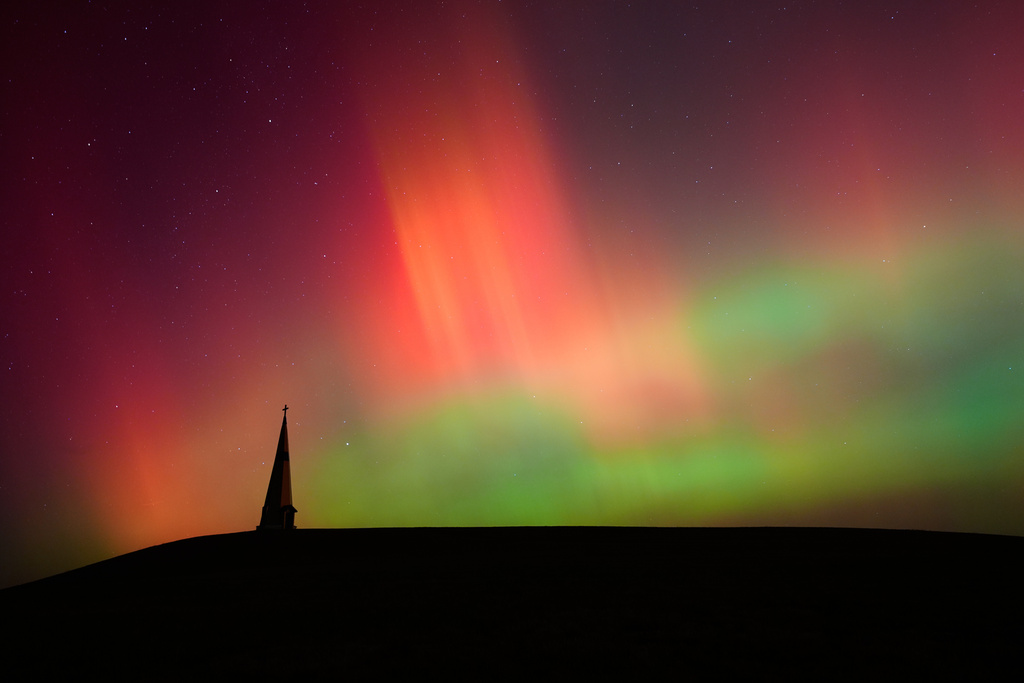
While many anticipate fireworks or drone shows this July 4 weekend, nature might offer its own breathtaking display. Forecasters indicate some could witness the northern lights on Friday.
The NOAA’s Space Weather Prediction Center (SWPC) is monitoring two significant sunspot groups this week. One of these spots triggered a solar flare of X1 magnitude, as reported by Shawn Dahl, a service coordinator at SWPC, in an update on Tuesday. The classification “X” denotes the highest category for solar flares, with “1” being the weakest level in this range.
It was a rather impulsive event, meaning it was fairly quick, it didn’t last very long, but clearly a lot of energy there,
explains Dahl about the event.
Initially, it was uncertain if the coronal mass ejection (CME), believed to be linked to this activity, was headed toward Earth. On Wednesday, the SWPC confirmed the CME is likely to affect us and trigger increased geomagnetic activity. Depending on specific conditions, particularly the orientation of the magnetic field, there could be moderate geomagnetic storming. If this occurs, the northern lights might be visible just before Independence Day.
Potential Visibility of Northern Lights on July 3
If the conditions meet the SWPC’s forecasts, residents in the northern U.S. might catch sight of the aurora. Moderate, or G2, geomagnetic storms have the potential to bring the northern lights as far south as New York and Idaho. The SWPC states that this could mean visibility for those in Washington, Oregon, Idaho, Montana, North Dakota, South Dakota, Minnesota, Wisconsin, Michigan, Vermont, New Hampshire, New York, and Maine. Technically, Alaska is also included in this category, as the state often has some chance to witness the lights.
Additionally, the University of Alaska Fairbanks forecasts suggest that residents slightly further south—in places like Wyoming, Nebraska, Iowa, Illinois, Indiana, Ohio, Pennsylvania, and Massachusetts—might see the aurora near their northern horizon.
Visibility of the aurora depends on timing. If the strongest geomagnetic storming occurs before sunset, the lights might be obscured. Unfortunately, forecasts suggest this might be the case for part of Friday. The SWPC predicts that geomagnetic conditions could intensify around 2 a.m. EDT and persist throughout the day. However, by sunset, the activity might still be potent enough to ignite the northern lights for a short period.
There remains a chance that the prerequisites for seeing the northern lights won’t fully develop. Updated forecasts from the SWPC are accessible on their website. If the lights appear, you can boost your viewing chances by facing the northern horizon. If you struggle to see the aurora, try using your phone, as modern digital cameras have lenses more sensitive to light than human eyes and can capture green, pink, and red hues more effectively.
Copyright 2026 Nexstar Media Inc. All rights reserved. This material may not be published, broadcast, rewritten, or redistributed.