
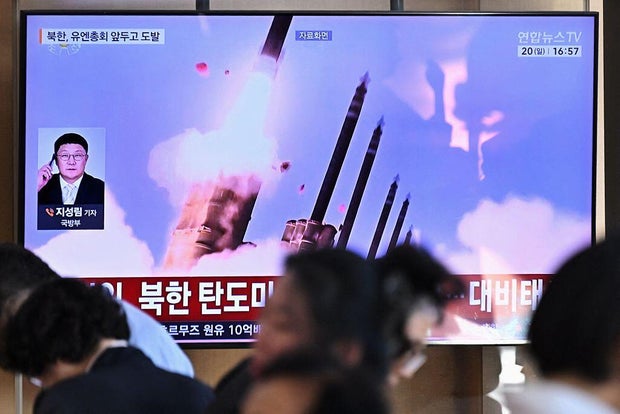
On September 20, 2026, North Korea launched two short-range ballistic missiles toward the sea. This action was confirmed by South Korea’s military. The missile launches occurred shortly after North Korea reaffirmed its status as a nuclear-armed state. The country also rejected a United Nations resolution demanding a halt to its nuclear activities.
These missile launches follow a pattern of weapons testing, despite diplomatic overtures. Last month, President Trump reduced a joint military exercise with South Korea aiming to facilitate discussions with North Korea’s leader, Kim Jong Un. The two missile launches were conducted about three hours apart from the Wonsan area on North Korea’s eastern coast. According to South Korea’s military, the first missile traveled approximately 280 miles, while the second exceeded 370 miles, both heading toward waters east of North Korea.
South Korea’s military, in cooperation with U.S. authorities, is analyzing the precise specifications of the second missile. Meanwhile, South Korea’s presidential office urged North Korea to cease its missile launches, which are prohibited by U.N. Security Council resolutions. The South’s military remains ready to counter provocations from the North through a strong alliance with the United States.
Japan’s Defense Ministry reported detecting a suspected North Korean missile earlier in the day. However, it did not impact Japan’s territorial waters. Kim Yo Jong, Kim’s sister and a senior official, dismissed Trump’s diplomatic attempts, stating that reducing the joint exercise would not alter its perceived aggressive nature.
Later, North Korea fired approximately ten short-range ballistic missiles toward the sea, following through on a threat related to the U.S.-South Korean drill. Kim’s sister criticized another recent U.S.-led maritime exercise as an aggressive move aimed at maintaining U.S. dominance in the Asia-Pacific region. This exercise, named “Pacific Vanguard,” included forces from the United States, South Korea, Japan, Australia, New Zealand, and Canada.
She attributed increasing tensions on the Korean Peninsula and surrounding areas to regular U.S.-led military rehearsal activities. Her remarks emphasized North Korea’s dedication to strengthening its nuclear war deterrence as a response to perceived threats. Earlier this month, North Korea executed a joint live-fire drill involving missiles, artillery, and drones. This occurred a day after the conclusion of a five-day military drill by U.S., South Korean, and Japanese forces. North Korea labeled this trilateral drill a provocation.
North Korea stated its drill included firing diverse weapons simultaneously, potentially aimed at overwhelming air defenses of South Korea and the U.S.