
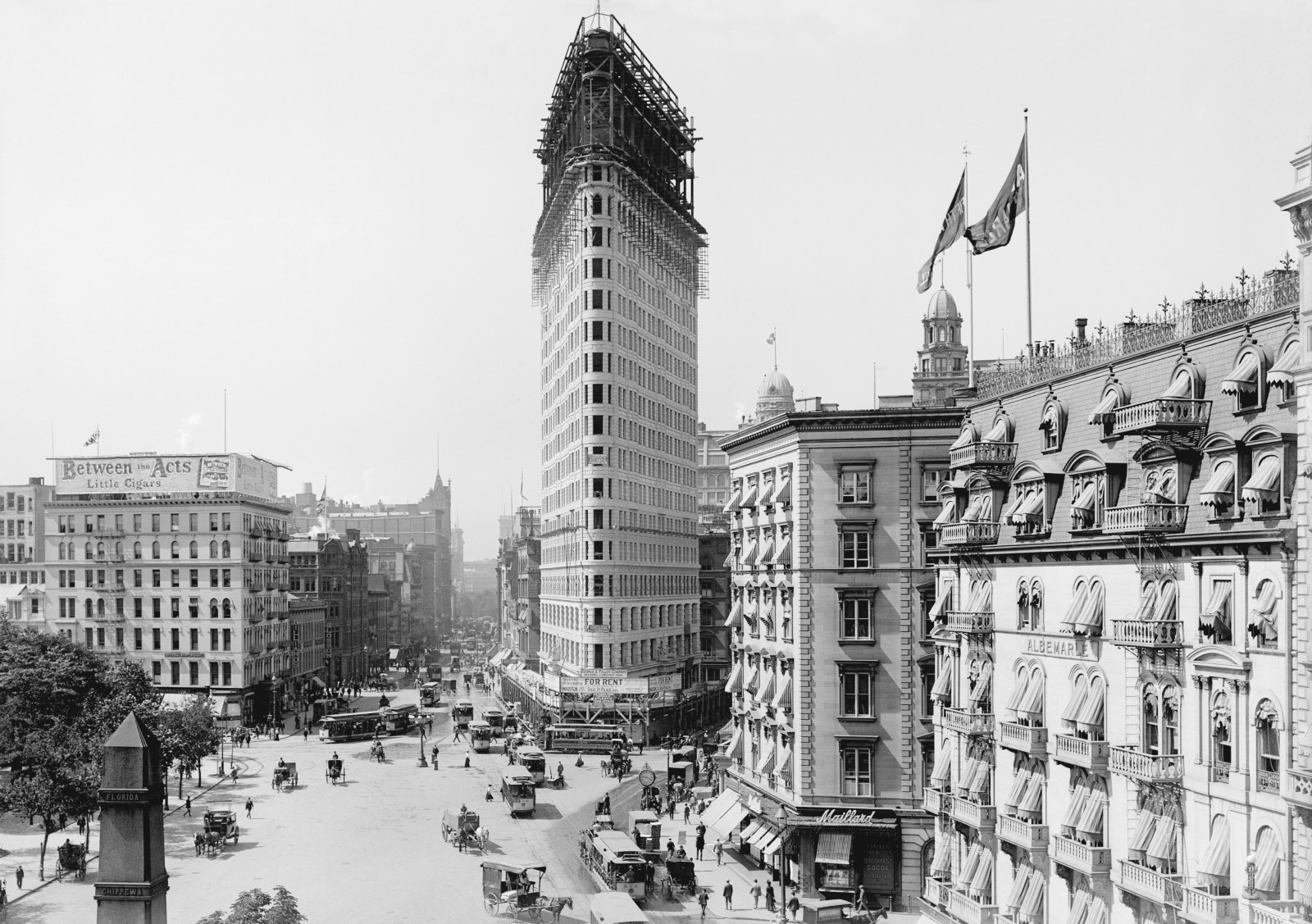
More than a century before the towering skyscrapers became a defining feature of Manhattan’s skyline, a recently shared film captured the remarkable Flatiron Building rising above its surroundings. This black-and-white footage, captured on October 8, 1902, and presented by the Library of Congress, showcases this early architectural marvel.
The film begins at street level, where pedestrians crowd the bustling Manhattan streets. The camera then tilts upward to reveal the top of the 24-story Flatiron Building. According to the Library of Congress, the footage provides a southern panoramic view from Madison Square, across Broadway, Fifth Avenue, and Twenty-third Street, focusing on this iconic structure.
The cameraman’s strategic elevation of the camera provides a comprehensive view that extends from street level to the roof. Completed in 1902, the Flatiron Building stands at 307 feet tall and is known for its triangular shape and steel-frame construction.
Today, the Flatiron Building is undergoing significant changes. Last month, it was illuminated for the first time in its history, marking an important step in its transformation into private residences. This project is part of a broader movement to restore and repurpose historic buildings across the United States.
According to the American Institute of Architects, nearly half of the country’s 125 million buildings are at least 50 years old. A report by RentCafe noted that approximately 25,000 apartments were created from conversions in 2024, representing a 50% increase from the previous year.
An Iconic Building That Once Dominated the Skyline
In the early 20th century, the Flatiron Building symbolized a significant shift in New York City’s architectural landscape. Historian Kevin Draper, founder of NY Historical Tours, highlighted that many residents questioned the necessity of such tall buildings and expressed concerns about their impact.
Critics feared the Flatiron might cast shadows over Madison Square Park, echoing similar concerns today regarding supertall constructions affecting Central Park. Draper noted that discussions about limiting building heights have persisted for over a century.
The footage reveals the imposing nature of the Flatiron Building at its opening. Draper remarked on the irony of its size appearing modest now compared to the current surrounding skyscrapers.
Glimpses of Everyday Life in Manhattan in 1902
The film also provides a glimpse into daily life in Manhattan from that era. Draper noted the crowded streets and the hurried pace of pedestrians, similar to present-day New York.
Transportation in the footage reflects a transitional phase. The film captured one early automobile passing through amidst several streetcars and horse-drawn carriages. The disappearance of streetcars and the transformation of horse-drawn carriages into tourist attractions highlight the city’s evolution.
The Flatiron Building’s emergence coincided with advancements in steel-frame construction and elevator technology, pushing architectural boundaries in New York. Prior achievements included the New York World Building in 1890 and the Park Row Building in 1899. However, the Flatiron’s unique form and strategic location at Broadway and Fifth Avenue distinguished it from others.
More than 120 years later, this old footage serves as a poignant reminder of the role the Flatiron Building played in heralding a new era of urban architecture, with New York City stepping into the age of skyscrapers.