
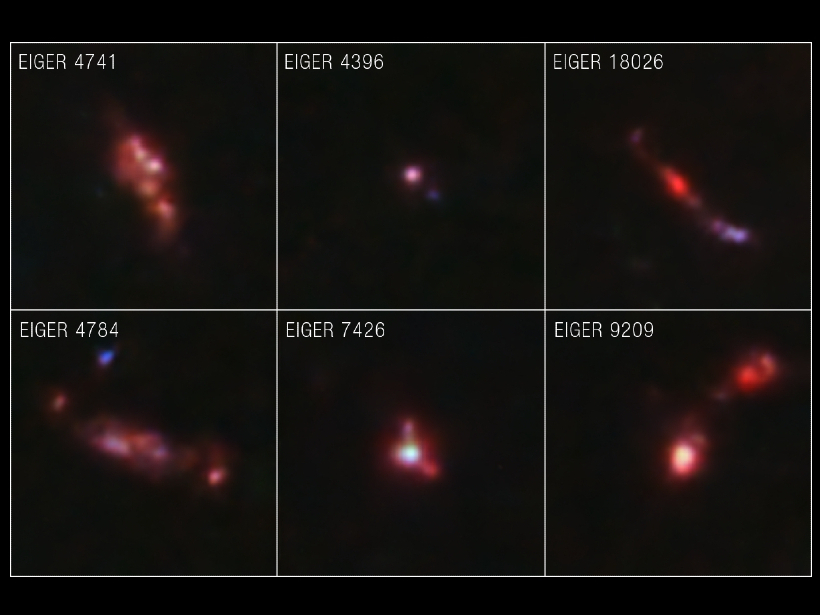
The James Webb Space Telescope has been capturing detailed images and spectra of galaxies from a time when the universe was merely 900 million years old. It has opened a new era in the field of astrophysics, allowing scientists to study galaxies that are farther and older than ever before.
Scientists are astonished by the Webb Telescope’s findings, which show galaxies forming just 200-500 million years after the Big Bang. These galaxies are larger and brighter than expected, creating excitement and puzzlement among astronomers worldwide. Jorge Moreno, an associate professor of astronomy at Pomona College, makes a comparison: instead of using time machines, astronomers look deep into space to explore our universe’s history.
Using Light to Peer into the Past
The Webb Telescope detects faint light emitted by distant galaxies, which has shifted to the infrared range by the time it reaches the telescope. This shift, known as cosmological redshift, occurs as light wavelengths elongate while traveling through the expanding universe.
For perspective, light from the sun takes about eight minutes to reach Earth, whereas light from Proxima Centauri, our nearest stellar neighbor, travels for over four years. These observations reveal unexpected brightness and structure in galaxies, suggesting surprising data.
Galaxies’ Unexpected Features
Moreno explains how the brightness of a galaxy is typically linked to its mass, as a galaxy’s light largely comes from stars. However, he cautions that this assumption may not always be accurate. Other factors like active supermassive black holes with bright accretion disks, high energy jets, or hot dust could make galaxies appear more massive than they are.
Surprisingly, scientists are now observing highly structured galaxies resembling local universe galaxies, challenging previous beliefs that early galaxies were merely blobs.
Age of the Universe in Question
The highly structured and bright galaxies have prompted debates about the universe’s age, leading some researchers to speculate that the universe might be older than the accepted 13.8 billion years. This theory, proposing an age of around 26.7 billion years, combines two models of the universe.
However, Moreno advises caution, suggesting that a simpler model backed by scientific evidence should be preferred. Without direct observation of stars and galaxies older than 13.8 billion years, there is insufficient evidence to support the hypothesis of a significantly older universe.
Lessons from Galactic Observations
Data from the Webb Telescope arrives continuously, presenting opportunities for new insights. Moreno emphasizes the importance of contemplation and reflection along with discoveries. Galaxies, which undergo phases of brightening and dimming, teach us to balance excitement with thoughtful analysis.
As astrophysicists continue to learn from the galaxies’ behavior, they strive to interpret this data with caution and care.