
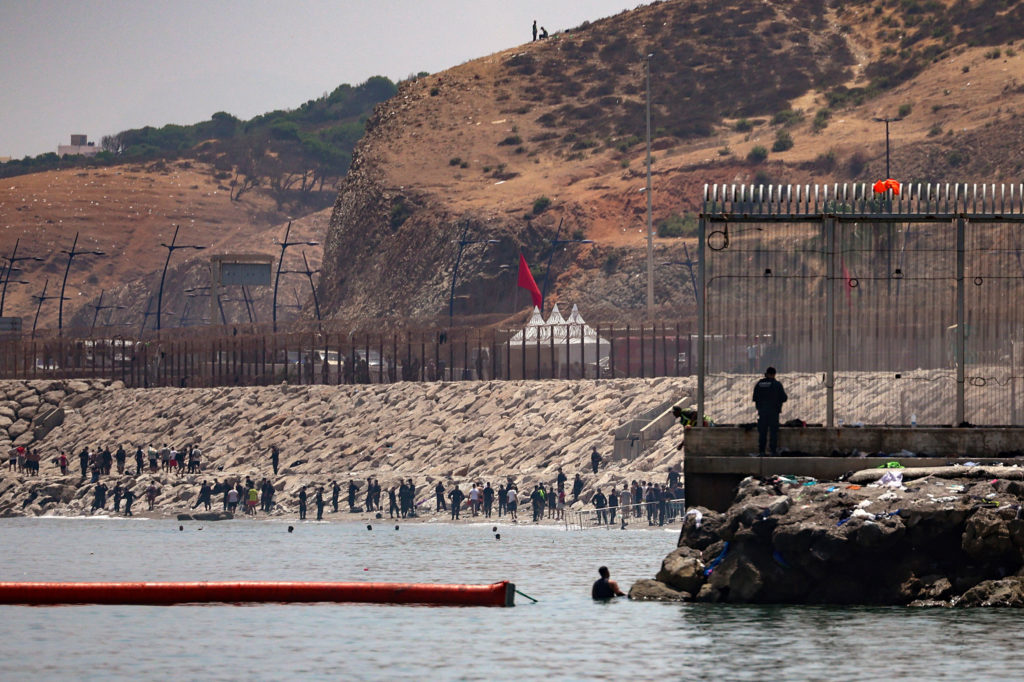
Spain is installing a 500-meter containment barrier on its sea border between the North African territory of Ceuta and Morocco. This follows an incident where between 50,000 and 60,000 migrants breached the frontier. The death toll has reached 67, with some drowning and others killed in a stampede attempting to cross a breakwater barrier, as noted by the Spanish government.
The Spanish Prime Minister, Pedro Sánchez, criticized some European Union leaders’ response to the Ceuta events. He opposed calls for Spain’s suspension from the EU’s Schengen zone, attributing these calls to prejudice, misinformation, ignorance, or political motives.
Some exhausted migrants who swam to Ceuta’s Tarajal beach were escorted back to Morocco by Spanish soldiers. The majority of those who entered have already returned, according to Spain’s interior ministry. Spain’s Interior Minister, Fernando Grande-Marlaska, defended Morocco, highlighting cooperation that resolved the situation within 24 hours. He emphasized that Morocco is a reliable partner and does not pose a threat to Ceuta or Spain.
EU Response to the Situation
Leaders of 22 EU countries have called for a coordinated response. A letter was sent to top EU officials, urging an extraordinary videoconference of interior ministers. The letter underscored the need to address and prevent the perception of possible illegal entry turning into legal stay in the EU. Signed by leaders of various countries, including Italy, Germany, and Sweden, the letter insisted that common migration policies must not be undermined.
Prime Minister Sánchez also requested a meeting of EU interior ministers for a common response, stressing that external border security is a shared responsibility among all EU member states. He condemned the reaction of some EU nations, particularly Italy, which threatened to suspend its Schengen agreement with Spain. Sánchez warned against such unlawful and divisive actions in the current global context.
Migrants’ Challenges and Return
Numerous migrants who crossed into Ceuta have returned to Morocco voluntarily. Exhausted and describing harsh conditions in Ceuta, migrants walked back across a breach in the border fence. Moroccan police and soldiers observed the returnees, who mostly consisted of Moroccans and some from sub-Saharan Africa. Many migrants faced hunger and described poor treatment on the Spanish side.
Ouail Lamzeiz, a migrant, recounted his eight-day stay in Ceuta without sufficient food. His friend, Salah Eddine El Arrage, claimed Spanish police mistreatment prompted his return. Migrants struggled for shelter and food, with some like Othmane El Merzoug, seeking financial support from their families for their return home.
Incidents left physical marks on paths, like the road linking Morocco’s Fnideq to the border, displaying burned-out vehicles. Traffic was redirected by police, with water cannons nearby. In Tangier, people returning from Ceuta crowded the railway station, some resting on the ground from exhaustion.
While many opted to return, others were determined to remain. Mohamed Hatri, 23, expressed his intent to stay despite attempts to force people back by closing access to food and supplies.
Continued Developments
Ceuta’s President, Juan Jesús Vivas, acknowledged disruptions in city life due to the border incident. He stressed the need to complete the return process, which has begun satisfactorily. In both Ceuta and Moroccan towns like Tangier, the impact of recent events remains apparent.