
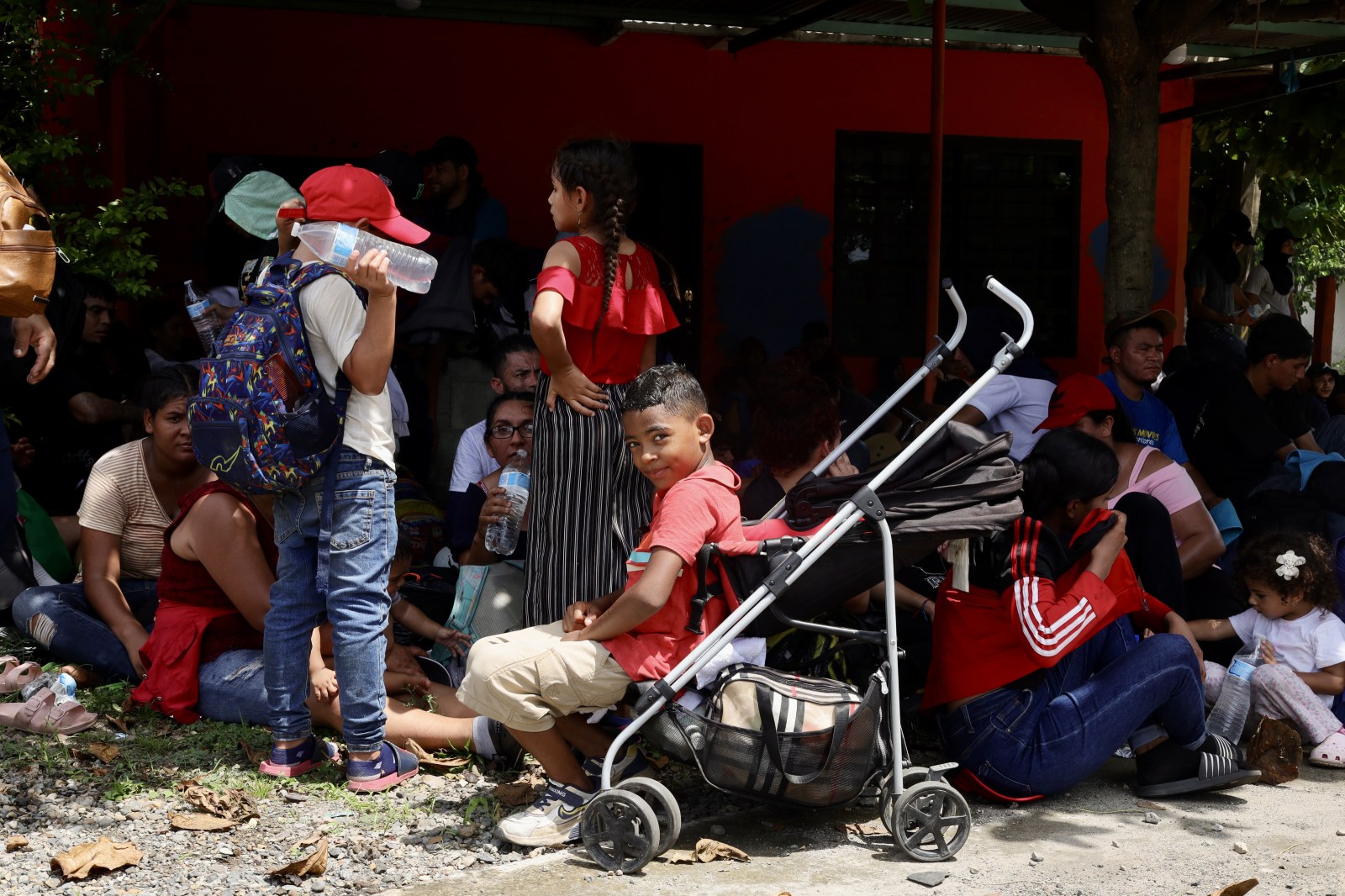
More than 600 migrants are currently traveling north through Mexico in a caravan aiming for the U.S. border. Their journey started in Honduras amidst a crackdown on migration by the Trump administration as the November midterms approach.
The group embarked on their journey on September 20, consisting initially of 200 to 400 Honduran migrants. They departed from San Pedro Sula in small groups and moved toward Guatemala’s border, as reported by Spanish news agency EFE.
By early September 28, the caravan, named “Fe y Esperanza” or “Faith and Hope,” expanded to over 600 migrants. They resumed their journey from Tapachula, southern Mexico, heading towards Mexico’s northern border with the United States, according to EFE. The group comprises individuals from Honduras, El Salvador, Guatemala, Ecuador, and Haiti.
The journey unfolds while President Donald Trump continues to enforce strict immigration measures, reducing illegal crossings at the U.S.-Mexico border. Since re-entering office in January 2025, Trump proclaimed a national emergency at the southern border.
He deployed active-duty military and National Guard troops to support border operations. Moreover, he imposed stringent restrictions on asylum access and implemented policies to detain and deport migrants crossing illegally instead of releasing them into the country.
These measures led to a sharp decline in border crossings. The U.S. Border Patrol reported 8,870 apprehensions along the southwest border in August 2026, as per the Department of Homeland Security (DHS), reflecting a 94% decrease compared to the monthly average during the Biden administration.
DHS stated that during that month, the Border Patrol did not release any migrants into the United States, maintaining a 16-month streak of zero releases.
Newsweek reached out to the White House, DHS, U.S. Customs and Border Protection, and Mexico’s government for comments. Access to asylum at the southern border has significantly diminished.
On his first day back in office, Trump issued a proclamation seeking to prevent migrants covered by the order from invoking asylum and other protections, although legal challenges to this policy persist.
The caravan, however, is still several hundred miles from the U.S. border. It remains uncertain how many of its members will reach northern Mexico or make attempts to enter the United States. Past migrant caravans have rarely reached the U.S. border as cohesive groups. Mexican authorities often intercept and disperse northbound caravans by detaining migrants or transporting them to other locations within Mexico.
According to EFE, migrants expressed economic hardship as a reason for leaving Honduras. A woman traveling with her two children cited a lack of employment opportunities in her home country. Another migrant acknowledged the challenges of reaching the U.S. but expressed determination to try.
Honduran nationals can enter Guatemala without a visa under the CA-4 regional agreement, according to Guatemala’s Institute of Migration. Meanwhile, Mexico’s National Migration Institute mentions that Honduran nationals generally need a visa to enter Mexico, subject to certain exceptions.
EFE reported the caravan reached Tapachula the previous Thursday with approximately 300 people before growing as migrants already in southern Mexico joined.
The current composition of the group over 600 strong means it should not be characterized as primarily composed of the Honduran migrants who originally departed San Pedro Sula.
U.S. authorities have cautioned migrants against attempts to unlawfully enter the United States.
On September 21, the U.S. Embassy in Tegucigalpa used X to communicate that “the borders of the United States are closed to those who violate the law.” The message warned against endangering lives on the perilous journey north and discouraged belief in human traffickers’ false assurances. It stated that illegal entry into the United States would lead to deportation.
The caravan has triggered political reactions within the United States. Republicans have leveraged its emergence to heighten concerns about border security and immigration, particularly ahead of the November midterms.
Representative Nancy Mace from South Carolina tweeted on X suggesting migrants hope for a Democrat Congress in November, and urged voters against facilitating one.
Former Representative Marjorie Taylor Greene questioned the timing of the caravan, suggesting Republicans are using the issue to sway voters.
José Zelaya, a Honduran migrant who left San Pedro Sula with seven family members on September 20, expressed an intent to reach the United States to support relatives left behind. Zelaya dismissed the notion of external direction within the group, attributing leadership to “hunger” and “necessity.”