
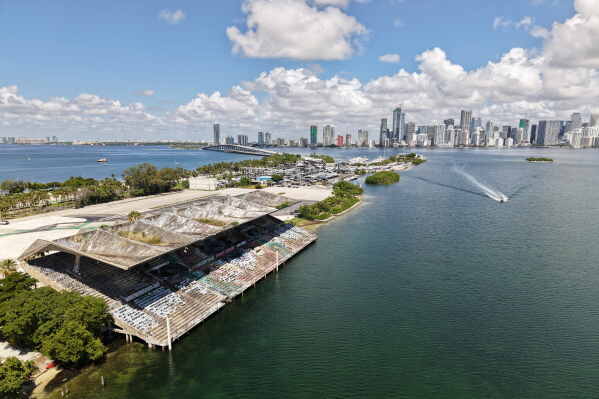
The Miami Marine Stadium stands as a notable example of midcentury Brutalist architecture, boasting a remarkable cantilevered roof and offering a breathtaking view of the city. Established in 1963 as the nation’s exclusive race venue for powerboats, the stadium symbolizes South Florida. Designed by a Cuban refugee, it served as the backdrop for Elvis Presley’s 1967 film “Clambake” and hosted performances by celebrities like Gloria Estefan and the late Jimmy Buffett, who performed on a movable, floating stage.
Since closing in 1992 due to severe damage from Hurricane Andrew, the 6,500-seat venue has deteriorated, becoming fenced off and covered in graffiti, despite its listing on the U.S. National Register of Historic Places. On an upcoming Tuesday, voters will decide whether to permit a partnership between the city and a private company to restore the unique stadium located on Virginia Key, across the water from downtown Miami, to its former glory.
The Miami Marine Stadium once hosted events such as a 1972 campaign rally with President Richard Nixon and Sammy Davis Jr., as well as Easter sunrise services and celebrations of Our Lady of Charity, a beloved figure among Cubans and Cuban Americans. “It encapsulated a time period in Miami that’s incredibly unique,” stated Miami Commissioner Damian Pardo. “This is a place that connects deeply with Miamians.”
Hilario Candela, a Cuban refugee who had recently arrived in the United States, designed this architectural gem in his late 20s. He continued designing numerous buildings around Miami and led community efforts to restore the marine stadium until his passing in 2022.
In 2018, the stadium was recognized by the National Park Service’s National Register of Historic Places. Florida’s then-Secretary of State, Ken Detzner, deemed it “one of Florida’s most unique architectural and historic resources,” reflecting the “multi-cultural influences evolving in Miami during the 1960s.”
Before passing away in 2023, Jimmy Buffett penned a letter urging Miami officials to save this “little cathedral of musical fun.” He shared memories of his 1985 concert at the stadium, which famously concluded with him leaping off the floating stage into the water, joining cheering fans. “Those were the ‘Miami Vice’ days,” Buffett recalled, mentioning actor Don Johnson, who introduced them.
Buffett’s daughter, Savannah, is involved with Restore Miami Marine Stadium, a group focused on saving this venue. Co-founder Donald Worth initiated this mission in 2008 after city officials initially planned to demolish the structure. “The architecture gives it the wow, the history gives it its soul,” Worth expressed. “It’s a special place where many in Miami share memorable experiences.”
Community Decision on the Stadium’s Future
Breakwater Hospitality Group co-founder, Emi Guerra, believes the stadium’s city skyline view and its prime location near Biscayne Bay can transform it into an entertainment hotspot rivaling Denver’s Red Rocks Amphitheatre. “There’s something here that can’t be duplicated, and that’s the view,” Guerra stated, addressing voter cynicism.
Guerra emphasizes that this is not a developer’s grab for more condo constructions. The city of Miami will retain full ownership of the stadium and its surroundings. The selected management company will uphold the city’s vision.
“When it’s historic, you can restore it or let it decay,” Guerra noted. However, Ernesto Cuesta, head of the Brickell Homeowners Association, offers an alternative. His group supports preserving this historical landmark but worries about potential noise and traffic affecting nearby residents and wildlife. Cuesta suggests a park with additional green spaces.
Restoration Efforts to Honor the Stadium’s Legacy
Though unused for decades, structural studies affirm the stadium’s safety. Project architect Richard Heisenbottle, known for Miami landmark restorations, aims to honor the original architect with this renovation.
The city has permitted construction documents for restoration, and renovations will include modern amenities and accessibility. Galvanized steel rebar from the initial construction has preserved the stadium from significant deterioration.
Commissioner Pardo acknowledged that a lack of city resources to run a major event space previously hindered reopening efforts. The upcoming referendum will allow the city to enter a management contract. A private company plans to convert the existing parking into a flexible park, including public recreational and event spaces. The city will gather revenue from events to finance repairs and upgrades, paying the management company a fee. The project cost remains undefined, but Pardo assures taxpayers won’t bear the burden. “It’s the right time to finally do this,” he affirmed.