
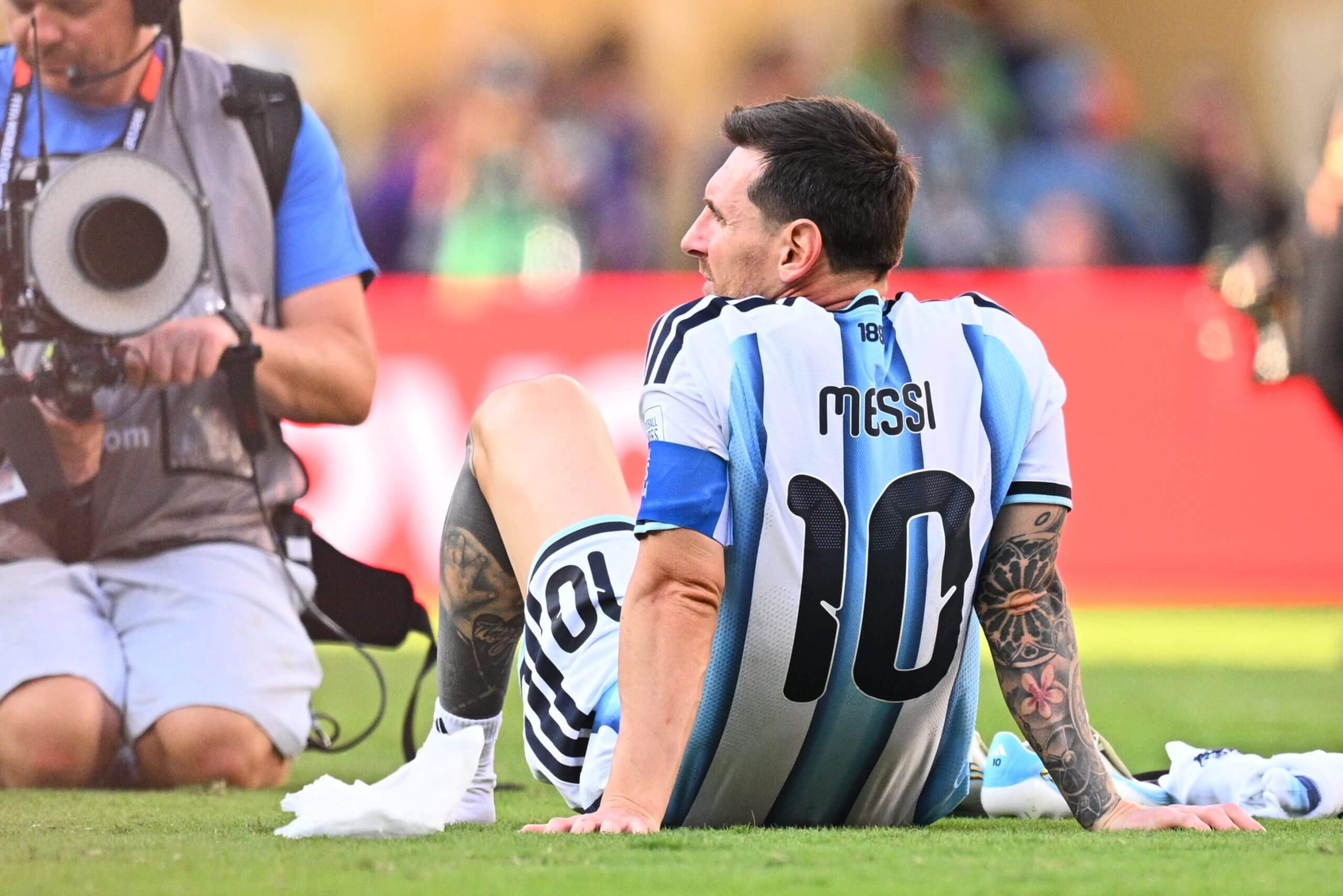
Lionel Messi found himself isolated amid a massive crowd at MetLife, surrounded by tens of thousands of fans and watched by billions worldwide. Yet, he appeared solitary. As the World Cup final concluded, the Spain team erupted in celebration, while Messi remained alone, embodying a defeated figure akin to an Argentine Achilles.
Throughout the game, Messi could not find space, and immediately after the final whistle, attention focused on him intensely. Captured by cameras and photographers, he appeared vacant and dejected, slipping off his specially made Adidas boots. Despite the surrounding noise, the atmosphere seemed quiet for Messi as his World Cup journey seemingly concluded.
Since the knockout stages began, Argentina displayed the constant threat of separation. For six weeks, there was an awareness that their endeavors might abruptly end. Moments like Sidny Cabral’s equalizer for Cape Verde, Egypt’s 2-0 lead with minutes to spare, and Switzerland’s persistent challenge all contributed to Argentina’s precarious presence in the tournament. Their journey was marked by constant transitions between triumph and near-elimination.
Every Argentina game witnessed the anticipation of Messi’s possible absence from the stage. His teammates were embroiled in a brawl rather than consoling him after the final whistle. The match winner, Ferran Torres, saw Argentina fall short during these crucial moments. Leandro Paredes contributed further indignity, and Enzo Fernandez’s sending-off left the team struggling as they faced extra-time for a third time in the tournament.
Argentina’s performance contrasted their hopes, with Lionel Scaloni acknowledging their inability to compete equally. Messi’s presence seemed obscured, contributing merely minimally in the initial phases of the match. Consequently, his contribution mirrored the anonymity of his numerous supporters, as Argentina struggled to bridge the gap between their ambitions and reality.
As Spain celebrated their victory, Messi guided his team to receive runners-up medals, trying to remain dignified despite his apparent loss. Facing their supporters rather than the celebration, Messi wept as symbols of shared history fluttered, portraying the shared spirit with Diego Maradona.
Argentina’s echoes of the 1990 final were clear, mirroring their initial championship status and subsequent challenges. When Spain’s Ferran Torres broke the deadlock, Messi acknowledged the impending conclusion and realized no comeback was forthcoming, despite Giuliano Simeone’s near opportunity.
Messi’s World Cup farewell resembled Diego Maradona’s exit from the tournament, although devoid of exasperation or disgrace. Messi left amidst emotions of love, gratitude, and yearning for alternate results. His exit reinforced F. Scott Fitzgerald’s notion of a hero intertwined with circumstances, yet his was no tragedy.
Messi expressed through social media his acknowledgment of the indelible story created by his team. Despite failing to retain their title, Argentina’s Copa America victories and their World Cup win highlighted their accomplishments. Even with Kylian Mbappe surpassing some of Messi’s records, many belong to him, reinforcing his monumental contribution.
Messi’s departure from the sport induces nostalgia, reflecting on World Cup tournaments without his presence. Although this likely marks the end of his World Cup journey, Messi’s contributions were predominantly remarkable, overshadowing FIFA’s flaws.
World Cup tournaments may expand and evolve, yet a missing Messi renders them incomplete, highlighting his irreplaceable impact on the world of sports.